Philosophy
Consciousness and the Unconscious: Summary and Study Notes
From Descartes to Freud and the neurosciences: how well do I really know myself?
Study this topic in OriaThe essentials
To be conscious is to know what you think, what you feel, what you do. You'll first see the different senses of the word consciousness, then Descartes's founding certainty and the way Hegel and Sartre show that self-consciousness runs through other people. You'll then discover the limits of consciousness: Leibniz's small perceptions, then Freud's unconscious, its models, its dreams and its slips. Finally, you'll see the criticisms levelled at Freud and what neuroscience today calls the cognitive unconscious.
Key dates and facts
- 1637
- Discourse on Method : "I think, therefore I am"
- 1641
- Meditations on First Philosophy : "I am, I exist"
- 1644
- Principles of Philosophy : ego cogito, ergo sum
- 1895
- Studies on Hysteria , with Breuer
- 1899
- The Interpretation of Dreams (dated 1900)
- 1901
- The Psychopathology of Everyday Life
- 1923
- The Ego and the Id
- 1974
- First description of blindsight
- 1977
- Nisbett and Wilson: "Telling More Than We Can Know"
- 1988
- Baars: global workspace theory
💡 What is consciousness?
The word consciousness comes from the Latin conscientia, formed from cum ("with") and scire ("to know"): literally, a "knowing with", a shared knowledge. Applied to self-knowledge, the word first took on a moral meaning. Before the 17th century, in French, it referred almost exclusively to conscience in the sense of right and wrong.
⚖️ Two senses not to be confused
The more or less clear awareness the mind has of its own states and acts: knowing that I see, that I think, that I am in pain. This is what disappears in dreamless sleep and gradually returns when a noise wakes us.
The capacity to make spontaneous judgments about the moral value of our actions. Turned toward the future, it takes the form of a voice that commands or forbids; turned toward the past, it shows up as satisfaction or remorse.
The German philosopher Christian Wolff was the first to clearly distinguish the two, using two different words: Bewusstsein for psychological consciousness, Gewissen for moral conscience. In French, the same word serves for both, which has caused a great deal of confusion. Rousseau celebrated moral conscience in Emile: "Conscience! Conscience! divine instinct, immortal voice from heaven; sure guide for a creature ignorant and finite indeed, yet intelligent and free; infallible judge of good and evil, making man like to God!"
🪞 Self-consciousness
A distinction is also drawn between immediate consciousness, turned toward the world (I see the tree), and reflective consciousness, which turns back on itself (I know that I see the tree). Self-consciousness relates our memories, feelings and judgments to an inner reality we call the "self". In children, it shows up in particular through the ability to recognize oneself in a mirror, around eighteen months to two years of age; some great apes, elephants, dolphins and magpies also pass this test.
🎯 All consciousness is consciousness of something
In the 20th century, the German philosopher Edmund Husserl revived a medieval idea: all consciousness is consciousness of something. Consciousness is not a closed box filled with images; it is always turned toward an object, which it aims at. This property is called intentionality.
📅 A modern concept
The psychological sense of the word only became established in the 17th century. The dictionary Le Petit Robert attributes it to Malebranche in 1676; the Englishman John Locke separated it from its moral meaning in his Essay Concerning Human Understanding (1689), and it was his translator, Pierre Coste, who introduced this usage into French. Paradoxically, Descartes, regarded as the father of the philosophy of consciousness, almost never uses the word in this sense, even though he defines thought as whatever takes place within us and of which we are aware.
🕯️ Descartes: I think, therefore I am
In the 17th century, René Descartes wanted to rebuild all knowledge on an absolutely certain foundation. To find it, he practised methodical doubt: rejecting as false everything that can be doubted, even slightly. This doubt is not that of the sceptics, who suspend judgment forever: it is temporary, deliberate, and aimed at finding an indubitable truth.
🌀 Doubting everything
The senses sometimes deceive us, so we can doubt what they show us. We dream, and in our dreams we believe false things: what guarantees that I am not dreaming right now? Descartes goes further in the Meditations on First Philosophy: he imagines an evil genius, an immensely powerful and cunning deceiver who would use all his skill to deceive him.
✅ The first certainty
But at the very heart of doubt, a certainty arises. To be deceived, one must exist; and as long as I think, I cannot fail to be. The deceiver can deceive me as much as he likes, but he will never make me nothing so long as I think I am something.
"And observing that this truth, I think, therefore I am, was so certain and so assured that all the most extravagant suppositions brought forward by the sceptics were incapable of shaking it, I came to the conclusion that I could unhesitatingly accept it as the first principle of the philosophy for which I was seeking."
René Descartes, Discourse on Method, part four (1637) (translated)
This formula exists in three versions. In French in the Discourse on Method (1637); in Latin, as ego sum, ego existo ("I am, I exist"), in the Meditations (1641); and finally as ego cogito, ergo sum in the Principles of Philosophy (1644). Hence the name cogito given to this discovery.
🧠 A thinking thing
What am I, I who exist? I am not sure of having a body, since I can still doubt it. I am therefore "a thing that thinks", that is, Descartes specifies, "a thing that doubts, understands, affirms, denies, wills, refuses, and that also imagines and feels". The mind thus appears as a reality distinct from the body: this is Cartesian dualism. And it seems transparent to itself: I know my own mind more surely than any external thing.
❓ The first objections
This privileged status of consciousness would later be challenged. Leibniz held that the cogito is not the only first truth: one must also add that "various things are thought by me". The philosopher David Hume doubted that there exists a single, stable self: when I observe myself, I find only a succession of perceptions. In the 19th century, Marx argued that it is not men's consciousness that determines their social existence, but the reverse, and Nietzsche saw the thinking "I" as an illusion produced by grammar. The ground was thus prepared for the most unsettling idea of all: that part of our mental life escapes us.
The rest of the course
This page publishes the first 2 parts. The full course has 8: here is what the next ones cover.
- 👥 Self-consciousness runs through other people: Hegel and Sartre
Hegel (Phenomenology of Spirit, 1807): self-consciousness requires recognition by another; the dialectic of master and slave; Sartre: the look of the other, shame, No Exit.
- 🌊 Leibniz: small perceptions
In the New Essays (1704, published 1765), Leibniz shows that an infinity of perceptions escape consciousness (apperception), with the example of the sound of the sea; early thinkers of the unconscious before Freud.
- 🛋️ Freud: the psychic unconscious
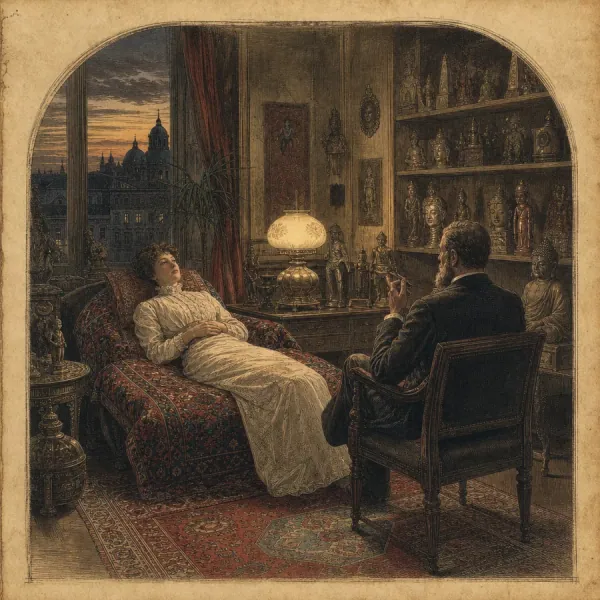
Freud, from hysteria to psychoanalysis: the unconscious as repressed material, the first topographical model (unconscious, preconscious, conscious), then the second (id, ego, superego), and the 'third blow' dealt to the ego.
- 🌙 Dreams, slips and parapraxes
The dream as the 'royal road' to the unconscious (manifest and latent content, condensation, displacement), the slips and parapraxes of The Psychopathology of Everyday Life, psychic determinism.
- 🔍 The criticisms of Freud
Sartre and bad faith (the paradox of censorship), Popper and unfalsifiability, Grünbaum, debates over efficacy and scientific status, and defences of psychoanalysis.
- 🧪 The cognitive unconscious today
What cognitive psychology and neuroscience show: non-conscious processes, blindsight, subliminal perception, the introspection illusion, the global workspace, and how they differ from the Freudian unconscious.
Study “Consciousness and the Unconscious” with flashcards and quizzes
In Oria, you read the full course, then practice on it: flashcards, multiple-choice quizzes, open questions or the Feynman method. Cards and questions then come back in your daily review, paced by spaced repetition.
Study this topic in OriaSources
These notes draw on the sources below. If a point seems doubtful, refer back to them.