Classic novels
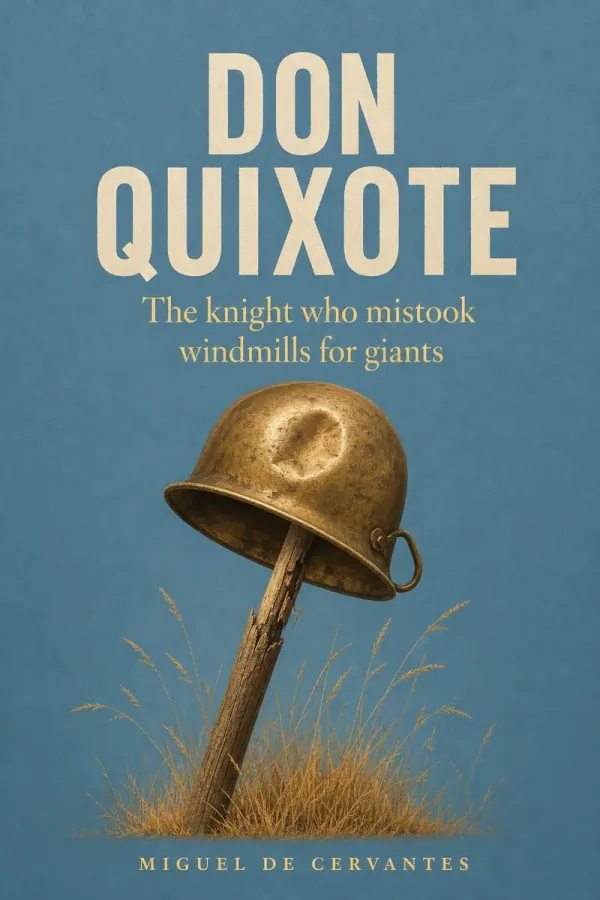
Don Quixote by Miguel de Cervantes: Summary and Study Notes
The knight who mistook windmills for giants
Study this topic in OriaThe essentials
Published in Madrid in two parts, in 1605 and 1615, Don Quixote tells the adventures of Alonso Quixano, a modest gentleman of La Mancha who has read so many chivalric romances that he believes himself to be a knight errant. With his squire Sancho Panza, he attacks windmills, frees galley slaves, and ends up mystified by nobles who have read of his exploits. You'll discover Cervantes's adventurous life, the plot of both parts, the unforgettable pairing of master and squire, the boldness of a book that plays with its own fiction, and its immense legacy.
Key dates and facts
- 1547
- Probable birth in Alcalá de Henares
- Oct. 7, 1571
- Wounded at the Battle of Lepanto
- 1575 – 1580
- Captive in Algiers
- 1597
- Imprisoned in Seville
- 1605
- First part, 52 chapters
- 1612
- First translation, into English
- 1614
- Avellaneda's fake sequel
- 1615
- Cervantes's second part, 74 chapters
⚔️ Cervantes, the one-armed man of Lepanto
Don Quixote is the work of Miguel de Cervantes (in Spanish, Miguel de Cervantes Saavedra), often regarded as the greatest writer in the Spanish language, so much so that Spanish is sometimes called "the language of Cervantes." He was probably born on September 29, 1547 in Alcalá de Henares, near Madrid: that is where he was baptized, and September 29 is the feast of Saint Michael, whose name he bears. His father, Rodrigo, was a barber-surgeon, often in debt, who moved his family constantly and was even jailed for debt. Almost nothing is known of young Miguel's schooling.
🌊 The soldier of Lepanto
In 1569, a warrant was issued against a Miguel de Cervantes accused of wounding a man in a duel: this is likely the reason for his departure for Italy. In Rome, he entered the service of a future cardinal, then enlisted in the Spanish infantry. On October 7, 1571, aboard the galley Marquesa, he took part in the Battle of Lepanto, where the fleet of the Holy League, commanded by Don Juan of Austria, crushed the Ottoman fleet. Sick with fever, he fought anyway and received three wounds: two to the chest, one to the left arm, which was left permanently paralyzed. He became known thereafter as the "one-armed man of Lepanto." He took immense pride in this for the rest of his life, later writing that he had lost the use of his left hand for the glory of the right.
⛓️ Five years of captivity in Algiers
On September 26, 1575, while returning to Spain with his brother Rodrigo, their galley, the Sol, was captured by Barbary corsairs off the coast of Catalonia. The two brothers were taken to Algiers and held for ransom. Rodrigo was ransomed in 1577, but the family could not afford to pay for Miguel. For nearly five years, he attempted to escape four times, and each time he alone claimed responsibility for the plot to protect his companions. In 1580, he was finally ransomed by the Trinitarians, a religious order devoted to freeing captives. This experience would feed several of his plays and the "captive's tale" in Don Quixote.
📜 An unlucky official
Back in Spain, Cervantes struggled to find his footing. In December 1584 he married Catalina de Salazar, in 1585 he published a pastoral novel, La Galatea, which went almost unnoticed, and he wrote for the theater without great success. In 1587, he became a supply commissioner: he traveled across Andalusia requisitioning wheat and oil for the Invincible Armada, then became a tax collector. Irregularities in his accounts and a banker's bankruptcy landed him in the Seville prison, notably from September to December 1597. It may have been there that he conceived his masterpiece: in his prologue, he describes his hero as a dry, whimsical child, "such as might be begotten in a prison." In 1604, he settled in Valladolid, then the kingdom's capital. He was well past fifty and had published nothing in twenty years.
📚 A gentleman who read too much
The opening sentence of Don Quixote is one of the most famous in the Spanish language. It introduces an ordinary hero at once, in a place the narrator refuses to name:
"In a village in La Mancha, the name of which I do not care to recall, there lived not long ago one of those gentlemen who keep a lance in the rack, an old shield, a skinny horse, and a greyhound for hunting."
Miguel de Cervantes, Don Quixote, I, 1 (1605) (translated)
🏚️ An idle gentleman
The hero is a hidalgo, that is, a member of the lowest rank of nobility, poor and without employment. He is close to fifty, lean, with a gaunt face, a keen huntsman, and lives with a housekeeper and a niece. His real name is uncertain — Quixada, Quesada, or Quijana, says the narrator — and we only learn at the very end that he is called Alonso Quixano. La Mancha, where he lives, is a region of dry plateaus in central Spain, perhaps the least romantic part of the country.
📖 Madness by books
In his idle hours, "which is to say nearly the whole year," the gentleman devours chivalric romances, those long tales of marvelous deeds very popular in the sixteenth century, such as Amadis of Gaul. He sells farmland to buy more of them and marvels at convoluted sentences like this one, which Cervantes quotes to mock: "The reason of the unreason with which my reason is afflicted so weakens my reason that I complain, with reason, of your beauty." From reading at night, the narrator writes, "his brain dried up, so that he came to lose his wits." He ends up believing that everything he has read — enchantments, challenges, and giants — is the plain truth.
🐴 Rocinante, Dulcinea, and a knight's name
He then decides to become a knight errant, to roam the world, right wrongs, and help the weak. He cleans an old suit of armor left by his ancestors and fashions part of a helmet out of cardboard. He names his old horse Rocinante, from rocín, a hack: the name means it was once a hack and has now become the foremost of all hacks. He himself takes the name Don Quixote of La Mancha; quixote is the Spanish word for the piece of armor that protects the thigh, and the -ote ending carries a slightly grotesque ring. Since every knight must serve a lady, he chooses a peasant woman from a nearby village, Aldonza Lorenzo, with whom he had once been vaguely, unrequitedly in love, and renames her Dulcinea del Toboso.
🏰 The inn-castle
One morning he sets out alone, without telling anyone. That evening he arrives at an inn he mistakes for a castle, greets women of ill repute as noble ladies, and begs the innkeeper, whom he takes for the lord of the castle, to knight him. To get rid of him, the innkeeper plays along and performs the knighting in a mock ceremony. His first adventures go badly. Don Quixote believes he has saved a young servant, Andrés, whom his master is whipping, but as soon as he leaves, the boy is beaten twice as hard. He then demands that merchants from Toledo swear that Dulcinea is the most beautiful woman in the world, without having seen her: he is badly beaten and brought home on a donkey by a neighbor.
🔥 The burning of the library
While he sleeps, the village priest and the barber, Master Nicholas, go through his library and burn most of the romances they blame for his madness, though they save a few they consider excellent. This scene lets Cervantes air his own literary tastes. They wall up the room and convince Don Quixote that an enchanter has made off with his books. The device becomes a running feature of the novel: whenever reality contradicts him, the knight blames jealous enchanters for transforming everything.
The rest of the course
This page publishes the first 2 parts. The full course has 8: here is what the next ones cover.
- 🌬️ Sancho and the windmills
The second sally of the first part (1605): Sancho Panza becomes a squire, the attack on the windmills, the helmet of Mambrino, the galley slaves, the Sierra Morena, and the return home in a cage.
- 📖 1615: a sequel that knows it has been read
The success of the first part in 1605, Avellaneda's fake sequel in 1614, and Cervantes's second part, in which the characters have read the first book: Dulcinea enchanted, the Knight of the Mirrors, the lions, and the Cave of Montesinos.
- 🏝️ At the duke's estate, Sancho as governor
The stay at the duke and duchess's castle, who toy with the two heroes for amusement, and Sancho's government of the island of Barataria, where the illiterate squire proves a shrewd judge.
- 🌅 The Knight of the White Moon and the death of Alonso Quixano
The novel's ending: Barcelona, defeat at the hands of the Knight of the White Moon, the return home, the cure of his madness, and the death of Alonso Quixano the Good.
- 🤝 Knight and squire: illusion and reality
The two heroes, their crisscrossing development (Sancho's 'quixotization,' Don Quixote's 'sanchification'), the novel's major themes, and what makes it the first modern novel.
- 🌍 Four centuries of knights errant
The legacy of Don Quixote: the novel's successive readings, the words 'quixotic' and 'tilting at windmills,' and its influence on writers, painters, musicians, and film.
Study “Don Quixote” with flashcards and quizzes
In Oria, you read the full course, then practice on it: flashcards, multiple-choice quizzes, open questions or the Feynman method. Cards and questions then come back in your daily review, paced by spaced repetition.
Study this topic in OriaSources
These notes draw on the sources below. If a point seems doubtful, refer back to them.