Classic novels
Fahrenheit 451 by Ray Bradbury: Summary and Study Notes
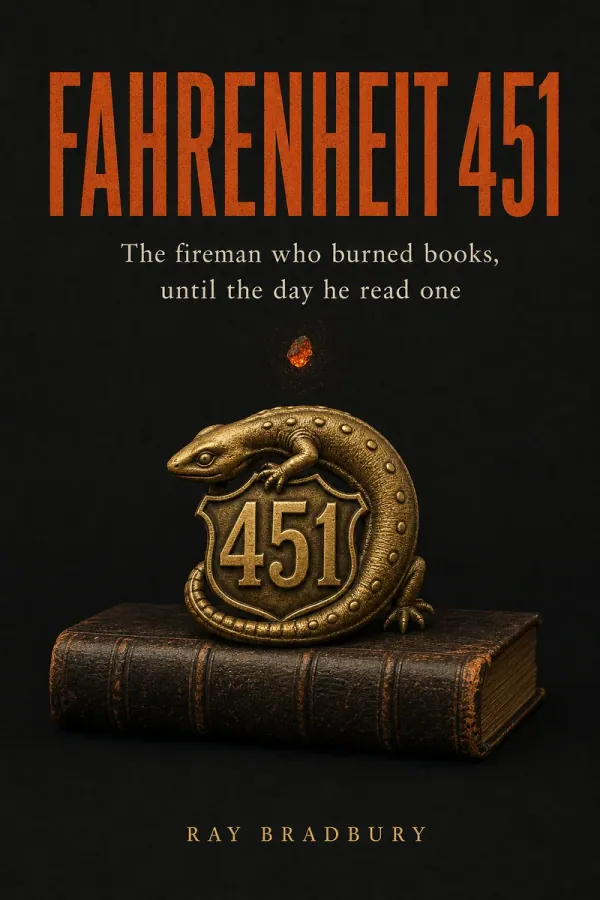
The fireman who burned books, until the day he read one
Study this topic in OriaThe essentials
Published in 1953 in the United States, Fahrenheit 451 imagines a society where books are banned and firemen are no longer tasked with putting out fires, but with burning libraries. Guy Montag, one of them, begins to doubt after meeting a young neighbor, Clarisse. You'll discover how Ray Bradbury wrote the book in a few days on a rented typewriter, his own self-taught story, the plot in three parts, its characters, its themes, from censorship to screens, and its immense legacy.
Key dates and facts
- Late 1949
- Stopped by a police officer on a walk
- Feb. 1951
- The Fireman appears in Galaxy
- Jan. 22, 1953
- Firefighters give him the number 451
- Oct. 19, 1953
- Published by Ballantine Books
- Aug. 22, 1920
- Born in Waukegan, Illinois
- May 1950
- The Martian Chronicles
- April 16, 2007
- Special Pulitzer Prize citation
- June 5, 2012
- Dies in Los Angeles, aged 91
- 1955
- French translation from Denoël
- 1966
- François Truffaut's film
🖋️ Ten cents a half hour
Fahrenheit 451 is a science-fiction novel by the American writer Ray Bradbury, published in October 1953. The idea took shape over several years through short stories. Between 1947 and 1948, Bradbury wrote "Bright Phoenix," the story of a librarian who confronts a book-burning "chief censor"; it would not be published until 1963.
🚶 The suspicious walker
In late 1949, while out on a late-night walk, Bradbury was stopped and questioned by a police officer. Asked "What are you doing?", he answered with a quip: putting one foot in front of the other. The incident inspired a short story, "The Pedestrian" (1951): in a future city, a man is arrested by an automatic police car for the sole crime of walking at night, while everyone else stays home in front of the television. This walker would gradually become Guy Montag.
⌨️ Nine days in a basement
In August 1950, Bradbury had just bought a house, but his garage was cluttered and the heat was oppressive. He set up in the typewriter room in the basement of Powell Library, at the University of California, Los Angeles (UCLA), where a machine could be rented for ten cents a half hour. In nine days, he typed a 25,000-word novella, first titled Long After Midnight. He modeled it on Arthur Koestler's novel Darkness at Noon, a cautionary tale about totalitarianism. The text, renamed The Fireman, appeared in the magazine Galaxy Science Fiction in February 1951. Bradbury turned down the magazine editor's suggestion for a darker ending: he was committed to his hopeful conclusion.
🔥 The firemen's number
In 1952-1953, the publisher Ballantine Books offered to double the text's length to turn it into a novel. Bradbury wanted a title referring to the temperature at which book paper burns, but no chemistry department at the Los Angeles universities could give him the figure: illustrator Joseph Mugnaini's first watercolors carry the working titles Fahrenheit 204, then 205. On January 22, 1953, a call to the Los Angeles Fire Department gave him the answer: 451 degrees Fahrenheit, about 233°C. In reality, studies show paper spontaneously ignites somewhere between roughly 424 and 475°F, depending on its quality.
The rewrite was more laborious than Bradbury would later recall: he missed two deadlines, then spent nine more days at UCLA's paid typewriters in June 1953. The fire captain, called Leahy in early drafts, became Beatty. The novel was published by Ballantine on October 19, 1953, simultaneously in hardcover and paperback. Two hundred signed copies were even bound in asbestos cloth, a fireproof material. The text was then serialized in the young magazine Playboy, in March, April, and May 1954.
📚 Ray Bradbury, a graduate of the library
Ray Douglas Bradbury was born on August 22, 1920, in Waukegan, an industrial town in Illinois on the shore of Lake Michigan, north of Chicago. He would later transpose this childhood town under the name Green Town in several books. As a child, he spent a great deal of time at the public library, devouring H. G. Wells, Jules Verne, and Edgar Allan Poe. During the Great Depression, his father lost his job and the family moved several times, before settling in Los Angeles in the spring of 1934. Bradbury would live there until his death.
🏛️ "Libraries raised me"
After high school, his family could not afford to send him to college. Bradbury sold newspapers on a street corner for about four years and educated himself: he would later say he went to the library three days a week for ten years, and came out "graduated" at 28. He often said that libraries raised him. He also mixed with Los Angeles's science-fiction fans, published fanzines, and sold his first short story in 1941. He went on to write a story a week for the pulp magazines.
Throughout his life, Bradbury championed public libraries, raising money to keep several of them in California from closing. On his death, he bequeathed his personal library to the one in Waukegan, where he had discovered reading.
🔥 Fear of the bonfires
As a teenager, Bradbury was horrified by the book burnings staged by the Nazis in 1933. He would later say that at fifteen, he learned Hitler was burning books in the streets of Berlin, and that it had terrified him. He was also marked by Stalin's purges, in which writers and poets were arrested and often executed: there, he said, they burned the authors rather than the books. He also knew that the great library of Alexandria, in antiquity, had been destroyed, and took from it a sense of how fragile books are.
🚀 A poet more than a science-fiction writer
In 1947, he married Marguerite McClure, whom he met in a bookstore; they would have four daughters. He became famous with The Martian Chronicles (1950), a cycle of stories about the colonization of Mars, then The Illustrated Man (1951). Classified early on among science-fiction authors, he nonetheless always rejected the label: in his view, his only true science-fiction book was Fahrenheit 451, because it described a possible reality, while the rest belonged to the realm of fantasy. His poetic style and his distrust of technology set him apart from other major names in the genre, such as Isaac Asimov.
The author of more than six hundred short stories, Bradbury received a special citation from the Pulitzer Prize board in 2007 for his career. He died in Los Angeles on June 5, 2012, at 91.
The rest of the course
This page publishes the first 2 parts. The full course has 8: here is what the next ones cover.
- 🔥 Part I: The Hearth and the Salamander
The novel's first part: Guy Montag the fireman, his meeting with Clarisse, Mildred's suicide attempt, the woman who dies with her books, and Captain Beatty's speech.
- 🎧 Part II: The Sieve and the Sand
Part two: Montag seeks to understand books with the help of the old professor Faber, reads a poem to Mildred's friends, and confronts Beatty, until the alarm that leads him home.
- 🌅 Part III: Burning Bright
Part three: Montag must burn his own house, kills Beatty, flees pursued by the Hound, and joins the book people, before the city is destroyed.
- 👥 Montag, Clarisse, Mildred, Beatty, Faber
The main characters of Fahrenheit 451 and what each one represents.
- 🧭 Censorship, screens, and conformity
The novel's major themes: state censorship, McCarthyism, the grip of mass media, group pressure, conformity, and the book's "predictions."
- 📚 Reception, censorship, and legacy
The novel's reception, its awards, the irony of its own censorship, François Truffaut's film, French translations, and its influence down to the Internet's error code 451.
Study “Fahrenheit 451” with flashcards and quizzes
In Oria, you read the full course, then practice on it: flashcards, multiple-choice quizzes, open questions or the Feynman method. Cards and questions then come back in your daily review, paced by spaced repetition.
Study this topic in OriaSources
These notes draw on the sources below. If a point seems doubtful, refer back to them.