Classic novels
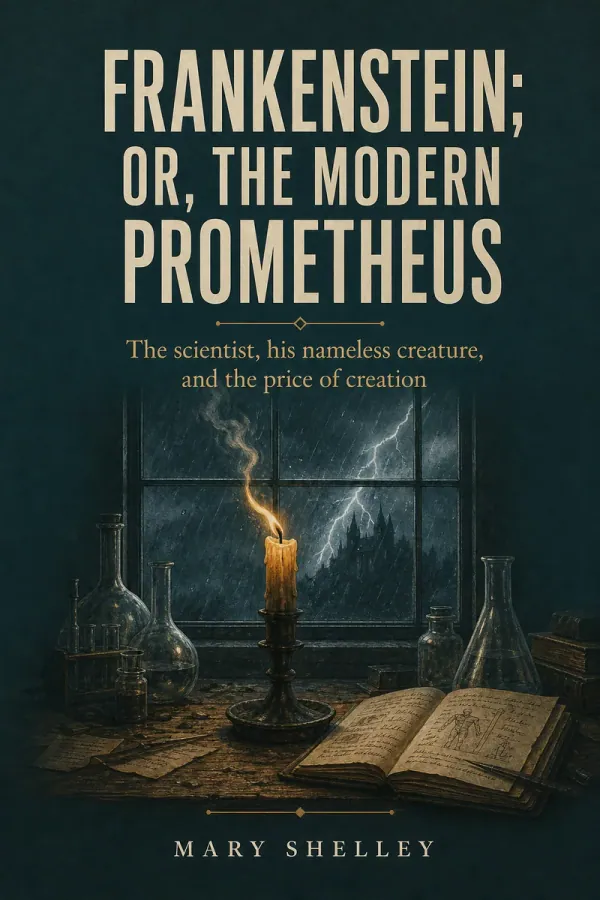
Frankenstein; or, The Modern Prometheus by Mary Shelley: Summary and Study Notes
The scientist, his nameless creature, and the price of creation
Study this topic in OriaThe essentials
Dreamed up on the shore of Lake Geneva during the rainy summer of 1816 and published anonymously in 1818, Frankenstein tells how young Victor Frankenstein gives life to a being assembled from human remains, then abandons it in horror. Rejected by everyone, the nameless creature teaches itself to speak and read before taking revenge on its creator. You'll discover the novel's genesis at the Villa Diodati, Mary Shelley's life, the plot and its nested narratives, the book's major themes, and how cinema turned it into a monster far removed from the text.
Key dates and facts
- 1815
- Eruption of Mount Tambora
- May 1816
- The Shelleys arrive near Geneva
- June 1816
- Byron's challenge and Mary's dream
- Aug. 30, 1797
- Born in London
- 1814
- Elopes with Percy Shelley
- 1822
- Percy Shelley drowns
- Feb. 1, 1851
- Dies in London
- Jan. 1, 1818
- Anonymous publication, 500 copies
- 1821
- Saladin's French translation
- Aug. 11, 1823
- Second, signed edition
⛈️ 1816, the sunless summer at Villa Diodati
It all began with a freezing summer. In 1815, the eruption of the Tambora volcano in Indonesia had thrown huge quantities of ash into the atmosphere. The year 1816 is remembered in history as "the year without a summer": across Europe it was cold, and it rained constantly.
🏡 A band of young romantics
In May 1816, an 18-year-old Englishwoman, Mary Godwin, arrived near Geneva with her lover, the poet Percy Bysshe Shelley, and her step-sister, Claire Clairmont. There they joined Europe's most famous poet, Lord Byron, who had rented the Villa Diodati, in Cologny, on the shore of Lake Geneva, along with his young physician, John William Polidori. The Shelleys settled into a nearby house. It was a small group considered scandalous for the time: Mary had run off with Percy, a married man; Claire had been Byron's mistress.
👻 Byron's challenge
Kept indoors by the rain, the friends spent their evenings by the fire reading German ghost stories collected in a book translated into French, Fantasmagoriana. In mid-June, Byron proposed a challenge: that each of them write a ghost story. Byron sketched out a fragment, which Polidori would later develop into The Vampyre (1819), the first great vampire tale in English literature. Percy Shelley soon abandoned his. Mary could think of nothing. Every morning she was asked whether she had found a story, and every morning, she later wrote, she had to answer with a mortifying negative.
🌙 The waking nightmare
One evening, the conversation between Byron and Percy turned to the principle of life. They discussed Erasmus Darwin's experiments and galvanism, the electrical shocks that make the muscles of corpses twitch. Perhaps, they wondered, a corpse could one day be reanimated. Going to bed well after midnight, Mary could not sleep. In a kind of waking dream, she saw, as she later wrote, "the pale student of unhallowed arts kneeling beside the thing he had put together," and then this hideous phantasm of a man stretched out, which, through the working of some powerful engine, showed signs of life and stirred. She had found her story.
In 2011, astronomer Donald Olson, after studying the position of the moon over the villa, proposed dating this dream to the night of June 16, 1816, between 2 and 3 a.m. Mary Shelley recounted the whole scene fifteen years later, in the introduction to the 1831 edition, likely with some embellishment.
🏔️ The Alps as backdrop
The stay also supplied the novel's landscapes. An excursion to Chamonix to see Mont Blanc inspired the scene in which Victor Frankenstein meets his creature again amid the glaciers. Mary Shelley would later say of that summer in Switzerland that it was when she passed from childhood into life.
🖋️ Mary Shelley, daughter of two revolutionaries
Mary Shelley was born Mary Wollstonecraft Godwin on August 30, 1797, in London. Her parents were two major figures of English radical thought. Her mother, Mary Wollstonecraft, had published A Vindication of the Rights of Woman in 1792, a founding text of feminism. Her father, William Godwin, was a well-known political philosopher and novelist. But her mother died of an infection just days after her birth. Godwin remarried four years later to Mary Jane Clairmont, with whom relations were difficult.
📖 A childhood among writers
Mary barely attended school, but her father placed great importance on her education. She grew up surrounded by Godwin's friends, writers and politicians who gathered at his house, and began writing at an early age.
💘 The 1814 elopement
In 1814, it was at her mother's grave, in St Pancras churchyard, that she secretly met a young poet who admired her father, Percy Bysshe Shelley. She was nearly 17, he was almost 22, and he was married. Godwin violently disapproved. The couple fled to the continent, accompanied by Claire Clairmont. Two years of debt, travel, and misfortune followed: on February 22, 1815, Mary gave birth to a premature baby girl, who died two weeks later. In her journal, she recorded dreaming that she brought the baby back to life by rubbing it. Some critics see in this one of the personal sources of Frankenstein.
🖤 A life of losses
Tragedy followed tragedy. In October 1816, Fanny, Mary's half-sister, killed herself; in December, so did Harriet, Percy's first wife. Mary and Percy married on December 30, 1816. Settled in Italy from 1818 on, they lost their daughter Clara in Venice in September 1818, then their son William in Rome in June 1819. Only Percy Florence, born on November 12, 1819, survived. In July 1822, Percy Shelley drowned in a storm in the Gulf of La Spezia. Mary was 24.
✍️ Living by her pen
Back in England in 1823, she decided to earn her living through writing to raise her son. She published novels, such as Valperga (1823) and The Last Man (1826), a work of speculative fiction in which an epidemic wipes out humanity, as well as short stories, biographies, and travel writing. She also devoted much effort to getting her husband's poems into print. Ill in her final years, she died in London on February 1, 1851, at 53. Long reduced to the author of Frankenstein alone, her body of work has been rediscovered by recent scholarship, which shows she remained a political radical her whole life.
The rest of the course
This page publishes the first 2 parts. The full course has 8: here is what the next ones cover.
- 📚 From short story to novel: 1818, 1823, 1831
The writing of the novel, Percy Shelley's role, the anonymous 1818 publication, and the major differences from the revised 1831 edition.
- ⚡ Walton, Victor, and the night of creation
The start of the novel: the frame of Robert Walton's letters, Victor Frankenstein's youth, his studies at Ingolstadt, and the birth of the creature.
- 🌲 The creature: learning the world, being rejected
The creature's own narrative: William's murder, the meeting on Mont Blanc, learning language from the De Lacey family, and rejection.
- 🧊 A refused companion, a chase to the pole
The rest of the plot: the request for a companion, its destruction in the Orkneys, the deaths of Clerval and Elizabeth, the chase north, and the novel's ending.
- 🔥 The modern Prometheus: what the novel says
The novel's major themes: the myth of Prometheus, the creator's responsibility, science, the Gothic, the double, the origin of the name, and the birth of science fiction.
- 🎬 From the stage to Boris Karloff: the birth of a myth
The novel's reception, its early stage adaptations, James Whale's films, and how the character became a pop-culture icon.
Study “Frankenstein; or, The Modern Prometheus” with flashcards and quizzes
In Oria, you read the full course, then practice on it: flashcards, multiple-choice quizzes, open questions or the Feynman method. Cards and questions then come back in your daily review, paced by spaced repetition.
Study this topic in OriaSources
These notes draw on the sources below. If a point seems doubtful, refer back to them.