Classic novels
Germinal by Émile Zola: Summary and Study Notes
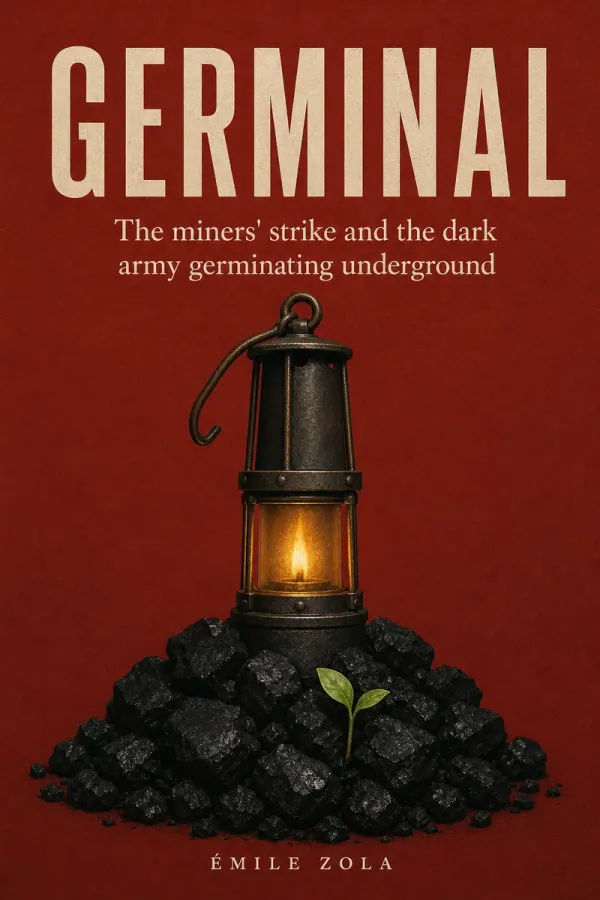
The miners' strike and the dark army germinating underground
Study this topic in OriaThe essentials
Published in 1885, Germinal is the thirteenth novel in the Rougon-Macquart cycle and the most famous of Émile Zola's works. It follows Étienne Lantier, a young unemployed worker hired at the Montsou mines in northern France, who discovers the misery of the mining families, leads a strike, witnesses its bloody repression, and then the disaster at the Voreux pit. You'll discover Zola's naturalist method, his research trip to Anzin, the plot part by part, the major characters, the novel's symbols, and its enormous legacy.
Key dates and facts
- February 1884
- The great Anzin strike begins
- Feb. 23 – Mar. 2, 1884
- Zola researches the coalfield
- April 1884
- Writing begins
- March 1885
- Published in book form
- March 1885
- Published by Charpentier
- 1888
- Premiere of the stage adaptation, long censored
- Sept. 29, 1902
- Zola dies; miners shout “Germinal!” at his funeral
- 1993
- Film by Claude Berri
🧬 The Rougon-Macquart and the naturalist method
Germinal is the thirteenth volume of the Rougon-Macquart, the great twenty-novel cycle that Émile Zola (1840-1902) published between 1871 and 1893. Its subtitle sums up the project: A Natural and Social History of a Family Under the Second Empire.
🌳 One family, five generations
Inspired by Balzac's La Comédie humaine, Zola nonetheless wanted to set himself apart from it. Rather than paint the whole of society, he follows a single family, originating from the fictional town of Plassans, across five generations. Its members scatter into every walk of life under the Second Empire: finance, trade, the railways, the mines. Even before writing the first novel, Zola drew up, in 1868 and 1869, a family tree of his characters, which he kept adding to until 1893. For each one, he noted their life, their occupation, and their inherited traits.
“My great endeavor is to be purely a naturalist, purely a physiologist.” (translated)
Émile Zola, Differences Between Balzac and Myself (1869)
🔬 Heredity and environment
Zola wanted to show how two forces shape individuals: heredity, passed down from parents to children, and environment, meaning occupation, place, and era. He borrowed his vocabulary from the science of his time, especially the work of Dr. Prosper Lucas on heredity and that of physiologist Claude Bernard. He also drew on Darwin, whom he wrongly read as describing a merciless struggle between the strong and the weak.
The literary movement led in France by Zola. It aims to depict reality through painstaking documentary research, drawing on the experimental method of physiologist Claude Bernard. In The Experimental Novel (1879-1880), Zola argues that the novelist is both an observer and an experimenter.
👨👩👦 Étienne, son of Gervaise
The hero of Germinal, Étienne Lantier, belongs to the poor branch of the Macquarts. He is the son of Gervaise Macquart, the laundress of L'Assommoir (1877), and her lover Auguste Lantier. Zola gives him his family's inheritance: a smoldering violence that can erupt under the effect of drink or anger. Étienne was originally meant to be the hero of another novel, The Beast Within (La Bête humaine); the enthusiastic reception of Germinal led Zola to hand that role to his brother Jacques instead.
📚 A novel without a thesis?
Zola claimed to draw no conclusions and simply lay out the facts. But critics have often noted that his theories don't fully account for his novels: as one of them put it, Germinal is not the application of The Experimental Novel. The book is also an epic, full of symbols and sweeping breath.
⛏️ The Anzin research trip
For Germinal, his novel about the “black faces,” Émile Zola carried out the most extensive research of his career. It is arguably the most carefully worked and best-documented of all his novels.
🚂 Eight days in the black country
On the advice of parliamentary deputy Alfred Giard, who guided him on site, Zola chose the coalfield of the North over that of Saint-Étienne. From February 23 to March 2, 1884, he traveled through the mining villages of Anzin and Bruay. The timing was extraordinary: the great Anzin miners' strike had just broken out. Zola went down into the Renard pit, at Denain. He questioned miners, foremen, and engineers, attended meetings, entered homes and cafés, and observed the strikers' calm and discipline. He met Émile Basly, the strike's leader and founder, in 1883, of Anzin's first miners' union. Back in Paris, he followed events in the press and gathered his observations into a file titled My Notes on Anzin.
✊ A real strike
The Anzin strike had a precise cause: the Company decided that timbering the galleries, until then handled by specialized workers, would now be done by the miners themselves. Paid by the quantity of coal brought up, the miners stood to lose money under the new arrangement. More than 10,000 miners walked out for 56 days. The Company didn't budge, and the miners went back to work on April 17, 1884. Zola would borrow this exact plot device almost word for word in his novel.
🐴 The horse that never comes back up
American writer Tom Wolfe recounted an episode from this research trip. Deep underground, Zola saw a huge draft horse hauling a coal cart and asked how it was ever brought back to the surface. The miners explained that the horse goes down very young, grows up, goes blind, and dies underground, never seeing daylight again. In the novel, the horses Bataille and Trompette become the very image of the miners' fate.
📖 Books and newspapers
Zola rounded out his research with extensive reading: treatises on miners' diseases, works of economics, books on socialism and the International, and trial reports. For the strikes at La Ricamarie, Aubin, and Montceau-les-Mines, he consulted La Gazette des tribunaux and several daily papers. His preparatory file ran between 900 and 1,000 pages.
🗞️ From serial to book
Zola wrote the novel from April 1884 to January 1885. It first appeared as a serial in the newspaper Gil Blas, from November 1884 to February 1885, then in book form at Charpentier in March 1885. The book is divided into seven parts.
The rest of the course
This page publishes the first 2 parts. The full course has 8: here is what the next ones cover.
- 🚶 Étienne Lantier arrives at Montsou
Étienne's arrival in coal country, his discovery of the Voreux pit, his hiring thanks to Maheu, and the characters he meets.
- 🏚️ The miners' life: the Maheus
The Maheu family, the mining village, the work underground, the wages, and, on the other side, the bourgeois and the heads of the Company.
- ✊ The strike
The disguised wage cut, Étienne as strike leader, the meeting in the forest, the hunger, and the great march of the strikers from pit to pit.
- 🔫 The crackdown
The shooting that kills Maheu, the end of the strike, the murder of the young soldier, and Bonnemort's madness.
- 🌊 The Voreux disaster
Souvarine's sabotage of the pit, the flooding and collapse of the Voreux, Étienne and Catherine's ordeal underground, and Étienne's departure for Paris.
- 🌱 The title, the symbols, and the reception
The meaning of the title Germinal, the final sentence, the novel's great images, and its immense success through to Zola's funeral and the cinema.
Study “Germinal” with flashcards and quizzes
In Oria, you read the full course, then practice on it: flashcards, multiple-choice quizzes, open questions or the Feynman method. Cards and questions then come back in your daily review, paced by spaced repetition.
Study this topic in OriaSources
These notes draw on the sources below. If a point seems doubtful, refer back to them.