Civilizations
Egypt of the Pharaohs: Summary and Study Notes
Three thousand years of pyramids, gods and kings along the Nile
Study this topic in OriaThe essentials
For nearly three thousand years, the Egypt of the pharaohs prospered thanks to the Nile's floods. We follow the birth of the state with Narmer, the age of the pyramids, and the great reigns of Hatshepsut, Akhenaten, Tutankhamun and Ramesses II. We also discover the gods, mummification and the Book of the Dead, the life of farmers and craftsmen, Champollion's decipherment of hieroglyphs, and finally the slow end of the pharaonic world through Cleopatra and Rome.
Key dates and facts
- c. 3250
- Earliest hieroglyphs
- c. 3150
- Unification of Egypt
- c. 3100
- Traditional reign of Narmer
- 1898
- Discovery of the Narmer Palette
- c. 2033
- Mentuhotep II reunifies Egypt
- c. 1550
- Start of the New Kingdom
- c. 1274
- Battle of Qadesh
- 1922
- Discovery of Tutankhamun's tomb
- 394
- Last hieroglyphic inscription, at Philae
- 1799
- Discovery of the Rosetta Stone
🌊 The Nile and the birth of the state
Ancient Egypt was born of a river. In the middle of an almost rainless desert, the Nile traces a long, green, fertile ribbon. Every summer, monsoon rains falling on the highlands of Ethiopia swell the Blue Nile and the Atbara, which together supply up to 90% of the river's water. The flood spills over the valley, then withdraws, leaving behind a fertile black silt.
🌾 Black land in the middle of a red desert
The Egyptians called their country Kemet, which Egyptologists translate as "the Black Land": the color of the silt left by the flood. It stood in contrast to Deshret, "the Red Land," the barren desert surrounding the valley. In their symbolism, black evoked fertility and rebirth, linked to the god Osiris, while red evoked chaos, linked to the god Seth.
All agricultural life followed the river's rhythm. The calendar counted three seasons: Akhet, the flood, Peret, the growing of crops, and Shemu, the harvest. Farmers practiced basin irrigation: fields were kept flooded for about forty days so the soil could soak and the silt settle, then drained for planting. The river was also worshipped: Hapy was the god of the flood. This natural cycle lasted for millennia, until the Aswan High Dam put an end to it around 1970.
👑 Two kingdoms, one crown
Before unity, the valley was split between two large regions: Upper Egypt to the south, along the narrow valley, and Lower Egypt to the north, in the delta where the Nile splits before reaching the Mediterranean. According to tradition, it was a king named Menes who joined the two lands. Ancient Egyptian civilization thus took shape around 3150 BC with this political unification.
Many scholars regard Narmer as the first king of the 1st Dynasty and identify him with the traditional Menes, though the link remains debated. His reign is traditionally placed around 3100 BC, with estimates varying depending on dating methods. His tomb lies at Umm el-Qaab, near Abydos, in Upper Egypt.
A carved stone slab discovered in 1898 at Hierakonpolis by archaeologist James Edward Quibell, now held at the Cairo Museum. Narmer is shown wearing the white crown of Upper Egypt on one side and the red crown of Lower Egypt on the other: an image that became the symbol of the country's unification.
🏛️ An organized state
Unity gave rise to a true state, led by a king who would later be called pharaoh. The country was gradually divided into provinces, the nomes, up to 42 of them, each entrusted to a governor, the nomarch. Writing also appeared around this time: the earliest hieroglyphs date to roughly 3250–3200 BC, at the end of the Naqada culture. Writing made it possible to count harvests, levy taxes, and preserve the memory of kings.
This first phase, called the Thinite period or Early Dynastic period, lasted until around 2686 BC. It laid the groundwork for everything that followed: a single king, an administration of scribes, an economy built on the Nile's agricultural surpluses, and an ideology in which the ruler guaranteed the order of the world. Pharaonic Egypt would then last nearly three thousand more years, until the Roman annexation in 30 BC.
🔺 The Old Kingdom, the age of the pyramids
The Old Kingdom refers to the period from roughly 2686 to 2181 BC, spanning the 3rd to the 6th Dynasty. This was the age when the pharaoh's power was strong enough to mobilize thousands of men and millions of tonnes of stone. Its symbol has remained the same for more than four thousand years: the pyramid.
🪜 Djoser and Imhotep: the first pyramid
Before the pyramids, elite tombs were mastabas, low structures with flat roofs. Under the reign of King Djoser, at the start of the 3rd Dynasty (c. 2667–2648 BC), his architect Imhotep transformed this model. The project went through several stages: first a mastaba, then successive enlargements, until it became a six-stepped pyramid 62.5 meters high, at Saqqara, northwest of Memphis.
It is the first colossal stone building in Egyptian history and the first pyramid ever built in Egypt. It was surrounded by a vast funerary complex, with a courtyard of about 15 hectares and an entrance colonnade of 40 columns. After a fourteen-year restoration, the pyramid reopened to visitors in March 2020.
🏔️ Khufu and the Great Pyramid of Giza
Less than a century later, under the 4th Dynasty, the pharaoh Khufu had the greatest of all pyramids built at Giza. It dates to around 2600–2560 BC, and its construction is thought to have taken about twenty years. Sources credit the vizier Hemiunu as its architect. Its numbers are staggering:
- an original height of about 146.6 meters, now reduced to roughly 137 meters by erosion and the loss of its tip;
- a square base of about 230 meters a side, oriented with remarkable precision;
- about 2.3 million blocks, for a total mass of several million tonnes;
- granite blocks weighing up to 80 tonnes, brought from Aswan, more than 900 kilometers away.
It remained the tallest human-made structure in the world for more than 3,700 years, until medieval cathedral spires in England surpassed it. Regarded in antiquity as the first of the Seven Wonders of the World, it is also the only one still standing today. Beside it, Khufu's successors Khafre and Menkaure had their own pyramids built.
👷 Who built the pyramids?
Contrary to a persistent myth, the pyramids were not built by crowds of slaves. Archaeologists estimate the workforce on Khufu's project at around 13,200 people on average, with a peak of roughly 40,000. These were organized laborers and craftsmen, housed in a village near Giza, supplemented by farmers called up under the corvée, labor owed to the state.
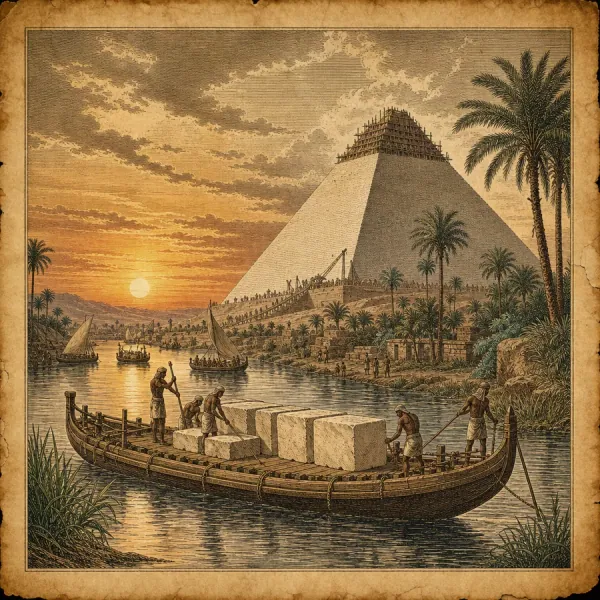
A papyrus discovered in 2013, kept as a logbook. It describes how a team led by a man named Merer transported limestone blocks from the quarries of Tura, across the Nile, during the 27th year of Khufu's reign. It confirms what historians had already surmised about how the project was organized.
⚖️ Why so much effort?
The pyramid was a royal tomb, but also a religious machine. The pharaoh was the intermediary between humans and the gods, charged with maintaining Maat, the rightful order of the world. His survival in the afterlife guaranteed that of the country. Building the king's pyramid therefore amounted to protecting all of Egypt.
By the end of the 6th Dynasty, central power weakened and provincial governors gained more autonomy. Around 2180 BC, the First Intermediate Period began, roughly 140 years of upheaval and division, before Egypt regained its unity.
The rest of the course
This page publishes the first 2 parts. The full course has 7: here is what the next ones cover.
- ⚔️ Middle and New Kingdom: the great pharaohs
The Middle Kingdom's reunification, the Hyksos episode, then the height of the New Kingdom with Hatshepsut, Akhenaten, Tutankhamun and Ramesses II.
- 🪲 Religion and the afterlife
Egypt's main gods, the concept of Maat, the components of a human being (ka, ba, akh), mummification and the Book of the Dead with the weighing of the heart.
- 🧺 Society and daily life
The hierarchy of Egyptian society, from pharaoh to farmers, the role of scribes, the moneyless economy, women's place, and the life of the craftsmen of Deir el-Medina.
- ✒️ Hieroglyphs and Champollion
How hieroglyphic writing worked, its cursive forms, its disappearance, then the Rosetta Stone and its decipherment by Jean-François Champollion in 1822.
- 🐍 Decline: from the Ptolemies to Rome
The long decline of pharaonic Egypt: successive foreign dominations, Alexander's conquest, the Greek Ptolemaic dynasty, Cleopatra VII and the annexation by Rome in 30 BC.
Study “Egypt of the Pharaohs” with flashcards and quizzes
In Oria, you read the full course, then practice on it: flashcards, multiple-choice quizzes, open questions or the Feynman method. Cards and questions then come back in your daily review, paced by spaced repetition.
Study this topic in OriaSources
These notes draw on the sources below. If a point seems doubtful, refer back to them.