Civilizations
The Byzantine Empire: Summary and Study Notes
A thousand years of Rome in the East, from Constantine to 1453
Study this topic in OriaThe essentials
When Rome fell in the West, the Roman Empire lived on in the East, around Constantinople, for nearly a thousand years. You'll discover the founding of the “New Rome” in 330, Justinian and Theodora, the dome of Hagia Sophia, the quarrel over images, the 1054 schism between Rome and Constantinople, the sack of 1204 by the Crusaders and the fall of 1453 to the Ottomans. You'll also see what the world owes it: Roman law, the Orthodox Church, the Cyrillic alphabet and the Greek texts passed on to the Renaissance.
Key dates and facts
- 324
- Constantine chooses Byzantium as his new capital
- 330
- Constantinople is inaugurated
- 395
- Final division between East and West
- 476
- End of the Western Roman Empire
- 527 – 565
- Reign of Justinian
- 533
- Belisarius lands in Africa against the Vandals
- 541
- The Plague of Justinian begins
- 1018
- Basil II annexes Bulgaria
- 1054
- Mutual excommunications between Rome and Constantinople
- 1071
- Defeat at Manzikert against the Seljuks
🏛️ From Byzantium to the New Rome
The Byzantine Empire never bore that name while it existed. Its inhabitants called it the “Empire of the Romans” and called themselves Romans, Rhōmaioi in Greek; their Persian, Arab and Turkish neighbors, for that matter, called them the “Rum.” The term “Byzantine” was popularized by Western historians much later: the German Hieronymus Wolf founded the study of this history in 1557, and the expression “Byzantine Empire” spread in the 19th century. For today's historians, it is quite simply the eastern half of the Roman Empire, Christian and Greek-speaking, which survived the fall of Rome by nearly a thousand years.
🌊 Constantine chooses Byzantium
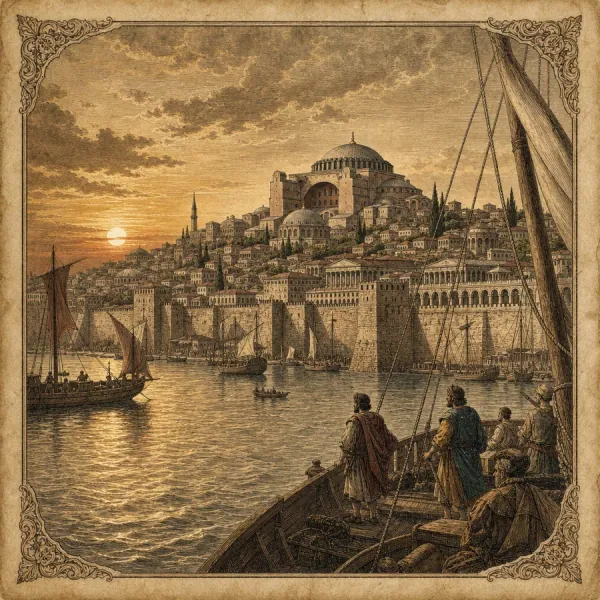
In the 4th century, the Roman Empire was too vast to be governed from a single city. The emperor Constantine, who favored Christianity after 312, chose from 324 an old Greek city, Byzantium, to make it a new capital. The site was exceptional: a triangle of land bordered by the sea on two sides, with a natural harbor, the Golden Horn, on the sea route linking the Black Sea to the Mediterranean and at the meeting point of Europe and Asia. Inaugurated in 330, the city was officially the “New Rome,” but everyone soon called it Constantinople, “the city of Constantine.” Like Rome, it had its hippodrome, its forums and its Senate.
✂️ 395: two empires
In 395, on the death of the emperor Theodosius I, the Empire was divided between his two sons: Honorius received the West, Arcadius the East. It wasn't the first division, but this one would be permanent. Contemporaries didn't see it as two separate states, though: the same laws applied on both sides, issued jointly. That's why historians hesitate over the Byzantine Empire's date of birth: 330, 395, or even the reign of Heraclius in the 7th century, when the state became thoroughly Greek.
🛡️ The East holds, the West falls
In the 5th century, Goths, Huns and Vandals struck mainly at the weaker West. In 410, Rome itself was taken by the Visigoths. The East, richer and militarily stronger, held firm. Under Theodosius II (408–450), Constantinople surrounded itself with a new circuit of walls, the Theodosian Walls, a double line of ramparts that would withstand every siege until 1453. The same emperor issued the Theodosian Code, a collection of imperial laws. In 476, Romulus Augustulus, the last Western emperor to rule in Italy, was deposed by the barbarian chieftain Odoacer. The emperor in Constantinople then became, in name, the sole ruler of the entire Roman world. His authority over the barbarian kingdoms of the West remained theoretical, but their kings often sought his recognition.
👑 The basileus, the law and the City
At the top of the state stood the emperor, called basileus from the reign of Heraclius in the 7th century. Since Constantine, he had been considered chosen by God, His representative on earth. His powers were immense: he made the law, his decrees had the force of law, he was the supreme judge and he even intervened in the affairs of the Church. His coronation by the patriarch of Constantinople became an obligatory step that proved his orthodoxy.
🗡️ A throne always under threat
Yet no rule of succession guaranteed the throne. Inherited from Rome, the idea that an emperor had to be acclaimed by the people, the Senate and the army remained alive. An emperor who was defeated, unpopular or accused of heresy could be overthrown, sometimes even blinded. A successful usurpation was even interpreted as a sign that God had chosen the new master. For the historian Jean-Claude Cheynet, this “right to revolt” was the main limit on Byzantine autocracy. Emperors therefore had their sons crowned during their own lifetimes, and regencies were dangerous periods.
⚖️ Roman law put in order
Byzantium was a state governed by law in the sense that the law was written and codified. After the Theodosian Code of the 5th century, the emperor Justinian had a vast body of law compiled between 529 and 534, under the direction of the jurist Tribonian, which we now call the Corpus Juris Civilis: the Code (imperial laws), the Digest (excerpts from the great Roman jurists), the Institutes (a textbook for students) and the Novels, his new laws, written in Greek. It was in this form that the West rediscovered Roman law from the 12th century on.
🏙️ Constantinople, the City par excellence
The Byzantines simply said “the City.” Under Justinian, Constantinople may have had about 500,000 inhabitants, and between 500,000 and 800,000 in the 9th and 10th centuries according to some estimates: it was the largest city in the Christian world. The emperor lived in the Great Palace; at the hippodrome, he met the people, who were passionate about chariot races and split between the “Blues” and the “Greens.” Along the main avenue, the Mese, were clustered shops and workshops, organized into guilds overseen by the prefect of the city. Whoever wanted to rule had to hold the capital.
🪙 The “dollar of the Middle Ages”
The Byzantine economy rested on a gold coin, the nomisma (solidus in Latin), which remained remarkably stable for centuries. Along with the Muslim dinar, it was the great currency of the Mediterranean; historians have nicknamed it the “dollar of the Middle Ages.” In the West, the Byzantine gold coin would be called the “bezant.”
🔥 Diplomacy, themes and Greek fire
Surrounded by enemies on several fronts, the Empire often preferred diplomacy to war: carefully codified embassies, tributes paid to buy peace, titles offered to foreign princes, royal marriages, the conversion of neighboring peoples. Militarily, it adapted: in the 7th century, facing the Arabs, the provinces of Asia Minor became themes, districts where farmer-soldiers could be mobilized quickly. At sea, the fleet had a fearsome weapon, Greek fire, an incendiary liquid sprayed from siphons, developed around 672; its recipe, a state secret, is now lost.
As for women, their first role was running the household, but they could practice a trade or own a business, except for posts such as judge or lawyer. Some left their mark on history, like Anna Komnene, an emperor's daughter and author of the Alexiad, or the empresses who ruled in their own right, like Irene at the end of the 8th century.
The rest of the course
This page publishes the first 2 parts. The full course has 8: here is what the next ones cover.
- ☦️ A Christian empire and the quarrel over images
The place of religion: emperor and patriarch, councils, saints, the monks of Mount Athos, icons, and the iconoclast crisis (726–843) that pitted supporters of holy images against their opponents.
- 🕌 Hagia Sophia, mosaics and manuscripts
Byzantine art and learning: the basilica of Hagia Sophia (532–537), gold mosaics and domed churches, schooling, and the historians and encyclopedists who copied and preserved ancient Greek texts, along with medicine and science.
- ⚔️ From Justinian to Basil II: two golden ages
The Empire's finest hours: Justinian and Theodora, the Nika riots and the reconquests of the 6th century, survival against the Persians and Arabs in the 7th century, then the high point of the Macedonian dynasty under Basil II (976–1025).
- 💔 From the schism of 1054 to the sack of 1204
The turning point: the break with Rome in 1054, the defeat at Manzikert against the Seljuk Turks in 1071, the Komnenian recovery and the Crusades, then the Fourth Crusade, which took and plundered Constantinople in 1204.
- 🌒 1453: the fall of Constantinople
The last two centuries: an Empire reduced to its capital as the Ottomans rose, appeals to the West, then the siege of April–May 1453 by Mehmed II and the capture of the city on May 29, when the last emperor, Constantine XI, died.
- 🕊️ Orthodoxy, law and Greek texts: the legacy
What Byzantium left behind: the Orthodox Church and the Cyrillic alphabet in the Slavic world, the idea of Moscow as the “Third Rome,” codified Roman law, Greek texts passed on to the Renaissance by émigré scholars, and the fate of Hagia Sophia up to 2020.
Study “The Byzantine Empire” with flashcards and quizzes
In Oria, you read the full course, then practice on it: flashcards, multiple-choice quizzes, open questions or the Feynman method. Cards and questions then come back in your daily review, paced by spaced repetition.
Study this topic in OriaSources
These notes draw on the sources below. If a point seems doubtful, refer back to them.