Civilizations
The Gauls and the Celts: Summary and Study Notes
From salt princes to fortified towns: Iron Age Europe
Study this topic in OriaThe essentials
For nearly a thousand years, Celtic-speaking peoples occupied much of Europe, from Britain to Anatolia. They mined salt, drank Greek wine, captured Rome, raided the outskirts of Delphi, struck coins and built real towns before being conquered by Rome. You'll discover what archaeology reveals about their society, economy and towns, how Caesar subdued Gaul, what survived in the British Isles, and why “our ancestors the Gauls” is first and foremost a 19th-century myth.
Key dates and facts
- c. 600 BC
- Phocaeans found Massalia
- c. 530 – 500 BC
- Princely tomb of Hochdorf
- c. 470 BC
- Burial of the Lady of Vix
- 1953
- Discovery of the Vix tomb
- c. 390 BC
- The Senones take Rome
- 279 BC
- The Celts fail at Delphi
- c. 278 BC
- The Galatians cross into Asia Minor
- 133 BC
- Fall of Numantia
- 121 BC
- Rome controls southern Gaul
- 58 BC
- The Gallic Wars begin
🗺️ Celts, Gauls, Galatians: who were they?
The Celts never formed an empire, or even a country. The word refers to a group of peoples of the European Iron Age who spoke Celtic languages, a branch of the great Indo-European family, and who shared cultural traits: objects, an art style, beliefs, ways of organizing themselves. In the 1st millennium BC, Celtic languages were spoken across much of Europe, from the British Isles to the Iberian Peninsula, from Gaul to the Danube Valley, and as far as central Anatolia, in present-day Turkey.
🏷️ Three names for one world
The Greeks were the first to name them. At the end of the 6th century BC, the geographer Hecataeus of Miletus mentions Keltoi living near Massalia, present-day Marseille; in the 5th century, Herodotus places them near the sources of the Danube. Later, the Greeks also spoke of Galatians, and the Romans of Galli, the Gauls. The “Gauls” are therefore the Celts of Gaul, a vast territory covering present-day France, Belgium and Switzerland as well as part of Germany, to which the Romans added “Cisalpine Gaul,” northern Italy. According to Julius Caesar, these Gauls called themselves Celts in their own language.
“Gaul as a whole is divided into three parts: one is inhabited by the Belgae, another by the Aquitani, and the third by the people who in their own language are called Celts, and in ours, Gauls.”
Julius Caesar, Commentaries on the Gallic War, I, 1 (1st century BC) (translated)
Not all the inhabitants of Gaul were Celts, in fact: south of the Garonne, the Aquitani spoke a language related to the ancestor of Basque.
🧩 A civilization or a label?
The very notion of “Celts” is debated. The British archaeologist John Collis disputes the idea of a Celtic ethnic group, and the French specialist on the Gauls Jean-Louis Brunaux sees it largely as a modern construct. Others, such as Venceslas Kruta, argue on the contrary for a civilization clearly identifiable by its language, its remains and its beliefs. Today, most researchers use “Celtic” first in the linguistic sense: a Celt is someone who speaks a Celtic language.
Their homeland is just as disputed. The classic theory places it in Central Europe, north of the Alps, with the Hallstatt culture. Another, defended notably by John T. Koch and Barry Cunliffe, places it on the Atlantic seaboard as early as the Bronze Age. The linguist Patrick Sims-Williams proposes a compromise: Celtic may have emerged somewhere in Gaul in the 2nd millennium BC, before spreading in several directions.
📜 A world described by others
The Celts wrote little. The oldest inscriptions in a Celtic language, known as Lepontic, date from the 6th century BC in northern Italy; Gaulish was later written in the Greek alphabet, then the Latin one. But the druids favored oral transmission. To learn about them, we therefore rely mainly on three kinds of sources: Greek and Roman writers, who were often their enemies; archaeology, which has profoundly changed our image of the Gauls over the past fifty years; and Irish and Welsh texts written down by Christian monks from around the 8th century onward.
⛏️ Hallstatt: salt, princes and Greek wine
The first chapter of Celtic history bears the name of an Austrian village. Hallstatt, on the shore of a lake in the Salzkammergut, gave its name to an archaeological culture that, according to specialists, stretched from about 1200 to 450 BC, from eastern France to Hungary. Historians generally regard it as the cradle of the Celtic peoples.
🧂 The white gold of the Alps
At Hallstatt, wealth came from salt. Essential for preserving food and feeding livestock, it was extracted from galleries dug into the mountain, worked on and off since the Neolithic and above all from the 8th to the 5th century BC. From 1846, Johann Georg Ramsauer, the mine's director, excavated a huge cemetery there: more than a thousand graves, rich in swords, jewelry and bronze vessels. The salt preserved what usually disappears: scraps of textiles, wooden tools and even leather backpacks used to haul the blocks of salt to the surface.
This was also the period when iron reached Central Europe, roughly between 800 and 700 BC. Long iron swords, their pommels sometimes covered with gold or ivory, became the emblems of an elite of horsemen.
🏰 Princes on the heights
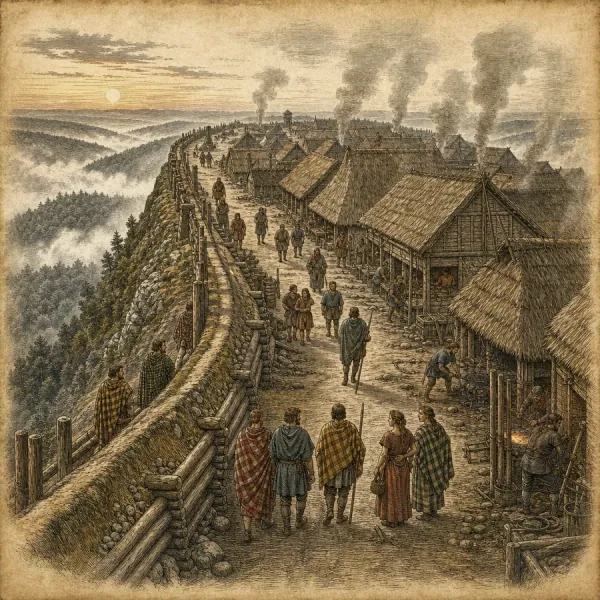
Toward the end of the period, in the 6th century BC, a dozen hilltop citadels dominated southern Germany, Switzerland and eastern France. The best excavated, the Heuneburg, on the Danube, was protected by a 600-meter rampart of mud bricks on a stone base, fitted with towers: a Mediterranean technique, unusual north of the Alps. Greek pottery and amphorae have been found there.
For these “princes” traded with the south. Around 600 BC, Greeks from Phocaea founded Massalia (Marseille). Up the Rhône–Saône–Seine route came wine and luxury tableware; down it went tin from Britain, amber from the Baltic, metals and slaves. Those who controlled the crossing points grew rich.
👑 Hochdorf and the Lady of Vix
Their tombs bear witness to this. At Hochdorf, near Stuttgart, a burial mound 60 meters across, discovered in 1977–1978, held the body of a dignitary from around 530–500 BC, surrounded by sumptuous grave goods. In France, at the foot of Mont Lassois, near Châtillon-sur-Seine, the tomb of a woman in her thirties, buried around 470 BC in the body of a chariot, was discovered in January 1953. She wore a gold torc, a rigid neck ring, weighing 480 grams and decorated with small winged horses. Beside her stood the Vix krater: a bronze wine vessel 1.64 meters tall, weighing 208 kilos and holding about 1,100 liters, probably made in a Greek workshop in southern Italy around 540–530 BC. It is the largest known metal vessel of Western classical antiquity.
Who was this “Lady of Vix”? Some archaeologists long refused to accept that a woman could receive such a burial, which made it a textbook case for gender archaeology. Around 500 BC, this princely world collapsed: the citadels were abandoned and trade with Massalia shifted elsewhere.
The rest of the course
This page publishes the first 2 parts. The full course has 8: here is what the next ones cover.
- ⚔️ La Tène: a new art, and Celts from Rome to Ankara
The Late Iron Age (La Tène culture): the La Tène site and its offerings, Celtic art, then the great Celtic expansion into Italy (the sack of Rome), the Balkans (Delphi), Anatolia (the Galatians) and the Iberian Peninsula (the Celtiberians).
- 🌾 Farmers, craftsmen, druids and aristocrats
Gaulish society on the eve of the conquest: farming and food, crafts and inventions, the social hierarchy (druids, warrior aristocracy, producers, clients and slaves), political institutions, the place of women, and coinage.
- 🏘️ The oppida, the first towns north of the Alps
Celtic urbanization in the 2nd and 1st centuries BC: what an oppidum is, Manching, Bibracte, Corent, the murus gallicus technique, and the trade in Italian wine.
- 🛡️ From Narbonensis to Alesia: the Roman conquest
Rome's conquest of Gaul: the province of Narbonensis, Caesar's Gallic Wars (58–51 BC), Vercingetorix's revolt, Gergovia, the siege of Alesia, and the disputed human toll.
- 🏛️ Gallo-Romans, Britons and Irish: what survived
The fate of the Celts after the conquest: the Romanization of Gaul (Lyon, Claudius), the survival and disappearance of Gaulish, the ban on druids, the conquest of Britain and Boudica's revolt, Ireland never conquered, Christianization and Insular art.
- 🔍 “Our ancestors the Gauls”: myths, legacies and discoveries
How the Celts were reinvented: ancient clichés, the French national narrative (Amédée Thierry, Napoleon III, the Third Republic, Asterix), British Celtomania, today's Celtic nations, debunked misconceptions, and recent findings from genetics.
Study “The Gauls and the Celts” with flashcards and quizzes
In Oria, you read the full course, then practice on it: flashcards, multiple-choice quizzes, open questions or the Feynman method. Cards and questions then come back in your daily review, paced by spaced repetition.
Study this topic in OriaSources
These notes draw on the sources below. If a point seems doubtful, refer back to them.