Civilizations
The Achaemenid Persian Empire: Summary and Study Notes
The first universal empire, from Cyrus to Darius III
Study this topic in OriaThe essentials
In the 6th century BC, a small people of horsemen from southern Iran built, in a single generation, the largest empire the world had ever known. You'll discover Cyrus the Great and his famous cylinder, Darius and his satrapies, the Royal Road and the palaces of Persepolis, the religion of Ahura Mazda, the Persian Wars told from the Persian side, and finally the fall to Alexander in 330 BC. You'll also see why historians have thoroughly revised the image of a “decadent” Persia inherited from Greek writers.
Key dates and facts
- 559 BC
- Cyrus II becomes king of Anshan
- c. 550
- Victory over the Medes, capture of Ecbatana
- c. 546
- Capture of Sardis, end of the kingdom of Lydia
- 539
- The Persians enter Babylon
- c. 525 BC
- Cambyses II conquers Egypt
- 522
- Darius I seizes the throne
- c. 521
- Construction of Persepolis begins
- 486
- Death of Darius I
- 499 – 493 BC
- Revolt of the Greek cities of Ionia
- 490
- Battle of Marathon
🏔️ Cyrus the Great founds an empire
The Achaemenid Empire was the first Persian empire in history and one of the largest of antiquity. At its height, it stretched from the Indus, in present-day Pakistan, to Egypt and Libya, and from Central Asia to Thrace, in Europe: between 5.5 and 7.5 million km² according to estimates. For the first time, it brought together in a single state the oldest civilizations of the Near East: Mesopotamia, Egypt, Elam and Asia Minor.
🐎 A people of horsemen from Fars
The Persians were an Iranian-speaking people settled in the southwest of present-day Iran, in the region of Fars. They were originally semi-nomadic herders and horsemen. They mingled with the Elamites, a very ancient people of the region, many of whose traditions they adopted. The dynasty takes its name from a founding ancestor, Achaemenes, whose existence is disputed: some historians see him as a figure invented later by Darius I to legitimize his rule. The first kings, Teispes and his descendants, bore the title “king of Anshan,” an old Elamite city. At the time they were subject to their powerful neighbors, the Medes.
👑 Cyrus overthrows the Medes
In 559 BC, Cyrus II came to the throne of Anshan. Between 553 and 550, he went to war against Astyages, king of the Medes, defeated him and seized his capital, Ecbatana, present-day Hamadan. Remarkably, he spared the defeated king's life and presented himself as his legitimate successor. The Persians became masters of the former Median kingdom.
🗺️ From Lydia to Babylon
Alarmed, Croesus, the fabulously wealthy king of Lydia in Asia Minor, attacked Cyrus. Cyrus counterattacked in the dead of winter and captured the Lydian capital, Sardis, probably in 546 BC. Croesus was spared. The Greek cities of Ionia, on the coast, came under Persian rule. Cyrus then headed east, where he subdued vast regions of Central Asia, from Bactria to Sogdiana.
Then it was the Neo-Babylonian Empire's turn. In late September 539 BC, the Persian army won a victory at Opis; on October 12, 539, it entered Babylon. King Nabonidus was overthrown. Along with Mesopotamia, Cyrus took over Syria, the Phoenician cities and Judea. He then allowed the Judeans exiled in Babylon to return to Jerusalem, which earned him a very positive image in the Bible.
⚰️ Death in battle and a tomb at Pasargadae
In 530 BC, Cyrus led an expedition into Central Asia against the Massagetae, a nomadic people. According to Herodotus, he died in battle against their queen, Tomyris; ancient accounts of his death are numerous and fanciful. His body was brought back to Persia and laid in a stone tomb at Pasargadae, the capital he had founded amid gardens. This tomb on six steps still stands on the plain. Two centuries later, Alexander the Great would treat it with respect.
📜 The Cyrus Cylinder: propaganda or human rights?
In March 1879, the archaeologist Hormuzd Rassam, excavating Babylon for the British Museum, discovered in the foundations of the Esagila, the great temple of the god Marduk, a barrel-shaped clay object about 22.5 centimeters long, covered with cuneiform writing in Akkadian. This is the Cyrus Cylinder, written shortly after Cyrus II captured Babylon, between 539 and 530 BC according to the British Museum. It is still kept in London.
🔎 What the text says
The text was written by Babylonian scholars. It says that the former king, Nabonidus, was a bad ruler who had offended Marduk, the great god of Babylon. The god then chose Cyrus to restore order. Cyrus presents himself with his titles (“king of the world, great king…”), claims to have entered the city peacefully, relieved the inhabitants of unjust forced labor, allowed displaced populations to return home and returned to their sanctuaries the statues of gods that had been gathered in Babylon. The text ends with the restoration of one of the city walls.
“My vast army marched into Babylon in peace; I did not allow anyone to frighten the people of Sumer and Akkad.”
Cyrus Cylinder (c. 539 – 530 BC) (translated)
⚖️ A “first charter of human rights”?
In the 20th century, the cylinder became a political symbol. The last shah of Iran, Mohammad Reza Pahlavi, presented it as the “first charter of human rights” and displayed it in Tehran in 1971 for the 2,500th anniversary of the Iranian monarchy. That same year, the UN had it translated into its official languages and made it a forerunner of the Universal Declaration. This image is still very widespread today.
Specialists, notably at the British Museum, nonetheless reject this reading as anachronistic. The cylinder is a typical royal inscription in the Babylonian tradition: a piece of propaganda meant to legitimize a foreign conqueror by presenting him as the chosen one of the local god, modeled on the texts of earlier Babylonian kings. The notions of human rights or religious tolerance in the modern sense did not exist at the time. Historians also point out that giving conquered peoples back their gods and temples was a common practice among conquerors in the ancient Near East.
✡️ And the return of the Judeans?
Some readers of the Bible have seen the cylinder as confirmation of the decree of Cyrus reported in the Book of Ezra, which allows the exiled Judeans to return and rebuild the Temple in Jerusalem. But the cylinder names only sanctuaries in Mesopotamia: it mentions neither the Judeans nor Jerusalem. Most specialists also consider that the decrees reproduced in the Bible were at least rewritten later. The return of the exiles remains plausible, but it fits into an ordinary policy rather than an exceptional one.
The cylinder keeps traveling as a symbol: lent to Iran from September 2010 to April 2011, it drew crowds there, and it was later shown in the United States as an emblem of freedom.
The rest of the course
This page publishes the first 2 parts. The full course has 8: here is what the next ones cover.
- 🗺️ Darius, satrapies and the Royal Road
How such a vast empire was governed: Darius I's seizure of power in 522 and the Behistun inscription, the satrapies and their inspectors, tribute, the Royal Road and its couriers, coinage, languages and the army.
- 🔥 Ahura Mazda, truth and the Lie
The religion of the Persian kings: Ahura Mazda, the creator god, the opposition between truth and the Lie, the magi, the Elamite gods still honored, the debate over whether the Achaemenids were Zoroastrian, and what Zoroastrianism, still practiced today, is.
- 🏛️ Persepolis, Pasargadae and the art of kings
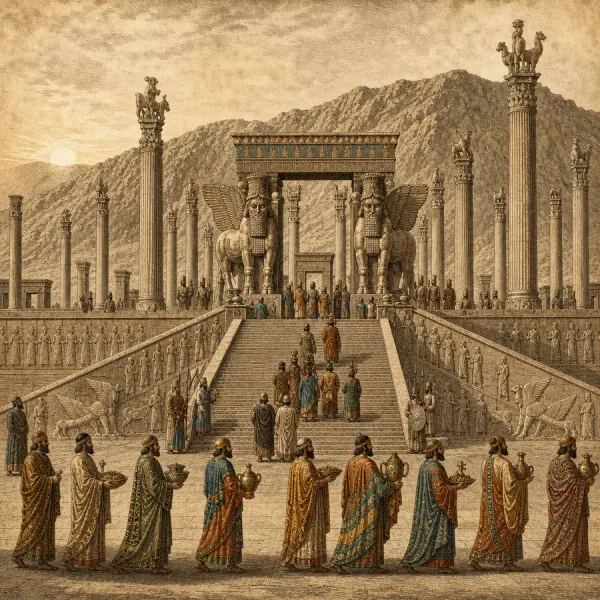
Achaemenid art and architecture: Pasargadae, Susa and above all Persepolis, built from 521 BC by craftsmen from all over the empire, with its reliefs of delegations, its columns, its colors, its archives, and its paradise gardens.
- ⚔️ The Persian Wars seen from Persia
The conflict between the Persian Empire and the Greek cities (499–449 BC) told from the Persian point of view: the Ionian Revolt, Marathon, Xerxes's expedition, Salamis and Plataea, and why historians put the image handed down by Greek sources in perspective.
- 🌒 Court intrigue and Alexander's conquest
The last two centuries: an empire that stayed solid despite revolts and succession crises, the expedition of the Ten Thousand, the reconquest of Egypt, then the conquest by Alexander the Great (334–330 BC) and the death of Darius III.
- 🕊️ The legacy of the Great Kings
What remains of the Achaemenid Empire: an imperial model taken up by Alexander, the Seleucids, the Parthians and the Sasanians, the image of Cyrus among the Greeks and in the Bible, the decipherment of cuneiform, and the place of this past in modern Iran.
Study “The Achaemenid Persian Empire” with flashcards and quizzes
In Oria, you read the full course, then practice on it: flashcards, multiple-choice quizzes, open questions or the Feynman method. Cards and questions then come back in your daily review, paced by spaced repetition.
Study this topic in OriaSources
These notes draw on the sources below. If a point seems doubtful, refer back to them.