History
Franklin D. Roosevelt: Biography and Study Notes
The president of the Great Depression and World War II
Study this topic in OriaThe essentials
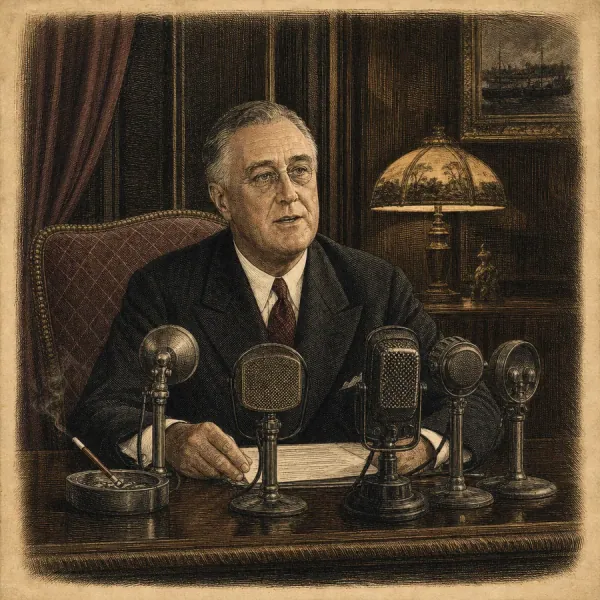
Heir to a wealthy New York family, Franklin Delano Roosevelt saw his career shattered by paralysis in 1921, then fought his way back to the White House in the depths of the Great Depression. The only American president elected four times, he launched the New Deal, created Social Security, then made his country “the arsenal of democracy” and became one of the architects of the United Nations. You'll follow his life, his reforms and his conduct of the war, but also the darker sides historians hold against him, from the internment of Japanese Americans to his policy toward Jewish refugees.
Key dates and facts
- 1882
- Born in Hyde Park
- 1900
- Death of his father
- 1903
- Graduates from Harvard
- 1905
- Marries Eleanor
- 1921
- Paralyzed at 39
- 1926
- Warm Springs center
- 1928
- Elected governor of New York
- 1932
- Elected president
- March 4, 1933
- Inauguration and banking crisis
- 1933
- The Hundred Days
🌳 An only son of the Hudson Valley
Franklin Delano Roosevelt was born on January 30, 1882, in Hyde Park, in the Hudson River valley, about 100 miles (160 km) north of New York City. He grew up at Springwood, the vast family estate. His father, James Roosevelt, was a wealthy landowner and businessman; his mother, Sara Ann Delano, devoted almost all her energy to her only son. Franklin had just one half-brother, much older, from his father's first marriage.
🌍 Roots in Europe
Both families were old patrician New York lines. On his father's side, the ancestor was a Dutchman who settled in the 17th century in New Amsterdam, the future New York. On his mother's side, the name Delano came from Philippe de La Noye, a Protestant who left Tournai, in present-day Belgium, and landed in Plymouth, Massachusetts, in 1621. His maternal grandfather, Warren Delano, had made a fortune in part through the opium trade with China.
🎓 A gentleman's education
According to the historian Alan Brinkley, the family lived “in a manner reminiscent of the English aristocracy,” in a very sheltered world. Thanks to frequent trips to Europe, young Franklin spoke German and French; at nine, he even briefly attended a public school in Germany. Until fourteen he was taught at home by tutors, then entered Groton, an elite boarding school in Massachusetts whose headmaster, the Reverend Endicott Peabody, preached the Christian duty to serve the common good. Peabody would remain a major figure in his life.
At Harvard, he was an average student but became editor-in-chief of the student newspaper, the Harvard Crimson. His father died in 1900. The following year, his distant cousin Theodore Roosevelt became president of the United States: his energy and reforming spirit made him Franklin's role model. After graduating in history in 1903, he entered Columbia Law School in 1904, which he left in 1907 after passing the bar exam.
💍 Eleanor
On March 17, 1905, despite his mother's reluctance, he married his distant cousin Eleanor Roosevelt, Theodore's niece; the president himself walked the bride down the aisle in place of her late father. The couple would have six children, one of whom, a son, died in infancy in 1909. Franklin was self-assured and at ease in high society; Eleanor was then shy and insecure. Yet she would become a major figure in American and world politics.
⚓ From Albany to the Navy: a rapid rise
Franklin Roosevelt was bored at the Wall Street law firm where he worked from 1908 and told his friends he wanted to go into politics. Although he admired his Republican cousin Theodore, he chose the Democratic Party.
🚗 New York state senator
In 1910 he ran for the New York State Senate in a rural district considered safely Republican. He campaigned by automobile, at a time when very few people owned one, and won a surprise victory. Settled in Albany, the state capital, on January 1, 1911, he led a small group of reform Democrats opposed to Tammany Hall, the party's powerful political “machine” in New York, known for its patronage. He was reelected in 1912 thanks to the journalist Louis McHenry Howe, who would become his most loyal adviser.
🚢 The Navy at war
Having backed Woodrow Wilson's presidential candidacy, he was appointed Assistant Secretary of the Navy in March 1913, the department's number two. Enthusiastic, sometimes to the point of insubordination, he championed a powerful navy and learned to negotiate with unions and Congress. Historians also note that he carried out some of the Wilson administration's discriminatory measures: in 1916 he had separate restrooms installed for whites and “colored” people, before the order was reversed in the face of protests from the NAACP, the leading African American civil rights organization.
When the United States entered World War I in April 1917, he coordinated from Washington a navy whose ranks grew fourfold. In the summer of 1918, he inspected naval installations in Europe and met King George V, British Prime Minister Lloyd George and French Premier Georges Clemenceau; it was also the first time he crossed paths with Winston Churchill. On the way back, he caught the Spanish flu, complicated by pneumonia.
🗳️ Running for vice president
In 1920, the Democratic Party chose him as the running mate of its presidential candidate, James Cox. During the campaign, speaking in Butte, Montana, on August 18, 1920, he boasted that he had personally written the constitution imposed on Haiti, then occupied by the United States, and that he thought it was a rather good one. The Cox-Roosevelt ticket was soundly beaten by the Republican Warren Harding. Roosevelt would nonetheless note that the networks he built during this campaign served him later.
💔 A marriage transformed
From 1914, he had an affair with his wife's social secretary, Lucy Mercer. Eleanor discovered it in 1918. Franklin promised never to see her again; the couple did not divorce, but their marriage became above all a political partnership. Eleanor devoted herself to her own social and political causes, in a separate house at Val-Kill, near Hyde Park.
The rest of the course
This page publishes the first 2 parts. The full course has 9: here is what the next ones cover.
- ♿ Paralysis and the comeback
The illness of 1921 that paralyzed him, his rehabilitation at Warm Springs, his political return, his term as governor of New York during the crash of 1929 and his victory in the 1932 presidential election.
- 🏦 The Hundred Days and the New Deal
The situation in 1933, the inaugural address, the bank closures, the Hundred Days, the major agencies of the First New Deal, then the Second New Deal with Social Security, the WPA and labor rights, up to the landslide reelection of 1936.
- ⚖️ Second term: momentum lost
The 1937 address, the attempt to enlarge the Supreme Court, the recession of 1937–1938, the last major social law of 1938, the rise of conservative opposition and the debated economic record of the New Deal.
- 🛠️ From neutrality to the “arsenal of democracy”
The Good Neighbor policy, the Neutrality Acts, the gathering storm, aid to Britain, the third election of 1940, the Four Freedoms speech, Lend-Lease and the Atlantic Charter.
- 🌍 War leader and architect of the peace
Pearl Harbor and the entry into the war, the “Germany first” strategy, war production, the internment of Japanese Americans, the debate over the Holocaust, relations with Free France, the great conferences, the Manhattan Project and the fourth election of 1944.
- 🕯️ April 1945: death at Warm Springs
His failing health hidden from the public, his exhausted return from Yalta, his sudden death at Warm Springs on April 12, 1945, the funeral, reactions around the world and the two-term limit adopted afterward.
- 🏛️ A vast and debated legacy
Roosevelt's place among the greatest presidents, his transformation of the role of government and of the presidency, Eleanor's influence, criticism from right and left, and tributes in the United States and around the world.
Study “Franklin D. Roosevelt” with flashcards and quizzes
In Oria, you read the full course, then practice on it: flashcards, multiple-choice quizzes, open questions or the Feynman method. Cards and questions then come back in your daily review, paced by spaced repetition.
Study this topic in OriaSources
These notes draw on the sources below. If a point seems doubtful, refer back to them.