Classic novels
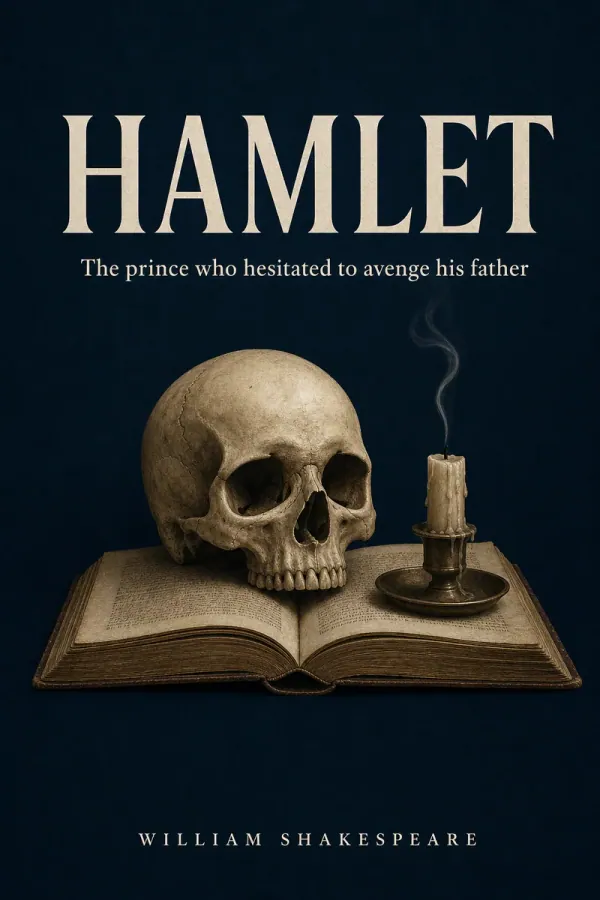
Hamlet by William Shakespeare: Summary and Study Notes
The prince who hesitated to avenge his father
Study this topic in OriaThe essentials
Written by William Shakespeare around 1600, Hamlet tells how a prince of Denmark, ordered by his father's ghost to avenge his murder, feigns madness, traps his uncle with a play, and drags almost the whole court down with him into death. You'll discover the world of Elizabethan theatre, the play's sources, its plot act by act, the "To be, or not to be" soliloquy, its major themes, its characters, and four centuries of staging and adaptation.
Key dates and facts
- 1564
- Shakespeare born in Stratford
- 1599
- The Globe built in London
- 1603
- First Quarto of Hamlet
- 1623
- First Folio of the complete works
- 1768
- Voltaire tears the play apart
- 1827
- Hamlet performed in Paris, a shock for the Romantics
- 1948
- Best Picture Oscar for Laurence Olivier
- 1988
- Patrice Chéreau's production at Avignon
👑 Shakespeare, the Globe, and England in 1600
William Shakespeare was born in Stratford-upon-Avon, England, where he was baptized on April 26, 1564, and died there on April 23, 1616. The son of a prosperous glover, he married Anne Hathaway at eighteen, and they had three children. At an unknown date between 1585 and 1592, he left for London, where he became an actor and playwright. His body of work includes 39 plays and 154 sonnets.
🎭 Elizabethan theater
From 1594 on, his plays were performed exclusively by the Lord Chamberlain's Men, a company in which he held a share and which quickly became the most popular in London. In 1599, several of its members built their own playhouse in Southwark, south of the Thames: the Globe, which could hold about 3,000 spectators. Actors performed there in the clothing of their own time, with very little scenery. This was the England of Queen Elizabeth I; after her death in 1603, her successor James I became the company's patron, and it was renamed the King's Men. Shakespeare almost certainly wrote the role of Hamlet for Richard Burbage, the company's leading tragedian.
📅 When was Hamlet written?
Any dating remains tentative. The play does not appear in a list of twelve Shakespeare plays published by Francis Meres in 1598, and it makes many allusions to Julius Caesar, dated to 1599. On July 26, 1602, an entry in the Stationers' Register in London notes that it had recently been performed by the Lord Chamberlain's company. Its composition is therefore placed between 1599 and 1601. It is Shakespeare's longest play: roughly 3,900 lines in modern editions, more than four hours of performance in full, when an ordinary Elizabethan play ran two or three hours.
📚 Three different texts
Three early versions have survived, each with passages missing from the others. The First Quarto (1603), rediscovered only in 1823, contains just over half the text. The Second Quarto (1604) is the longest. The First Folio (1623), the first edition of the complete works, published after the author's death, gives a third version. Modern editors generally combine these texts. Even the division into five acts is not Shakespeare's own: it dates from a 1676 edition.
✝️ An uneasy religious backdrop
The play was written shortly after the English Reformation. It mixes Catholic elements, such as the ghost's claim to come from purgatory, having died without last rites, with Protestant echoes: Hamlet and his friends study at Wittenberg, Luther's city.
📜 From Amleth to Hamlet: the sources
Most of the events in the play were invented by Shakespeare, but the story of a prince who feigns idiocy to avenge his father had existed for a long time. Legends of this kind appear in Italy, Spain, Scandinavia, Byzantium, and Arabia, which suggests a very ancient origin.
🗡️ The legend of Amleth
Around 1200, Saxo Grammaticus told the story of Amleth in Latin, in his Deeds of the Danes (Gesta Danorum). King Horvendil is murdered by his brother Fengo, who then marries his widow, Gerutha. The victim's son, Amleth, feigns madness to be spared. He avoids the trap of a young woman, kills a spy hidden in his mother's chamber, then intercepts a letter ordering the king of England to have him executed: two messengers die in his place instead. But in Saxo's version, the hero triumphs: he marries the English king's daughter, returns to Denmark, attends his own funeral, kills Fengo, and takes the throne.
📖 Belleforest and the "Ur-Hamlet"
In 1570, the Frenchman François de Belleforest adapted this legend in his Histoires tragiques. He nearly doubled the length of the story and added the hero's melancholy. Shakespeare may have known this version, although the differences are clear: in Belleforest, the king's murder is known to everyone, whereas in Shakespeare it is secret.
The most direct source is probably a lost play, already in existence around 1589, known as the Ur-Hamlet ("primitive Hamlet"). It is often attributed to Thomas Kyd, author of The Spanish Tragedy, who may be behind the idea of the ghost; some scholars think it could even be an early version by Shakespeare himself. No copy of it survives.
A tragedy whose entire plot turns on revenge: a crime, an avenger, a bloody ending. Hamlet draws on these conventions, as does The Spanish Tragedy by Thomas Kyd, one of its possible sources.
👦 Hamlet and Hamnet
Shakespeare had one son, Hamnet, who died in 1596 at age eleven. Most scholars reject any link to the play: the story comes from legend, and the name was common at the time. Scholar Stephen Greenblatt has nonetheless argued that the near-interchangeable spelling of the two names at the time, and the father's grief, might lie at the heart of the tragedy. Novelist Maggie O'Farrell drew on this idea for her novel Hamnet (2020).
🔍 What Shakespeare changes
Comparing the versions shows how much Shakespeare invented. The murder becomes a secret revealed only by the ghost, raising a doubt: is the ghost telling the truth? The hero is no longer a cunning man who triumphs, but a man who thinks, hesitates, and dies. And around him, Polonius's family, with Ophelia and Laertes, mirrors his own.
The rest of the course
This page publishes the first 2 parts. The full course has 9: here is what the next ones cover.
- 👻 Acts I and II: the ghost and the feigned madness
The start of the plot: the ghost's appearance at Elsinore, Claudius's murder revealed, Hamlet's feigned madness, and the arrival of the players.
- 🎭 Act III: the play within the play
The heart of the tragedy: the soliloquy, the scene with Ophelia, the performance that exposes Claudius, the king's prayer, and the murder of Polonius.
- ⚔️ Acts IV and V: Ophelia, the graveyard and the duel
The play's ending: the failed exile to England, Ophelia's madness and drowning, Laertes's return, the graveyard scene with Yorick's skull, and the final duel.
- 💭 "To be, or not to be"
Theater's most famous soliloquy (Act III, Scene 1): its text, its meaning, its variants, and its French translations.
- 🌀 Revenge, doubt, and death
Hamlet's major themes: revenge and hesitation, appearance versus reality, madness, the corruption of the state, and the ever-present theme of death.
- 👥 The characters
Hamlet, Claudius, Gertrude, Polonius, Ophelia, Laertes, Horatio, Rosencrantz and Guildenstern, Fortinbras: who they are and how they have been interpreted.
- 🎬 Four centuries of staging
Hamlet's reception and legacy: criticism from Voltaire, the French Romantics, great actors, Olivier's and Branagh's films, rewritings, and French productions.
Study “Hamlet” with flashcards and quizzes
In Oria, you read the full course, then practice on it: flashcards, multiple-choice quizzes, open questions or the Feynman method. Cards and questions then come back in your daily review, paced by spaced repetition.
Study this topic in OriaSources
These notes draw on the sources below. If a point seems doubtful, refer back to them.