Classic novels
The Alchemist by Paulo Coelho: Summary and Study Notes
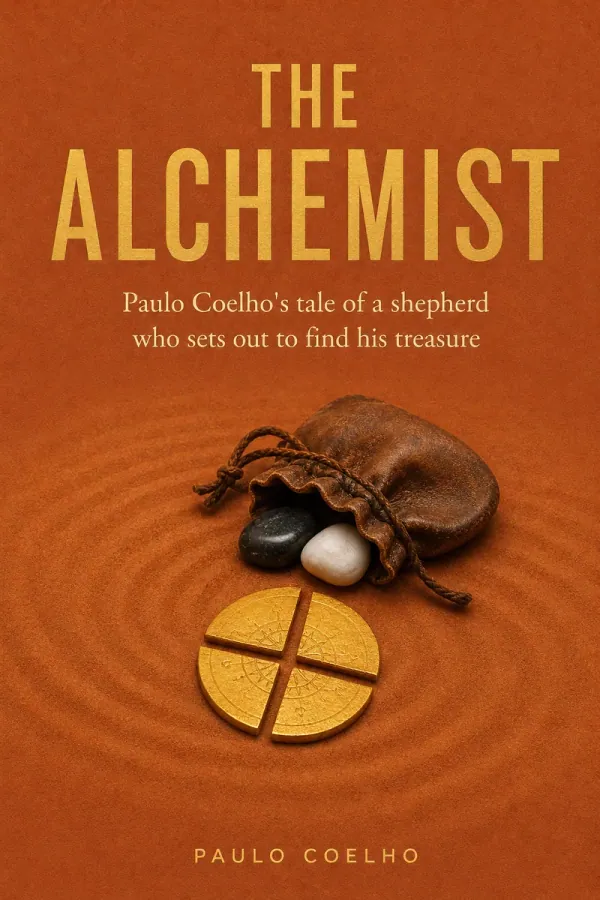
Paulo Coelho's tale of a shepherd who sets out to find his treasure
Study this topic in OriaThe essentials
Published in Brazil in 1988, Paulo Coelho's The Alchemist tells of the journey of Santiago, an Andalusian shepherd who leaves everything behind to search for a treasure he dreamed of at the foot of the pyramids of Egypt. Overlooked at first, this short philosophical tale became one of the best-selling and most translated books in the world. You'll discover its author's life, the old tales it draws on, Santiago's story, its key ideas such as the "Personal Legend," the reasons for its success, and the harsh criticism it has also drawn.
Key dates and facts
- Aug. 24, 1947
- Born in Rio de Janeiro
- 1974
- Arrested and tortured under the dictatorship
- 1986
- Pilgrimage to Compostela
- 1988
- The Alchemist published in Brazil
- 1988
- Published in Brazil, about 900 copies
- 1993
- English translation in the United States
- 1994
- French translation from Anne Carrière
- 2009
- Coelho named most translated living author by Guinness
✍️ Paulo Coelho, from rebel to pilgrim
Paulo Coelho was born on August 24, 1947, in Rio de Janeiro, Brazil, into a middle-class family. His father, an engineer, and his mother wanted him to follow a respectable path. He, a student at a Jesuit school, dreamed of theater and writing.
🚪 A rebellious teenager
Introverted and defiant, he clashed with his parents. At seventeen, they had him committed to a psychiatric hospital. He escaped three times before finally being released at twenty. He would later say that his parents had wanted to save him, not destroy him, and he would draw on this ordeal for his novel Veronika Decides to Die.
🎸 Hippie, lyricist, and prisoner
To please his parents, he enrolled in law school, then dropped out after a year. He then lived the hippie life, traveling through South America, Europe, and North Africa. Back in Brazil, he wrote song lyrics for stars such as Raul Seixas, Elis Regina, and Rita Lee, and took part in the revival of Brazilian rock. In 1974, under the military dictatorship, he was arrested for activities deemed "subversive" and tortured during his detention. He then became a journalist, worked for a record label, and tried his hand at theater.
🥾 The Camino de Santiago
His spiritual search led him through very different experiences, including magical rituals. He eventually made peace with the Catholic faith. In 1986, he walked the Camino de Santiago, in northern Spain, and experienced it as a turning point. Out of it came his first real book, The Pilgrimage, published in 1987. He then realized that his deepest dream was to become a writer, and gave up his other pursuits to devote himself to it.
📜 A very old tale, rewritten in two weeks
Paulo Coelho wrote The Alchemist (O Alquimista) in 1987, right after The Pilgrimage. He claims to have written it in just two weeks, because the story was, he says, "already written in his soul." But this story is far older than he is.
💤 The treasure that was at home
The plot reworks a folktale known the world over, classified by specialists under tale type 1645, "The Treasure at Home." A man dreams that a treasure awaits him in a distant city. He travels there, finds nothing, and tells his dream to a stranger, who laughs at him: he too dreamed of a treasure, hidden in a place he describes — which turns out to be the first man's own home. The man goes home and finds the treasure there.
The oldest known version is a poem by the Persian poet Rumi, in the 13th century. A variant appears in One Thousand and One Nights; Coelho says he drew on "eleven lines" from that collection. The Argentine writer Jorge Luis Borges turned it into a one-page short story, Tale of the Two Dreamers. A 17th-century English version is also known, the Pedlar of Swaffham, along with a Jewish legend tied to the founder of a Kraków synagogue.
🪞 A prologue from Oscar Wilde
The book opens with a short passage almost directly copied from Oscar Wilde's The Disciple, a retelling of the myth of Narcissus. In Wilde's version, the pool in which Narcissus saw himself had loved him only because it could admire its own reflection in his eyes. For the scholar Thérèse Nadeau-Lacour, this prologue is a key to the novel: every reader risks looking there mainly for their own reflection. The original Brazilian edition, in fact, featured Caravaggio's Narcissus on its cover.
⚗️ The four keys of alchemy
Coelho presented his novel as an illustration of four "fundamental keys of alchemy": Signs, the Soul of the World, the Personal Legend, and the Language of the Heart. He has also said he was influenced by the Sufi mystical tradition of Islam. The text, finally, contains numerous references to the Bible.
An ancient practice, both scholarly and mystical, that sought to turn ordinary metals into gold using the "philosopher's stone" and to find an "elixir of long life." In the novel, it serves mainly as a metaphor: transforming oneself.
The rest of the course
This page publishes the first 2 parts. The full course has 8: here is what the next ones cover.
- 🐑 Santiago, the shepherd who dreamed of a treasure
The story's beginning: Santiago, an Andalusian shepherd, has a recurring dream, consults a fortune-teller, meets the old king Melchizedek, sells his sheep, and sets off for Tangier, where he is robbed and then works for a crystal merchant.
- 🏜️ The desert, the oasis, and the alchemist
The rest of the story and its ending: crossing the Sahara with an Englishman, falling in love with Fatima at the oasis, meeting the alchemist, the trial of the wind, arriving at the pyramids, and the final twist.
- 🧭 Personal Legend, signs, and the Soul of the World
The novel's key ideas: the Personal Legend, signs, the Soul of the World, the language of the heart, the fear of failure, and the value of the path traveled.
- 🕊️ A spiritual novel at the crossroads of religions
The religious dimension of The Alchemist: biblical references, Sufi mysticism, New Age beliefs, and the debate between Christian readers who see a parable in it and those who see a spiritualized selfishness.
- 📈 From failure to a worldwide phenomenon
The publishing history of The Alchemist: a first print run that did not sell, Coelho's persistence, success in France and then worldwide, conflicting sales figures, and adaptation projects.
- ⚖️ Criticism and limits
What critics hold against The Alchemist: a simplicity judged simplistic, a self-help tone, the naive optimism of "magical thinking," the hero's self-centeredness, and Coelho's response.
Study “The Alchemist” with flashcards and quizzes
In Oria, you read the full course, then practice on it: flashcards, multiple-choice quizzes, open questions or the Feynman method. Cards and questions then come back in your daily review, paced by spaced repetition.
Study this topic in OriaSources
These notes draw on the sources below. If a point seems doubtful, refer back to them.