Geography & countries
Germany: Summary and Study Notes
The powerhouse at the heart of Europe, between memory and reinvention
Study this topic in OriaThe essentials
With more than 83 million people, Germany is the most populous country in the European Union and its largest economy. Its history runs from the Holy Roman Empire to unification in 1871, from the catastrophes of the 20th century to division and then reunification in 1990. You'll discover its landscapes, its history in brief, its society, its culture, its economic model, its federal system, its role in Europe and the world, and the challenges facing a country that has to reinvent its model.
Key dates and facts
- 1517
- Luther launches the Reformation
- 1648
- End of the Thirty Years' War
- 1871
- Birth of the German Empire
- 1919
- Weimar Constitution
- 1933
- Hitler comes to power
- 1949
- Birth of West and East Germany
- 1961
- The Berlin Wall goes up
- 1989
- Fall of the Wall, November 9
- 1990
- Reunification, October 3
- 2005
- Angela Merkel becomes chancellor
🗺️ At the heart of Europe
The Federal Republic of Germany lies in the middle of Europe, between the North Sea and the Baltic Sea to the north and the Alps to the south. It shares borders with nine countries: Denmark to the north, Poland and the Czech Republic to the east, Austria and Switzerland to the south, and France, Luxembourg, Belgium and the Netherlands to the west. At about 357,000 km² (138,000 square miles), it is the seventh-largest country in Europe, considerably bigger than the United Kingdom (about 244,000 km²) and slightly smaller than Montana.
⛰️ Three tiers of landscape
From north to south, the land rises like a staircase. In the north stretches the North European Plain, shaped by Ice Age glaciers, with its heaths, lakes and low coastlines; the country's lowest point is here, 3.54 m (11.6 feet) below sea level. In the center, wooded uplands such as the Harz and the Black Forest alternate with basins. In the south, beyond the Bavarian plateau, rise the Alps, where the Zugspitze (2,963 m, or 9,721 feet) is the highest point.
🌊 Rivers that connect Europe
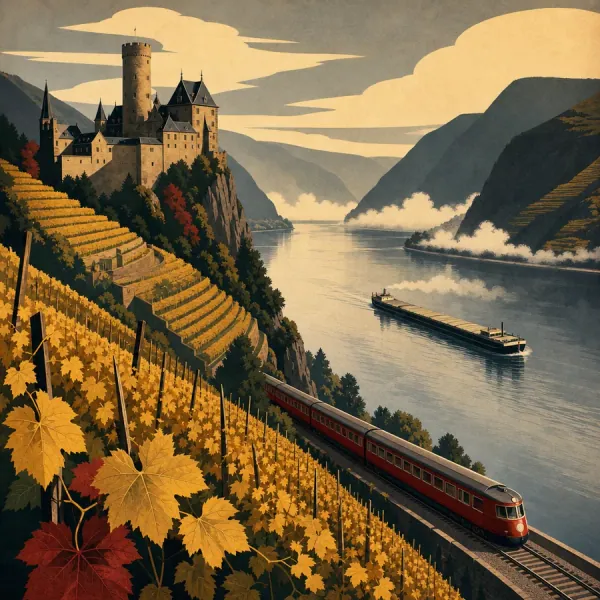
The Rhine, which flows 865 km (537 miles) through Germany and passes through Cologne, is the main economic artery of the country and of “Rhineland Europe.” The Elbe runs through Hamburg, the Danube rises in the Black Forest before heading for the Black Sea, and the Oder forms part of the border with Poland. Lake Constance, shared with Switzerland and Austria, is the country's largest lake.
🌦️ Climate and nature
The climate is temperate: oceanic in the northwest, under the influence of the North Sea, it becomes more continental toward the east and southeast, with colder winters and hotter summers. The summers of 2003, 2018 and 2019 were the hottest ever recorded, and droughts and flash floods are becoming more frequent with climate change. Farmland covers about 51% of the territory, forest 30% (beech, oak, spruce and pine) and built-up areas 14%. The country has 16 national parks, from the Wadden Sea to Berchtesgaden, home to wolves, lynx and ibex among others. But one study showed that between 1989 and 2016, flying insects declined by about 75% in the areas studied.
🏙️ A country with many centers
According to the World Bank, Germany had about 83.5 million inhabitants in 2025, 82% of them city dwellers, with a density of about 235 people per km² (610 per square mile). It is polycentric: four cities have more than a million inhabitants, Berlin, the capital, Hamburg, Munich and Cologne, but the largest urban area is the Rhine-Ruhr region, around Cologne, Düsseldorf and the Ruhr industrial basin (about 11 million people), ahead of the Frankfurt, Berlin and Stuttgart regions. The west and south are more populous and wealthier than the east. The country is divided into 16 Länder (states), three of which are city-states: Berlin, Hamburg and Bremen.
📜 From the Holy Roman Empire to the Third Reich
German territory has been inhabited for more than 600,000 years: it was in the Neander Valley that the first fossil identified as a Neanderthal was discovered. In the Swabian Jura, flutes about 42,000 years old are among the oldest known musical instruments.
🏛️ The Germanic peoples versus Rome
The Romans called the lands east of the Rhine Germania. In AD 9, the Germanic chieftain Arminius wiped out three legions in the Teutoburg Forest, a defeat that discouraged Rome from conquering the region. The Roman frontier, the limes, then followed the Rhine and the Danube. After the great migrations, the Franks dominated western Europe; the empire of Charlemagne, crowned in 800, was divided in 843, and its eastern part gave rise to the kingdom of East Francia and then to the Holy Roman Empire, whose core it formed from 962.
✝️ A fragmented empire
For centuries, the Holy Roman Empire remained a patchwork of principalities, bishoprics and free cities. In 1356, the Golden Bull entrusted the election of the emperor to seven prince-electors. In the north, the merchants of the Hanseatic League prospered. Gutenberg introduced movable-type printing to Europe, and in 1517 Martin Luther launched the Protestant Reformation (see the chapters “Gutenberg's Printing Press” and “The Protestant Reformation”). Religious conflict peaked with the Thirty Years' War (1618 – 1648), which devastated the German lands and sharply reduced their population, until the Peace of Westphalia.
🦅 From Prussia to the German Empire
From 1740 on, Habsburg Austria and Prussia fought for dominance over the German lands. The Holy Roman Empire came to an end in 1806, during the Napoleonic Wars; in 1815, a German Confederation of 39 states replaced it, and a customs union, the Zollverein, paved the way for economic unity. The revolutions of 1848 failed to unify the country. The Prussian chancellor Otto von Bismarck succeeded through three wars, against Denmark (1864), Austria (1866) and France (1870 – 1871): in 1871 the German Empire was born, dominated by Prussia, with Berlin as its capital. Under Wilhelm II, it joined the race for colonies; in present-day Namibia, from 1904 to 1908, the German colonial authorities annihilated the Herero and Nama peoples in reprisal for an uprising: the first genocide of the 20th century.
💥 Wars, republic and dictatorship
World War I cost the lives of about two million German soldiers. On November 9, 1918, the republic was proclaimed; the Treaty of Versailles (1919), experienced as a humiliation, stripped the country of about 13% of its European territory and all its colonies. The Weimar Republic went through hyperinflation, then the “Golden Twenties” of artistic creativity, before being swept away by the crisis of 1929: in 1932, nearly 30% of the workforce was unemployed. Appointed chancellor on January 30, 1933, Adolf Hitler set up a totalitarian dictatorship within weeks, persecuted Jews through the Nuremberg Laws (1935) and started World War II by invading Poland on September 1, 1939. The Nazi regime carried out the Holocaust, the murder of about 6 million Jews, as well as the killing of Roma, disabled people and political opponents. Germany surrendered on May 8, 1945 (see the chapters “Totalitarianism,” “World War II” and “The Holocaust”). Twelve to thirteen million Germans were then expelled from Eastern Europe, and the country lost about a quarter of its prewar territory.
The rest of the course
This page publishes the first 2 parts. The full course has 9: here is what the next ones cover.
- 🧱 Two Germanys, then one
Germany since 1945: occupation, the creation of West and East Germany, the economic miracle, the Berlin Wall, reunification in 1990 and the major milestones up to the 2025 election.
- 👥 An aging, diverse society
Germany's population: aging and low birth rates, immigration and minorities, the German language and regional languages, religions, the education system and health care.
- 🎼 Musicians, poets and thinkers
German culture: classical and electronic music, literature and fairy tales, philosophy, art and architecture from Gothic to Bauhaus, film, traditions, food and sport.
- 🏭 Europe's largest economy
Germany's economy: GDP and world rank, the social market economy, industry and exports, big corporations and the Mittelstand, research, energy and the debt brake.
- 🏛️ A federal democracy built against dictatorship
Germany's political system: the 1949 Basic Law, the federalism of the Länder, the Bundestag and Bundesrat, the president and the chancellor, parties and coalitions, the 2025 election, the debate over the AfD and freedom indexes.
- 🌍 The engine of Europe
Germany's place in the world: European integration, the Franco-German partnership, NATO and military restraint, the 2022 turning point, support for Ukraine, relations with the United States and China, development aid.
- ⏳ The challenges of a model to reinvent
Germany's major challenges today: growth and the industrial model, demographics and pensions, the East-West divide, immigration and the rise of the AfD, investment, climate and security.
Study “Germany” with flashcards and quizzes
In Oria, you read the full course, then practice on it: flashcards, multiple-choice quizzes, open questions or the Feynman method. Cards and questions then come back in your daily review, paced by spaced repetition.
Study this topic in OriaSources
These notes draw on the sources below. If a point seems doubtful, refer back to them.