Classic novels
The Iliad by Homer: Summary and Study Notes
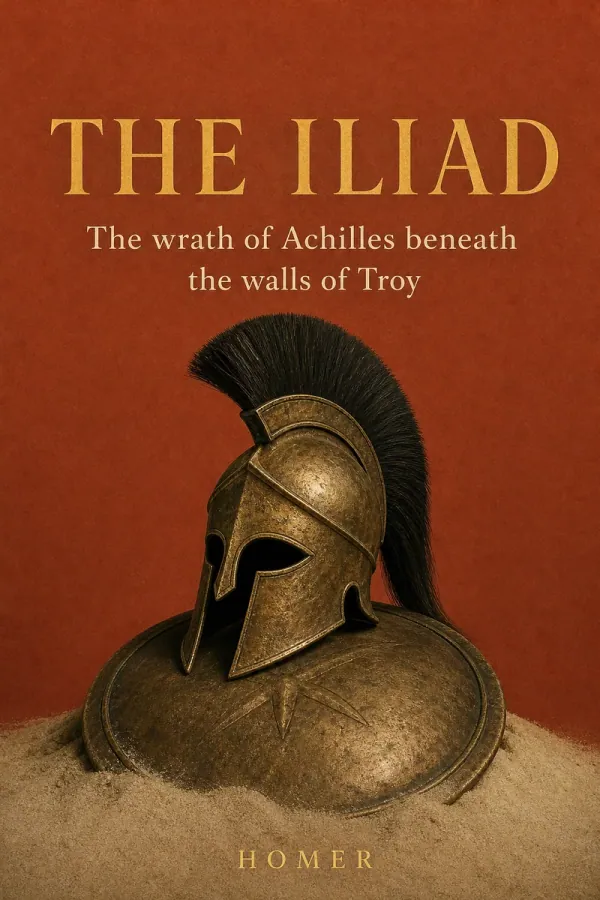
The wrath of Achilles beneath the walls of Troy
Study this topic in OriaThe essentials
Attributed to Homer and composed toward the end of the 8th century BC, the Iliad does not tell the whole Trojan War but a few weeks of its tenth year: the wrath of Achilles, insulted by Agamemnon, and its terrible consequences up to the death of Hector. You'll discover how this oral poem became a written text, what archaeology says about Troy, the plot book by book, the major characters, Homeric style, the ideas of glory, death, and fate, and three thousand years of legacy, from Virgil to film.
Key dates and facts
- c. 750 – 700 BC
- Most likely date of composition
- c. 530 BC
- First edition, in Athens
- c. 445 BC
- First mention of the title, in Herodotus
- 10th century
- Venetus A, the oldest complete manuscript
- c. 1200 BC
- Possible real conflict, end of the Mycenaean period
- c. 2200 BC
- Actual date of "Priam's Treasure"
- 1870s
- Schliemann's excavations at Hisarlik
- 1488
- First printed edition, in Florence
- 1715 – 1720
- Alexander Pope's English translation
- 1935
- Tiger at the Gates , by Giraudoux
🏺 Homer, the bard, and the birth of the text
The Iliad is a Greek epic of 15,693 lines in dactylic hexameter, divided into twenty-four books of uneven length. Its title comes from Ilion, another name for the city of Troy: in Greek, it means "the poem of Ilion." The earliest mention of this title appears in the historian Herodotus, around 445 BC. It is estimated that reciting the whole poem would take about twenty-six hours, or at least three full days.
🎙️ Homer and the "Homeric question"
The Greeks attributed the Iliad, like the Odyssey, to Homer, whom they imagined as a blind bard, that is, a singing poet. They firmly believed in his existence, but knew almost nothing about him: the ancient biographies are too late to be credible. From the late 18th century on, following the work of the German scholar Friedrich August Wolf, scholars began to wonder whether a single author had really composed these poems: this is the Homeric question. Today, most specialists accept the overall unity of the work, without ruling out later additions. Book X, for example, is often considered a later insertion.
A professional poet of archaic Greece who sang epic tales in public, especially at aristocratic banquets or funerals. Later, rhapsodes recited Homer's poems at festivals.
🧩 A poem born of the voice
In the 1920s and 1930s, the American scholar Milman Parry, and later his student Albert Lord, studied illiterate bards in Yugoslavia. They showed that these poets did not recite a text learned by heart: they recomposed it as they sang, using ready-made formulas. The Iliad is the product of a very long oral tradition of this kind. Most researchers nonetheless believe it was set down in writing fairly quickly, perhaps dictated by its author, at a time when the Greeks were reinventing writing through the alphabet borrowed from the Phoenicians. The poem thus sits at the hinge between the oral and the written.
📅 Dating and editing the poem
The Homeric epics seem to reflect no social practice later than 750–700 BC. The most common view therefore dates them to 750 – 700 BC, or even as late as 675; some, such as Martin West, place them later still, around 630. This is the period when Greece was emerging from the "dark ages" that followed the fall of the Mycenaean world: the birth of city-states, the first colonies, and great sanctuaries like Olympia and Delphi.
Around 530 BC, in Athens, the tyrant Pisistratus (or a member of his family) is said to have had an official version drawn up for recitation at the Great Panathenaea. The decisive work later fell to the scholars of the Library of Alexandria, such as Zenodotus and Aristarchus, who are credited with dividing the poem into twenty-four books, matching the twenty-four letters of the Greek alphabet. The oldest complete manuscript, the Venetus A, dates from the 10th century.
🏛️ Troy, between legend and archaeology
The Iliad belongs to the Trojan Cycle, a set of Greek epics devoted to the Trojan War and its aftermath. The other poems of the cycle, such as the Cypria, which told of the war's beginnings, were composed after Homer and are now lost: we know them only through summaries. The ancients considered them far inferior to the two Homeric epics.
🍎 What the audience already knew
The Iliad's first audience knew the whole story. Paris, a Trojan prince, had carried off Helen, wife of King Menelaus of Sparta, with the help of Aphrodite, whom he had named the most beautiful of the goddesses at the Judgment of Paris. To avenge this insult, Agamemnon, Menelaus's brother, gathered the Greek leaders, who set out from the port of Aulis. The poem therefore does not need to recap everything, but it also cannot change the broad outlines: Hector must die at Achilles' hand, Achilles must in turn die beneath the walls of Troy, and the city must fall after ten years of siege. These events are foretold within the poem, but only Hector's death is actually narrated.
⛏️ Schliemann and the mound of Hisarlik
In the 19th century, most European scholars believed the Trojan War had never happened. The German businessman Heinrich Schliemann was convinced otherwise. In the 1870s, he excavated the mound of Hisarlik, in what is now Turkey, then part of the Ottoman Empire, and discovered a hoard he attributed to King Priam. Later excavations showed that this "Priam's Treasure" dates from around 2200 BC, far too early for the period Homer sings of.
Other clues have nonetheless kept alive the idea of a historical core. Hittite texts contemporary with Mycenaean civilization mention a site called Wilusa, which recalls the name Ilion, and a people called the Ahhiyawa, which recalls Homer's Achaeans.
⚖️ What historians think
There is no decisive proof. But, much as the Song of Roland draws on a real but heavily transformed battle, it is generally accepted that the Trojan Cycle preserves the memory of a conflict that really took place toward the end of the Mycenaean period, around 1200 BC, far less grand than the one sung nearly five centuries later. The world of the Iliad remains a poetic creation: it blends very ancient memories, such as the boar's-tusk helmet worn by Odysseus, realities from Homer's own time, and a large measure of invention.
The rest of the course
This page publishes the first 2 parts. The full course has 9: here is what the next ones cover.
- 🔥 Books I to IX: the wrath and withdrawal of Achilles
The quarrel between Achilles and Agamemnon over Briseis, Zeus's promise to Thetis, the first battles, Hector and Andromache's farewell, and the embassy that fails to bring Achilles back.
- 🛡️ Books X to XVIII: the rout and the death of Patroclus
The night raid of the Doloneia, the Trojan assault on the Greek camp, the death of Patroclus at Hector's hands, Achilles' grief, and the shield forged by Hephaestus.
- 🕯️ Books XIX to XXIV: from vengeance to pity
Achilles' return to battle, his fury up to the river Scamander, the duel with Hector, Patroclus's funeral, and Priam's night visit to ransom his son's body.
- 👥 Achilles, Hector, and the gods of Olympus
The main characters: Achilles and his fate, Patroclus, Agamemnon, Hector and his family, Helen and Paris, the captive women, and the gods divided between the two sides.
- 🎶 A style made to be sung
The devices of Homeric style: epithets and formulas, typical scenes, extended similes, direct speech, digressions, and ring composition.
- ⚖️ Glory, death, and fate
The Iliad's major themes: the heroic code of honor (kleos, timê, aidôs), an ambivalent view of war, death and the human condition, and the place of the gods and fate.
- 📜 Three thousand years of the Iliad
The Iliad's legacy: a Greek school textbook, Virgil's model, forgotten in the medieval West, rediscovered in the Renaissance, a source for painters, thinkers, novels, and films up to today.
Study “The Iliad” with flashcards and quizzes
In Oria, you read the full course, then practice on it: flashcards, multiple-choice quizzes, open questions or the Feynman method. Cards and questions then come back in your daily review, paced by spaced repetition.
Study this topic in OriaSources
These notes draw on the sources below. If a point seems doubtful, refer back to them.