Great discoveries & mysteries
The Antikythera Mechanism: Summary and Study Notes
The bronze computer that came out of the sea
Study this topic in OriaThe essentials
In 1901, Greek sponge divers brought up a corroded lump of bronze from a Roman-era shipwreck. A year later, gear wheels were spotted inside it: it is the oldest known geared mechanism, an astronomical calculator from the 2nd century BC. You'll follow an investigation that has lasted more than a century, from gamma rays to 3D scanners, you'll understand what the machine calculated (the positions of the Sun and Moon, eclipses, calendars, the Panhellenic Games) and you'll see why it is anything but an “impossible” object.
Key dates and facts
- c. 70 – 60 BC
- The ship sinks off Antikythera
- 1900
- Sponge divers discover the wreck
- 1901
- The mechanism is brought up with the cargo
- 1976
- Jacques Cousteau's team recovers coins that date the sinking
- 1959
- Derek de Solla Price's first article
- 1974
- Price publishes Gears from the Greeks
- 2005
- X-ray tomography by an international team
- 2006
- First results published in Nature
🌊 A storm, some sponges and a shipwreck
Antikythera is a small, remote Greek island between Kythira and Crete, at the edge of the Aegean Sea. Around Easter 1900, two boats of sponge divers from the island of Symi, under Captain Dimitrios Kontos, took shelter there while waiting for favorable winds before heading on to the coast of North Africa. To pass the time, the men dived with the equipment of the day: a canvas suit and a copper helmet connected to the surface by an air hose.
🐴 “Corpses and horses”
One of them, Elias Stadiatis, went down to a depth that sources put at roughly 45 to 60 meters (150 to 200 ft), then signaled to be pulled up urgently. He said he had seen a heap of bodies and horses among the rocks. Thinking it was nitrogen narcosis, the captain dived in turn and came back up with the arm of a bronze statue. The “bodies” were statues. Even so, the divers went off sponge fishing as planned and only reported the find to the authorities in Athens at the end of the season.
⚓ A perilous underwater salvage
The Greek government sent ships of its Royal Navy in November 1900. Working with the Ministry of Education, the Symi divers spent months bringing up an extraordinary cargo: bronze statues, including the famous Antikythera Youth (c. 340 BC) and the statue known as the “Philosopher,” thirty-six marble sculptures, a bronze lyre, glassware, jewelry, pottery and parts of the ship. The work was exhausting and dangerous: the death of one diver, Giorgos Kritikos, and the paralysis of two others, victims of decompression sickness, brought the operation to an end in the summer of 1901. Everything was taken to the National Archaeological Museum of Athens, where these treasures now fill several rooms.
📅 When did the ship go down?
It was a large Roman-era merchant ship, with an elm hull, a wood the Romans often used. For a long time it was thought to have been carrying loot taken from Athens by the Roman general Sulla in 86 BC. That hypothesis was abandoned when the team of Commander Jacques Cousteau, invited by the Greek government in 1976, brought up nearly 300 objects, including coins struck between 76 and 67 BC. Together with the amphorae and pottery, they place the sinking around 70–60 BC. The ship may have been bound for Italy with works of art intended for a wealthy Roman or for a triumphal parade.
🤿 The wreck still has secrets to give up
Since 2012, new expeditions, with divers using rebreathers and mapping robots, have resumed exploration. They have identified a second wreck a few hundred meters away and brought up pieces of statues, jewelry, a rigging ring and even a war “dolphin,” a 100-kilogram lead weight designed to smash through an enemy ship's hull, the only known example. A 2,000-year-old human skeleton was found there in 2016. In 2022, the archaeologist Lorenz Baumer, of the University of Geneva, described the wreck as “an extremely rich site, the richest in the ancient world.” But the wreck's most famous object had almost gone unnoticed.
🔍 A bronze pebble hiding gear wheels
Among the objects brought up in 1901 was a shapeless lump of corroded bronze and wood, the size of a large book. For two years, nobody paid it any attention: the museum's curators in Athens were busy reassembling the far more spectacular statues. Nor did anyone treat the lump after it came out of the water. The bronze had turned into atacamite, a copper mineral that cracks and shrinks as it dries: the lump warped and eventually broke apart.
⚙️ May 17, 1902
That day, the archaeologist Valerios Stais, the museum's director, and his cousin, the politician Spyridon Stais, noticed that one of the pieces had a gear wheel embedded in the rock, along with Greek inscriptions. Stais first thought it was an astronomical clock. Most scholars of the day were skeptical: such gearing seemed far too complex to have been made at the same time as the wreck's other objects. Some saw it as an astrolabe, a simpler astronomical instrument. The German philologist Albert Rehm was the first to propose, as early as the 1900s, that it was a genuine astronomical calculator.
🧩 An 82-piece puzzle
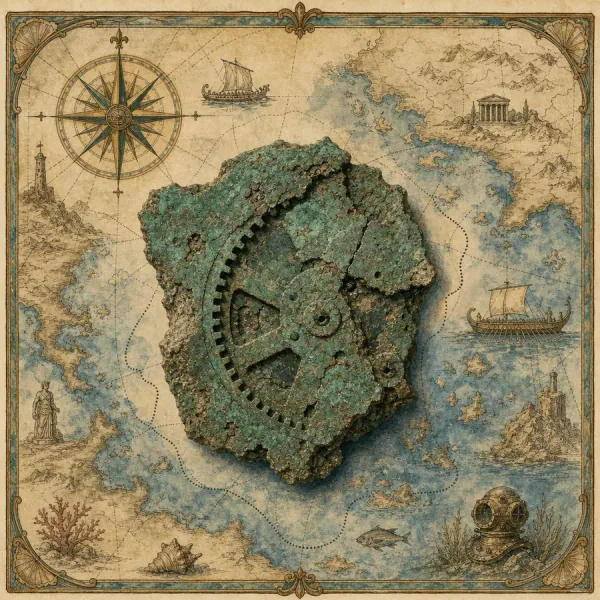
The mechanism came out of the sea as a single lump, which soon broke into three large pieces. With cleaning, handling and later finds, there are now 82 fragments. Only seven contain most of the gears and inscriptions. The most important, Fragment A, measures about 18 by 15 centimeters (7 by 6 in), weighs 369 grams and contains 27 gear wheels; the largest, about 13 centimeters across, originally had 223 teeth. Some fragments were found much later: Fragment E by Cousteau's team in 1976, and Fragment F in 2005, forgotten in the museum's storerooms.
A machine that represents quantities through continuous physical movements, here the rotation of gear wheels, rather than with digits. Turning a crank moves time forward, and the pointers directly show the result: the position of a celestial body, the date of an eclipse.
📦 What did the object look like?
Originally, the bronze gears were housed in a wooden case about 34 centimeters high, 18 wide and 9 thick (roughly 13 by 7 by 3.5 in), about the size of a large book. Dials filled the front and back, protected by panels covered in inscriptions. The tiny Greek letters (1.5 to 2.5 millimeters high) add up to more than 2,200 characters in all. A crank, now lost, drove the whole thing. All the fragments are kept at the National Archaeological Museum of Athens, along with several reconstructions.
This small box would become one of the most studied objects in archaeology. But it would take until the second half of the 20th century, and imaging techniques able to see through corroded metal, to understand what it really contained.
The rest of the course
This page publishes the first 2 parts. The full course has 8: here is what the next ones cover.
- 📡 Seeing through bronze: a century of investigation
The stages in the study of the mechanism: Derek de Solla Price and his radiographs (1959, 1974), Michael Wright's corrections, then the 2005 research project with an eight-ton X-ray scanner and the papers in Nature.
- ⚙️ The front face: the sky at the turn of a crank
How the front face worked: the crank and the main wheel, the zodiac dial and the Egyptian (or lunar) calendar, the Sun and Moon pointers, the moon-phase ball and the pin-and-slot system that imitates the Moon's varying speed.
- 📅 The back face: eclipses, calendars and the Games
The spiral dials on the back: the Metonic cycle (235 months, 19 years), the Callippic cycle, the Saros cycle for predicting 38 lunar and 27 solar eclipses, the exeligmos and the dial of the Panhellenic Games, including the Olympics.
- 🪐 The planets, the missing piece
The debate over whether the mechanism displayed the five planets known to the Greeks, the clues discovered in 2016 for Venus and Saturn, Tony Freeth's team's 2021 reconstruction, and the question of how accurate the machine really was.
- 🏛️ Who built it, where and when?
The hypotheses about the date (from 205 to 87 BC), the place (Rhodes, Corinth and its colonies, Syracuse, Pergamon) and the designer (Hipparchus, Posidonius, the school of Archimedes), and the similar machines described by Cicero.
- 🛸 An “impossible” object? What science says
Why the machine is neither an out-of-place artifact nor alien technology, how this knowledge passed to the Byzantine and Islamic worlds and on to medieval astronomical clocks, and its place in popular culture.
Study “The Antikythera Mechanism” with flashcards and quizzes
In Oria, you read the full course, then practice on it: flashcards, multiple-choice quizzes, open questions or the Feynman method. Cards and questions then come back in your daily review, paced by spaced repetition.
Study this topic in OriaSources
These notes draw on the sources below. If a point seems doubtful, refer back to them.