Civilizations
Imperial China: Summary and Study Notes
Two thousand years of empire, from the First Emperor to the last
Study this topic in OriaThe essentials
In 221 BC, the king of Qin unified China and became its First Emperor. For more than two thousand years, a succession of dynasties ruled over a vast empire. You'll discover the Great Wall and the Terracotta Army, the Han dynasty and the Silk Road, Confucius and the imperial examinations, the inventions of paper, printing, the compass, and gunpowder, the golden ages of the Tang and Song, Mongol rule, Zheng He's great voyages and the Forbidden City of the Ming, and finally the fall of the Qing and the end of the empire in 1912.
Key dates and facts
- 221 BC
- The king of Qin unifies China
- 213 BC
- Burning of books begins
- 210 BC
- Death of the First Emperor
- 207 BC
- End of the Qin dynasty
- 618
- Founding of the Tang dynasty
- 755
- An Lushan Rebellion, a turning point for the Tang
- 960
- Founding of the Song dynasty
- 1127
- The Song lose the north, capital moves to Hangzhou
- 1279
- Mongol conquest of China
- 1271
- Kublai Khan founds the Yuan dynasty
🐉 221 BC: The First Emperor Unifies China
For more than two thousand years, from 221 BC to 1912, China was ruled by emperors. They belonged to successive ruling families, the dynasties, which gave their names to the great periods of Chinese history. Since antiquity, rulers had claimed the Mandate of Heaven: the right to rule came from Heaven, but a ruler who neglected his people, or whose reign was struck by disaster, could be seen as having lost it.
⚔️ The End of the Warring States
Before the empire, China was divided among several rival states: this was the period of the Warring States. One of them, the kingdom of Qin, grew steadily more powerful. In 247 BC, a young prince named Zheng became its king. Between 230 and 221 BC, he conquered every other kingdom, one by one. In 221 BC, now master of all of China, he took a new title: Shi Huangdi, the “First Sovereign Emperor.” History remembers him as Qin Shi Huang, the First Emperor of Qin.
📏 A Unified Empire, Down to the Smallest Detail
The First Emperor wanted the whole empire to function in the same way. He standardized writing, currency, weights and measures, and even the width of cart axles. He divided the territory into thirty-six commanderies, run by officials appointed for merit rather than hereditary lords: this marked the end of China's feudal system. A network of roads linked the capital to every province.
📚 An Authoritarian Power
The emperor drew on Legalism, a doctrine that grounds order in strict laws and harsh punishments. Scholars attached to the traditions of the old dynasties criticized him. From 213 BC, he had many books banned and burned; this book burning and the persecution of scholars permanently tarnished his reputation. It is mainly for this cruel, authoritarian streak that he is remembered, not least through the Records of the Grand Historian (Shiji) by the historian Sima Qian, written a century later.
💥 A Short-Lived Dynasty
Qin Shi Huang died in 210 BC. His dynasty outlived him by only three years: China plunged back into civil war until the founder of the Han dynasty prevailed. But the essential legacy remained: the idea of a unified China under a single emperor, with a shared administration, would never disappear again.
🧱 The Great Wall and the Terracotta Army
Two monuments have become the symbols of imperial China, and both are linked, at least in part, to the First Emperor Qin Shi Huang: the Great Wall and the Terracotta Army.
🏯 A Wall, or Rather Many Walls
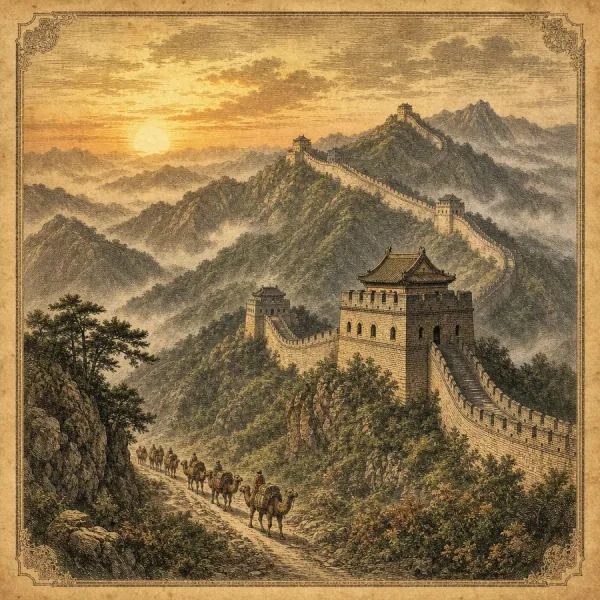
The Great Wall is not a single wall built in one go. It is a vast network of fortifications built, destroyed, and rebuilt many times, in many places, to defend China's northern frontier against the peoples of the steppe. To push back the Xiongnu, the First Emperor sent his general Meng Tian, who began building a great wall. But the details of this project are poorly documented, and historians disagree about how much was actually completed. In popular memory, though, it remains a colossal feat, built through the forced labor of thousands of convicts, soldiers, and peasants.
The wall visitors see today dates mainly from the Ming dynasty (1368–1644). It runs from the Shanhai Pass in Hebei, in the east, to the Jiayu Pass in Gansu, in the west. It averages 6 to 7 meters in height and 4 to 5 meters in width. In 2012, China's heritage administration estimated the total length of all the Great Walls, including ruined sections, at roughly 21,196 kilometers. It has been a UNESCO World Heritage Site since 1987.
Contrary to popular belief, the Great Wall is not visible to the naked eye from the Moon. It has been photographed from near space, but only with instruments far more precise than the human eye.
🗿 An Army for Eternity
In March 1974, farmers digging a well near the city of Xi'an uncovered fragments of statues. They had just discovered the Terracotta Army, buried in pits near the First Emperor's mausoleum around 210–209 BC to protect the dead emperor. By 2007, archaeologists estimated that the three main pits held more than 8,000 soldiers, 130 chariots drawn by 520 horses, and 150 cavalry horses. Infantrymen, cavalry, and generals almost all have a different face, and their height varies with rank. Statues of officials, acrobats, and musicians have also been found.
💧 The Mysterious Tomb
A century after the emperor's death, the historian Sima Qian described a fabulous tomb: palaces, treasures, a map of the empire on the floor, a reproduction of the night sky on the ceiling, and a hundred rivers flowing with mercury. Modern soil analysis of the burial mound has revealed unusually high mercury concentrations, which tends to confirm his account. The tomb itself has never been excavated, partly to preserve what lies inside.
The rest of the course
This page publishes the first 2 parts. The full course has 8: here is what the next ones cover.
- 🐫 The Han and the Silk Road
The Han dynasty (206 BC – 220 AD): founded by Liu Bang, Western and Eastern Han, the reign of Emperor Wu, Confucianism as state doctrine, Zhang Qian's mission, the opening of the Silk Road and the exchange of goods, techniques, and religions, then decline.
- 📜 Confucius and the Imperial Examinations
Confucianism (Confucius, benevolence, ritual, filial piety), which became state doctrine under the Han, and the imperial examination system that recruited officials by merit from the Sui dynasty until its abolition in 1905.
- 💡 Paper, Printing, the Compass, and Gunpowder
China's “Four Great Inventions”: paper (Cai Lun, 105 AD), printing (woodblock printing, the Diamond Sutra of 868, Bi Sheng's movable type), the compass (the magnetized needle under the Song), and gunpowder (9th-century alchemists), along with the Song dynasty's paper money.
- 🏮 Tang and Song, the Golden Ages
Reunification under the Sui, the cosmopolitan and brilliant Tang dynasty (618–907; Chang'an, Wu Zetian, the poets Li Bai and Du Fu, the An Lushan rebellion), then the prosperous, inventive Song dynasty (960–1279), Northern and Southern Song, up to the Mongol conquest.
- ⛵ From the Mongols to the Ming: Zheng He and the Forbidden City
The Mongol Yuan dynasty (1271–1368), founded by Kublai Khan, then the Ming dynasty (1368–1644): Hongwu, Emperor Yongle and the move of the capital to Beijing, the Forbidden City, Zheng He's seven great sea voyages, and the Ming's fall in 1644.
- 🏯 The Qing and the End of the Empire
The last dynasty, Manchu (1644–1912): its height under Kangxi and Qianlong, then 19th-century decline (the Opium Wars, unequal treaties, the Taiping Rebellion, defeat by Japan, the Boxers), the 1911 Revolution, and Puyi's abdication in 1912.
Study “Imperial China” with flashcards and quizzes
In Oria, you read the full course, then practice on it: flashcards, multiple-choice quizzes, open questions or the Feynman method. Cards and questions then come back in your daily review, paced by spaced repetition.
Study this topic in OriaSources
These notes draw on the sources below. If a point seems doubtful, refer back to them.