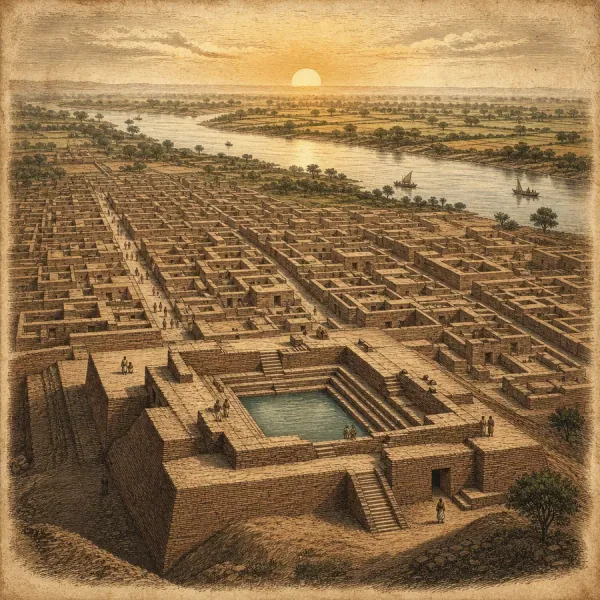
Civilizations
The Indus Valley Civilization: Summary and Study Notes
Harappa, Mohenjo-daro and the script no one can read
Study this topic in OriaThe essentials
4,500 years ago, on the plains of present-day Pakistan and northwestern India, the largest civilization of the Bronze Age flourished. Its cities, such as Harappa and Mohenjo-daro, had straight streets, wells everywhere and covered drains, but no visible palaces or royal tombs. You'll discover how it arose, how people lived and traded as far as Mesopotamia, what we know (and don't know) about its script and its gods, and why its cities emptied out after 1900 BC.
Key dates and facts
- c. 3300 BC
- Start of the Early Harappan phase
- c. 2600 BC
- Rise of the great cities of the mature phase
- c. 1900 BC
- Start of urban decline
- 1924
- John Marshall announces its rediscovery
- c. 1900 BC
- First signs of urban decline
- c. 1700 BC
- Most of the great cities are abandoned
- 1980
- Mohenjo-daro becomes a World Heritage site
- 2021
- Dholavira becomes a World Heritage site
🗺️ The largest civilization of the Bronze Age
The Indus Valley Civilization, also called the Harappan civilization after the city of Harappa, was a Bronze Age civilization that developed in northwestern South Asia. Its successive phases run from about 3300 to 1300 BC, and its most brilliant period, known as the mature phase, from about 2600 to 1900 BC. Along with ancient Egypt, Mesopotamia and China, it ranks among the great centers of antiquity, and its territory was larger than those of Egypt and Mesopotamia combined.
🌊 Between two river systems
It stretched across much of present-day Pakistan, northwestern India and northeastern Afghanistan: from Balochistan in the west to the outskirts of Delhi in the east, and from the site of Shortughai, in Afghanistan, to Maharashtra in the south. Its heartland was the alluvial plain of the Indus and its tributaries, but also that of a second, monsoon-fed river system, now reduced to a seasonal river: the Ghaggar-Hakra. Some authors identify it with the Sarasvati of the Vedic hymns and speak of an “Indus-Sarasvati civilization,” an identification challenged by recent geophysical research.
🏙️ A thousand sites, five great cities
More than a thousand sites from the mature phase have been identified, about a hundred of them excavated, now divided between Pakistan and India. Only five are very large cities of more than 80 hectares: Mohenjo-daro and Harappa in Pakistan, Ganweriwala in the Cholistan Desert, and Dholavira and Rakhigarhi in India. Mohenjo-daro and Harappa probably each had between 30,000 and 60,000 inhabitants, and the civilization as a whole between one and five million people, depending on the estimate.
❓ A civilization full of mysteries
Unlike Egypt or Mesopotamia, we cannot read what the people of the Indus wrote: their script has never been deciphered, and their language remains unknown. Everything we know comes from archaeology: cities, objects, skeletons. That is why many questions remain open, starting with this one: who governed these cities, and how?
🔦 Forgotten for millennia, found again in 1924
After it disappeared, the Indus Valley Civilization was completely forgotten: no ancient text describes it, and no one remembered its cities. It would only reappear during the British colonial period.
🧱 Bricks under the rails
In 1829, Charles Masson, a deserter from the East India Company's army, traveled through Punjab and described the ruins of Harappa, which he published in 1842, wrongly believing them linked to the campaigns of Alexander the Great. But the site suffered: after the British annexed Punjab in 1848–1849, its fired bricks were carted away in bulk to serve as ballast for railroad tracks. Nearly 160 kilometers of track between Multan and Lahore, laid in the mid-1850s, rest on Harappan bricks. In 1875, Alexander Cunningham, the first director of the Archaeological Survey of India, founded in 1861, published a seal from Harappa bearing an unknown script, without suspecting its real age.
📰 The 1924 announcement
In the early 20th century, the new director of the Archaeological Survey, John Marshall, revived the research. Daya Ram Sahni excavated Harappa, while in 1919–1920 R. D. Banerji spotted at Mohenjo-daro, in Sindh, remains far older than the Buddhist stupa that stands there. The seals and the script of the two sites looked alike. Convinced, Marshall made a public announcement in the Illustrated London News on September 24, 1924. Archaeologists, he wrote, had rarely been given the chance, as Schliemann had been at Tiryns and Mycenae or Stein in the deserts of Turkestan, to bring to light the remains of a long-forgotten civilization.
“It looks, however, at this moment, as if we were on the threshold of such a discovery in the plains of the Indus.”
John Marshall, Illustrated London News (September 24, 1924)
A week later, the British Assyriologist Archibald Sayce pointed out very similar seals found in Mesopotamia and Iran in Bronze Age layers: the Indus Valley Civilization was therefore contemporary with Sumer. Excavations at Mohenjo-daro continued until 1931, then under Mortimer Wheeler in the 1940s.
✂️ Split in two by partition
In 1947, the partition of India placed most of the major excavated sites in Pakistan. The 12,000 or so objects from Mohenjo-daro were divided equally between the two countries, to the point that some necklaces were split bead by bead. Pakistan received the statuette known as the “Priest-King,” India the small bronze “Dancing Girl.” Indian archaeologists then actively explored the sites on their own territory, especially along the Ghaggar-Hakra and in Gujarat, and foreign teams (French, German, Italian, American) carried out many excavations in Pakistan.
The rest of the course
This page publishes the first 2 parts. The full course has 9: here is what the next ones cover.
- 🌾 From Mehrgarh to the first cities
The origins of the Indus Valley Civilization: the Neolithic farming of Mehrgarh in Balochistan, local domestication, the cultures of the early phase (Ravi, Kot Diji) and the appearance of the first walled settlements.
- 🧱 Cities laid out on a grid
Harappan town planning: grid layout, citadel and lower town, standardized bricks, courtyard houses, and mastery of water (wells, covered drains, the Great Bath of Mohenjo-daro, the reservoirs of Dholavira, the basin at Lothal).
- ⚖️ Farmers, craftsmen and the merchants of Meluhha
The Harappan economy: two harvests a year, zebu and buffalo herding, luxury crafts (carnelian beads, faience, seals), standardized weights and trade with Afghanistan, the Persian Gulf and Mesopotamia (Meluhha).
- 🔣 A script no one can read
The Indus script: seals and inscriptions, number of signs, length of texts, reading direction, why decipherment has failed, and hypotheses about the language (Dravidian, Indo-European, a non-linguistic system).
- 🐂 Gods without temples?
Harappan religion: the so-called Pashupati seal and the debate over a “proto-Shiva,” the female figurines, the absence of any identified temple, the Great Bath as a place of purification, the “fire altars” and funeral practices.
- 🕊️ Who was in charge? A society without visible kings
The political and social organization of the Indus: no palaces or royal tombs, the hypotheses of a single state or of city-states, the debate over a peaceful society, and the “Priest-King” and “Dancing Girl” statuettes.
- 🍂 The slow decline and what remains
The end of the Harappan cities after 1900 BC: gradual abandonment, late regional cultures, the rejection of the Aryan invasion theory, the role of droughts (2025 study) and of trade, then genetic and cultural legacies and the state of the sites today.
Study “The Indus Valley Civilization” with flashcards and quizzes
In Oria, you read the full course, then practice on it: flashcards, multiple-choice quizzes, open questions or the Feynman method. Cards and questions then come back in your daily review, paced by spaced repetition.
Study this topic in OriaSources
These notes draw on the sources below. If a point seems doubtful, refer back to them.