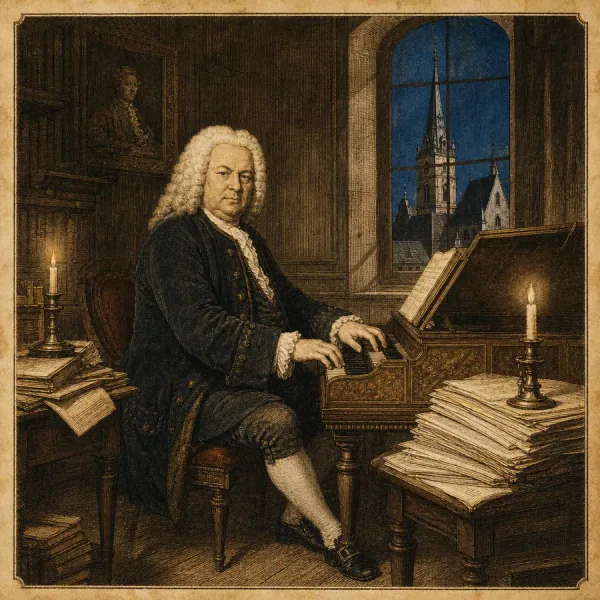
Arts
Johann Sebastian Bach: Biography and Study Notes
The Leipzig cantor, supreme master of counterpoint
Study this topic in OriaThe essentials
Born in 1685 into a dynasty of musicians in Thuringia, Johann Sebastian Bach never left central Germany and spent his life serving small courts and a town council that considered him mediocre. Yet his cantatas, Passions, fugues and suites stand among the summits of Western music. You'll follow his life from Eisenach to Leipzig, understand how a fugue and counterpoint work, and see how a composer who had gone out of fashion became, a century later, a universal reference.
Key dates and facts
- 1685
- Born in Eisenach
- 1694
- Death of his mother
- 1695
- Death of his father, move to Ohrdruf
- 1700
- Pupil in Lüneburg
- 1723
- Cantor in Leipzig
- 1724
- St John Passion
- 1727
- St Matthew Passion
- 1736
- Court composer to Saxony
- 1741
- Goldberg Variations
- 1747
- Visit to Frederick the Great, The Musical Offering
🕯️ A family of musicians in Thuringia
Johann Sebastian Bach was born in Eisenach, capital of the small duchy of Saxe-Eisenach, in present-day Germany, on March 21, 1685, according to the Julian calendar then used in Protestant Germany, or March 31 according to the Gregorian calendar. He was the eighth and last child of Johann Ambrosius Bach, court trumpeter and director of the town musicians, and of Maria Elisabeth Lämmerhirt, the daughter of a town councillor. He was baptized into the Lutheran faith at St. George's Church.
🎺 A dynasty of musicians
To be born a Bach in Thuringia was almost to be born a musician. For several generations, the family had supplied the whole region with organists, court, town and church musicians, cantors and instrument makers. The earliest known ancestor, Veit Bach, a miller and cittern player who died in 1619, is said to have come from Hungary or Slovakia to practice his Protestant faith freely. Later, Johann Sebastian himself probably drew up a genealogy, the “Origin of the Musical Bach Family,” which lists fifty-three musicians of his blood. In this world, a boy's destiny seemed mapped out: learn from his father, an uncle or an elder brother, then take over.
His father probably taught him the violin and the basics of music, and from the age of eight the boy attended the Latin school in Eisenach. Beyond that, very little is known for certain about his early years.
💔 Orphaned at ten
His mother died in 1694; he was nine. His father remarried a few months later, then died in turn in February 1695. Orphaned at ten, Johann Sebastian was taken in by his eldest brother, Johann Christoph, organist in Ohrdruf, about fifty kilometers (30 miles) away. A former pupil of the famous Johann Pachelbel, Johann Christoph trained his younger brother on keyboard instruments and introduced him to the music of the great German, French and Italian composers of the day.
At the Ohrdruf lyceum, the boy studied theology, Latin and Greek, and sang in a choir to help with the family's income. Above all, he copied scores relentlessly in order to study them, sometimes despite his brother's ban: manuscript scores were precious possessions at the time, and ruled paper was expensive. This passion for learning by copying, imitating and correcting others would remain one of the most striking traits of his character.
🚶 Off to Lüneburg
In the spring of 1700, at fifteen, he left Ohrdruf with his friend Georg Erdmann for St. Michael's School in Lüneburg, in northern Germany, which took in poor boys with fine voices. The journey, more than 300 kilometers (nearly 200 miles), was probably made largely on foot. His departure also relieved his brother, now married with a family, of the cost of his keep.
🎶 Lüneburg, Arnstadt, Lübeck: the years of apprenticeship
At St. Michael's School in Lüneburg, where he arrived in 1700, the young Johann Sebastian Bach sang in the choir until his voice broke, then turned to the organ, the harpsichord and the violin. He also studied rhetoric, Latin, Greek and French there, and had access to a rich music library.
🌍 Three musical traditions
These years opened up Europe's great traditions to him. He got to know Georg Böhm, organist of St. John's Church, who introduced him to the style of the North German organists. In Lüneburg and at the nearby court of Celle, he mixed with émigré French musicians and discovered the music of Lully and François Couperin. In 1701, he traveled to Hamburg to hear Johann Adam Reinken, one of the greatest organists of the time. German by training, he thus absorbed French and later Italian manners very early on: his whole output would be a synthesis of these three traditions.
⛪ Organist at eighteen
His studies over, he failed in 1702 to win the post of organist in Sangerhausen, where the duke imposed another candidate. In early 1703, he joined the court of Weimar as a musician, a modest job that may have included a lackey's duties. Within seven months, his reputation as a keyboard player grew so fast that he was invited to inspect and inaugurate the new organ of the New Church in Arnstadt. In August 1703, at eighteen, he became its organist: light duties, a decent salary and a modern instrument.
Yet the young man was anything but a docile employee. He was unhappy with the choir, and a dispute with a bassoonist, Johann Heinrich Geyersbach, ended in a brawl.
🥾 The journey to Lübeck
In 1705, he was granted four weeks' leave to go to Lübeck to hear Dietrich Buxtehude, the most famous organist in northern Germany, and his celebrated “evening concerts.” The journey, more than 400 kilometers (250 miles), was reportedly made on foot. He came back only four months later, in January 1706. On his return, the Arnstadt consistory criticized him for his absence, but also for his new way of accompanying the congregation's hymns, with counterpoint so rich that the melody could no longer be recognized:
“How is it, sir, that since your return from Lübeck you have been introducing into your improvisations, which are much too long besides, modulations such that the congregation is greatly confused by them?”
Arnstadt consistory (1706), after Gilles Cantagrel, Bach en son temps (translated)
He was also reproached for having made music in the church with a “strange maiden”: his cousin Maria Barbara Bach, whom he would soon marry. Bach was already looking for another post.
The rest of the course
This page publishes the first 2 parts. The full course has 8: here is what the next ones cover.
- 🎹 Mühlhausen and Weimar: master of the organ
His marriage to Maria Barbara, his first cantatas in Mühlhausen, his years as organist and Konzertmeister in Weimar, the influence of Vivaldi, and his imprisonment in 1717.
- 🎻 Köthen: the years of secular music
As Kapellmeister to a Calvinist prince in Köthen, Bach composed his great instrumental works, lost his first wife, married Anna Magdalena, and prepared his move to Leipzig.
- ⛪ Cantor in Leipzig
His hiring in Leipzig in 1723 as a fallback choice, the cantata cycles, the Passions, the Collegium Musicum at Zimmermann's coffee house, and his constant conflicts with the town council.
- 🧩 Bach's language: counterpoint and fugue
What makes Bach's style: his synthesis of European styles, counterpoint, how a fugue works, the twenty-four keys of The Well-Tempered Clavier, the B-A-C-H motif, and his Lutheran faith.
- 👑 The king, blindness and The Art of Fugue
His last ten years: the Goldberg Variations, his visit to Frederick the Great and The Musical Offering, The Art of Fugue and the Mass in B minor, his eye operations, and his death in 1750.
- 🌍 Oblivion, then glory
The decline of Bach's reputation after 1750, the fame of his sons, his rediscovery by Mozart and Beethoven, the revival launched by Mendelssohn in 1829, and his worldwide standing in the 20th century.
Study “Johann Sebastian Bach” with flashcards and quizzes
In Oria, you read the full course, then practice on it: flashcards, multiple-choice quizzes, open questions or the Feynman method. Cards and questions then come back in your daily review, paced by spaced repetition.
Study this topic in OriaSources
These notes draw on the sources below. If a point seems doubtful, refer back to them.