Classic novels
Les Misérables by Victor Hugo: Summary and Study Notes
Jean Valjean, from the galleys to redemption
Study this topic in OriaThe essentials
Begun in Paris in 1845, finished in exile on Guernsey, and published in 1862, Les Misérables follows Jean Valjean, a former convict turned benefactor, hunted for years by Inspector Javert. Around him orbit Fantine, Cosette, Marius, the Thénardiers, and Gavroche, all the way to the barricades of June 1832. You'll discover the novel's genesis, its plot part by part, its great characters, its themes, and its immense legacy.
Key dates and facts
- 1845
- Hugo begins Les Misères
- 1851
- Coup d'état and the start of exile
- Dec. 30, 1860
- Resumes the manuscript on Guernsey
- April 3, 1862
- Publication in Paris
- June 18, 1815
- Battle of Waterloo
- June 5, 1832
- The insurrection begins
- June 6, 1832
- The barricade falls
🖋️ From Paris to Guernsey: a long genesis
Les Misérables is a novel by Victor Hugo published in 1862, one of the largest and most famous novels of the 19th century. In five parts, it tells the life of the convict Jean Valjean, from his release from the galleys in 1815 to his death, amid a crowd of poor characters crushed or threatened by misery. It is at once a historical novel, a social novel, and a philosophical novel.
⚖️ A writer against the death penalty
The subject had occupied Hugo for a long time. In 1829, he published The Last Day of a Condemned Man, a long monologue that is an indictment of the death penalty, followed by Claude Gueux in 1834. In 1839, he visited the Toulon prison hulks and took extensive notes there. On one page, he wrote in large letters a possible name for his future hero: "JEAN TRÉJEAN." Tréjean would become Valjean.
📓 "Les Misères" (1845 – 1848)
Hugo began writing in 1845, the year he was made a peer of France. The book was then called Les Misères. The novelist drew on what he saw and jotted down in his notebooks. In January 1841, he had defended a prostitute unjustly dragged to the police station: the scene would feed into Fantine's story. On February 22, 1846, he saw two gendarmes leading away a man accused of stealing a loaf of bread; he wrote that this man "was no longer, to me, a man, he was the specter of misery." In December of that same year, a dispute between an old woman and a street urchin gave him a glimpse of Gavroche. He visited the Conciergerie, inquired into wages and the cost of living for the working class, and asked Léonie d'Aunet and Juliette Drouet to describe convent life to him. The February 1848 revolution interrupted the work.
🏝️ Exile and resumption
After Louis-Napoléon Bonaparte's coup of December 2, 1851, Hugo tried in vain to organize resistance, then left for Brussels on December 11: the start of a nineteen-year exile. After three years on Jersey, he settled in 1855 on the neighboring island of Guernsey, where he bought Hauteville House in 1856. In 1859, he refused the amnesty offered by Napoleon III. After Contemplations (1856) and The Legend of the Ages (1859), he finally reopened his manuscript, noting on the page where he had stopped:
"February 14. Here the peer of France broke off, and the exile resumed it: December 30, 1860. Guernsey."
Victor Hugo, manuscript of Les Misérables (1860), translated
In 1860 and 1861, Hugo devoted himself almost entirely to the novel. In May 1861, he traveled to the battlefield of Waterloo to "confront legend with reality," and it was there that he finished his story. In June, he told his son François-Victor that he was done, adding: "I can die now."
📚 An extraordinary launch
The Belgian publisher Albert Lacroix bet everything on this book and had a colossal budget. Hugo refused serial publication but insisted on a cheap format so the book would remain affordable. The first part appeared on March 30, 1862, in Brussels and on April 3 in Paris, backed by heavy advertising; parts two and three followed on May 15, the last two on June 30.
🕯️ Jean Valjean and Bishop Myriel
The novel opens in 1815, not on its hero, but on the Bishop of Digne, Monseigneur Myriel. Hugo devotes the entire first book, titled "A Just Man," to him, and does not introduce Jean Valjean until fourteen chapters in. This choice says everything: it is this man's goodness that will turn the convict's life around.
⛪ Monseigneur Bienvenu
Myriel lives in voluntary poverty. Finding the town hospital too small, he trades it for his own episcopal palace: the next day, the twenty-six patients move into the bishop's residence, and the bishop moves to the hospital. His parishioners nickname him Monseigneur Bienvenu ("Monseigneur Welcome"), which pleases him: "Bienvenu corrects Monseigneur," he says. For Hugo, he embodies Christian charity. The character is modeled on Bishop de Miollis, the real Bishop of Digne at the time.
⛓️ Nineteen years in the galleys
Jean Valjean is a poor peasant from Faverolles, in the Aisne. To feed his sister's seven starving children, he stole a loaf of bread: five years in the galleys. His escape attempts lengthened his sentence, and he spent a total of nineteen years at the Toulon prison. In October 1815, he is released. For those nineteen years of labor, the administration pays him 109 francs and fifteen sous. His yellow passport marks him to everyone as a former convict: in Digne, innkeepers turn him away one after another, and he is about to sleep in the street, full of rage.
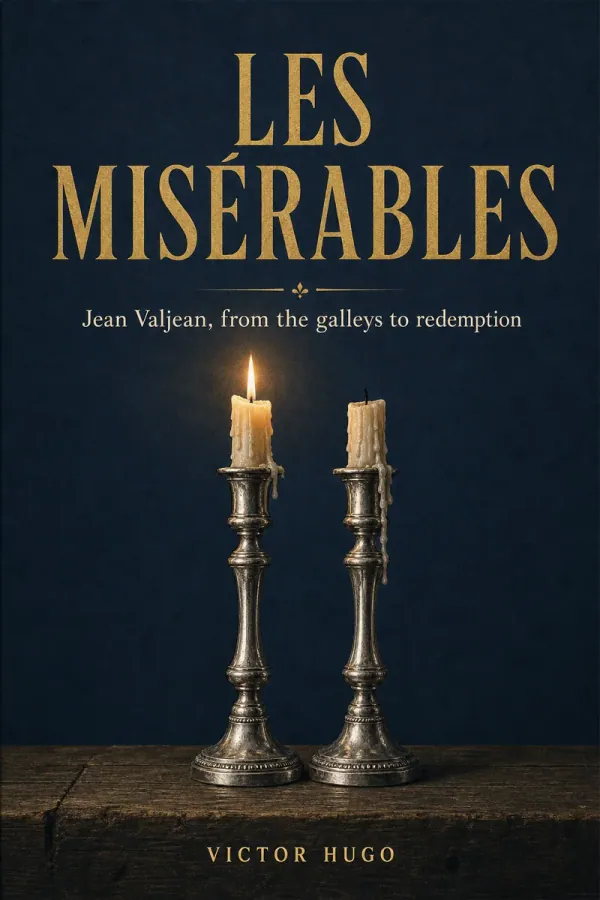
🕯️ The silver candlesticks
Myriel welcomes him to his table and offers him a bed. In the night, Valjean flees with the bishop's silverware. Caught by the gendarmes, he is brought back to the bishop's residence. Myriel then claims he had given him the silverware, and even scolds him for forgetting the two silver candlesticks, which he hands over to him. The gendarmes leave. Before letting him go, the bishop tells him:
"Jean Valjean, my brother, you no longer belong to evil, but to good. It is your soul that I buy from you; I withdraw it from black thoughts and the spirit of perdition, and I give it to God."
Victor Hugo, Les Misérables, I, Book 2, "The Bishop Works" (1862), trans. Isabel F. Hapgood
🪙 Petit-Gervais's coin
Shaken, Valjean turns the bishop's words over in his mind. A twelve-year-old Savoyard boy, Petit-Gervais, drops a forty-sou coin; out of old habit, Valjean puts his foot on it and chases the child away. He repents at once and searches for him everywhere, in vain. But the theft is reported: as a repeat offender, he now risks life imprisonment. He disappears.
🏭 Monsieur Madeleine
A few years later, a man named Monsieur Madeleine has made the fortune of Montreuil-sur-Mer by improving the manufacture of black glassware. He builds two factories, becomes one of the wealthiest men in the region, performs countless good deeds, and is eventually made mayor. It is Jean Valjean. One day, he single-handedly lifts a cart under which old Fauchelevent is trapped. The town's policeman, Javert, a former guard at the Toulon prison, has known only one man capable of such a feat: the convict Jean Valjean.
🌪️ A tempest within a skull
Javert eventually denounces the mayor, but learns that the "real" Valjean has been arrested: a vagrant, Champmathieu, caught stealing apples, whom former convicts believed they recognized. For Valjean begins a night of inner struggle, told in the chapter "A Tempest Within a Skull": stay silent and keep his honest life, or turn himself in to save an innocent man? Hugo writes there that "there is a spectacle greater than the sea, and that is the sky; there is a spectacle greater than the sky, and that is the inner depths of the soul." Valjean finally goes to the trial and reveals who he is, to save the innocent man.
The rest of the course
This page publishes the first 2 parts. The full course has 9: here is what the next ones cover.
- 🌹 Fantine and Cosette
Fantine's downfall (abandonment, dismissal, selling her hair and teeth, prostitution, death), Cosette's tormented childhood with the Thénardiers, Valjean buying her freedom at Montfermeil, and their refuge at the Petit-Picpus convent.
- 👮 Javert, the man of the law
The character of Javert: his origins, his unbending view of the law, his pursuit of Valjean from Montreuil-sur-Mer to the barricades, the mercy Valjean shows him, and his suicide in the Seine.
- 🧱 Marius and the barricades of 1832
The third and fourth parts: Marius caught between his royalist grandfather and his Bonapartist father, the Friends of the ABC, his love for Cosette, the Thénardier ambush, the idyll on the rue Plumet, and the insurrection of June 5–6, 1832.
- 🐦 Gavroche, street kid of Paris
Gavroche, the Thénardiers' abandoned son: his life on the street and inside the Bastille elephant, his role at the barricade, his death singing on June 6, 1832, and the birth of "gavroche" as a common noun.
- 🌒 The sewers, the wedding, and Valjean's death
The fifth part: Valjean saves Marius and carries him through the sewers, the marriage of Marius and Cosette, Valjean's confession, his withdrawal, Thénardier's revelation, and the hero's death.
- ⚖️ Misery, justice, and redemption
The novel's major themes: its social plea against misery, its critique of "the crime of the law," redemption through goodness, love, history, and the famous digressions.
- 🎬 Reception and adaptations
The 1862 reception, caught between harsh criticism and popular triumph, the novel's spread around the world, its main film, television, and stage adaptations, and its sequels.
Study “Les Misérables” with flashcards and quizzes
In Oria, you read the full course, then practice on it: flashcards, multiple-choice quizzes, open questions or the Feynman method. Cards and questions then come back in your daily review, paced by spaced repetition.
Study this topic in OriaSources
These notes draw on the sources below. If a point seems doubtful, refer back to them.