Classic novels
Madame Bovary by Gustave Flaubert: Summary and Study Notes
Emma, provincial boredom and the dream that kills
Study this topic in OriaThe essentials
Written over five years by Gustave Flaubert and published in 1857 after a sensational trial, Madame Bovary tells the story of Emma, wife of a modest Norman country doctor, who dreams of a life as glittering as those of the heroines in her books. Boredom, adulteries, debt and arsenic: the novel follows her downfall to the very end, under the satisfied gaze of the pharmacist Homais. You'll discover the book's genesis, its plot step by step, its great characters, Flaubert's revolutionary style, the 1857 trial, and the word 'bovarysme'.
Key dates and facts
- 12 Dec 1821
- Flaubert born in Rouen
- 19 Sep 1851
- Writing begins
- 1856
- Novel finished, serialized in the Revue de Paris
- Apr 1857
- Published in book form by Michel Lévy
- 1 Oct 1856
- Serialization begins in the Revue de Paris
- 29 Jan 1857
- Trial before the criminal court
- 7 Feb 1857
- Flaubert's acquittal
- 15 Apr 1857
- Published in two volumes
🖋️ Five years of work for a news item
Madame Bovary is the first published novel by Gustave Flaubert, born in Rouen on 12 December 1821. His father, Achille-Cléophas Flaubert, was chief surgeon at the Hôtel-Dieu hospital in Rouen: the future novelist grew up in the hospital's staff apartment, surrounded by doctors. He began law studies in Paris in 1841, without much enthusiasm, then abandoned them in January 1844 after a first serious epileptic seizure. He then devoted himself entirely to writing, at the family home in Croisset, on the banks of the Seine near Rouen.
📰 A Norman news item
In 1849, Flaubert finished a first version of The Temptation of Saint Anthony. It failed to convince his friends, and he abandoned plans to publish it. His friend the poet Louis Bouilhet advised him to pick a down-to-earth subject, a real-life news story: the case of Delphine Delamare. The wife of Eugène Delamare, a former student of Flaubert's father who had become a country doctor in Ry, Normandy, she had led a flat, unremarkable life that left her deeply frustrated, until her suicide by arsenic in 1848. Flaubert took up this ordinary fate while aiming much wider: in a line often attributed to him, his poor Bovary suffers and weeps in twenty villages across France.
⏳ The writing of a galley slave
Flaubert first mentions the project on 23 July 1851, sketches his plans over the summer, and begins writing on 19 September 1851. He proceeds at an extremely slow pace. The chapter on the agricultural show alone takes him three months; he studies the theory of club feet for a botched operation and researches arsenic poisoning. He complains constantly in his letters:
"It's too much for one man, 500 pages to write like this; and when you're only at page 240 and the action has barely begun!"
Gustave Flaubert, letter of 26 April 1853 (translated)
He finished the novel in the spring of 1856, after nearly five years of work. He had filled roughly 4,000 pages of drafts and manuscripts, now held at the Rouen library. Even the famous opening sentence was only written at the last moment, just before publication.
📖 "Provincial Manners"
The full title is Madame Bovary: Provincial Manners. This subtitle is a nod to Balzac, echoing the categories of The Human Comedy; Balzac had in fact already explored a similar subject in A Woman of Thirty. The novel first appeared as a serial in the Revue de Paris, from 1 October to 15 December 1856, in six instalments, before landing its author in court.
💍 Emma and Charles
The novel does not begin with Emma, but with her future husband. The opening sentence drops the reader into a classroom: a new pupil arrives, "dressed like a townsman", awkward and ridiculous. Told to say his name louder, he blurts it out in one breath, "Charbovari", and the whole class starts shouting it back. This ridiculous boy is Charles Bovary.
🩺 Charles, the country doctor
Charles struggles through his medical studies and only ever becomes an officier de santé, a second-tier doctor allowed to practise without the title of physician. His mother marries him off to a forty-five-year-old widow, Héloïse Dubuc, plain and sour-faced, believed to be wealthy. He settles in Tostes, Normandy. One day, he is called to a farm to treat old Rouault's broken leg. There he meets Rouault's daughter, Emma, and falls under her spell. When Héloïse dies, revealing she had no fortune after all, Charles waits a decent interval, then asks for Emma's hand. Her father agrees.
📚 Emma, raised on novels
Emma was sent to a convent around the age of thirteen. There she fed her imagination on books: Paul et Virginie, pious works, then, at fifteen, sentimental novels smuggled in by an old laundress. With Walter Scott, she dreams of manor houses, chatelaines and plume-helmeted horsemen; she worships Mary Stuart. Flaubert sums up these novels with irony: stories of lovers, persecuted ladies, vows, sobs and kisses by moonlight. Emma expects from life exactly what her books promised her.
🕯️ A disappointing marriage
The marriage soon turns disappointing. Charles is kind, devoted, in love, but his conversation, Flaubert writes, is "as flat as a pavement". Emma finds in him none of the passions of her reading. An invitation to the Marquis d'Andervilliers's ball, at the château of Vaubyessard, gives her a glimpse of an aristocratic, luxurious world, where she dances with a viscount. She will never belong to it. Back in Tostes, she counts the weeks, hoping for another ball that never comes.
"But her life was as cold as an attic facing north, and boredom, a silent spider, was spinning its web in the shadows in every corner of her heart."
Gustave Flaubert, Madame Bovary, I, 7 (1857) (translated)
🚚 The move to Yonville
Emma sinks into a depression. Charles, who was just beginning to build up a practice, realizes she needs a change. He decides to leave Tostes for a livelier town, Yonville-l'Abbaye. Emma is pregnant by then. The story unfolds under the July Monarchy, between 1830 and 1848, though Flaubert writes it under the Second Empire.
The rest of the course
This page publishes the first 2 parts. The full course has 9: here is what the next ones cover.
- 🏘️ Yonville-l'Abbaye and Léon
The Norman town where the Bovarys settle, its inhabitants, the birth of Berthe, Emma's platonic love for Léon, and Hippolyte's botched operation.
- 🍑 Rodolphe, from the agricultural show to the apricots
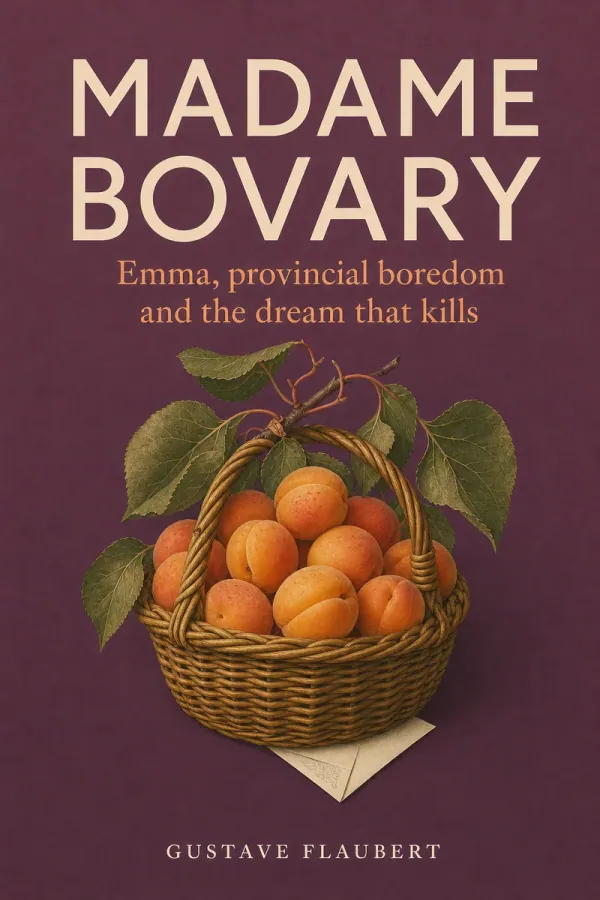
Emma's affair with Rodolphe Boulanger, from the agricultural-show scene to the breakup letter hidden in a basket of apricots.
- 🎭 Léon, Rouen and ruin
The reunion with Léon at the Rouen opera, their affair in the city, the cab scene, and the spiral of debt at Lheureux's shop.
- ⚰️ The arsenic and the end of the Bovarys
Emma's suicide by arsenic, her agony, Charles's despair, his death, and the fate of their daughter Berthe.
- 💊 Homais, the triumph of the pharmacist
The pharmacist Homais, a caricature of the vain, scientism-obsessed bourgeois, who prospers once every Bovary has fallen.
- ✍️ Flaubert's style
Flaubert's realism, his impersonality, his use of free indirect discourse and the imperfect tense, and why the novel changed the history of the genre.
- ⚖️ The 1857 trial and bovarysme
The trial for offending public morals, Flaubert's acquittal, the book's success, its reception, and the birth of the word 'bovarysme'.
Study “Madame Bovary” with flashcards and quizzes
In Oria, you read the full course, then practice on it: flashcards, multiple-choice quizzes, open questions or the Feynman method. Cards and questions then come back in your daily review, paced by spaced repetition.
Study this topic in OriaSources
These notes draw on the sources below. If a point seems doubtful, refer back to them.