Classic novels
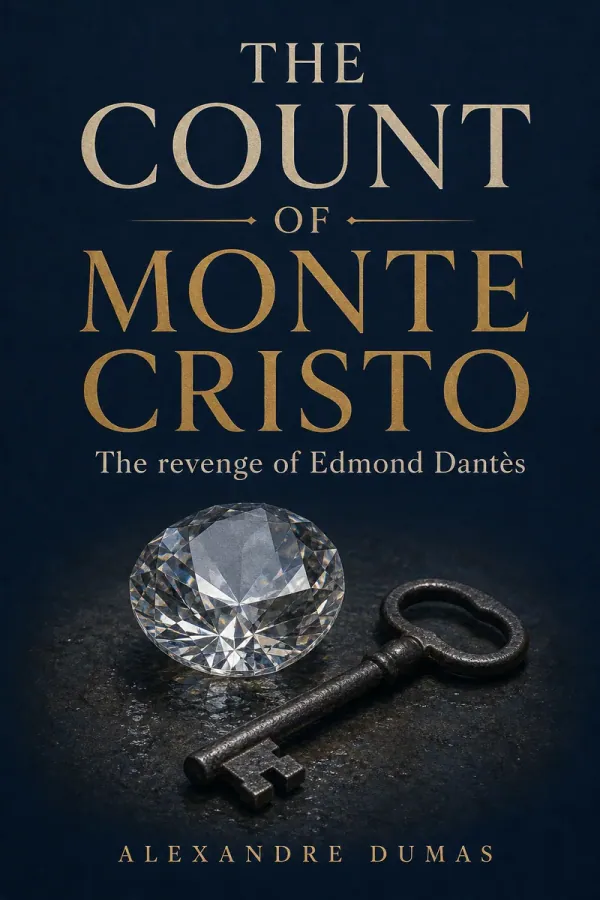
The Count of Monte Cristo by Alexandre Dumas: Summary and Study Notes
The revenge of Edmond Dantès
Study this topic in OriaThe essentials
Serialized from 1844 to 1846, The Count of Monte Cristo is, along with The Three Musketeers, Alexandre Dumas's most famous novel. A young sailor betrayed by his "friends" spends fourteen years in the Château d'If, escapes with the help of the Abbé Faria, and returns immensely wealthy to punish his enemies. You'll discover how the book came to be written, its plot part by part, its characters, its major themes, and its enormous afterlife.
Key dates and facts
- 1838
- Peuchet's anecdote is published
- 1843
- Dumas and Maquet work out the plot
- Aug. 28, 1844
- The serial begins
- Jan. 15, 1846
- The last installment
- 6 years
- Alone in his cell
- 8 years
- Pupil of the Abbé Faria
- 34
- His prisoner number
- 1829
- Faria's death and the escape
🖋️ A serial born of a true story
The Count of Monte Cristo is a novel by Alexandre Dumas, written with the collaboration of Auguste Maquet and published in serial form from 1844 to 1846. Along with The Three Musketeers, it is Dumas's best-known work, in France and abroad. It tells how Edmond Dantès, a young sailor unjustly imprisoned, escapes, becomes immensely rich, and takes revenge on those who betrayed him.
✍️ Dumas in 1844
Born in 1802, Dumas was already a celebrated writer. His father, General Thomas-Alexandre Dumas, the son of an enslaved Black woman from Saint-Domingue, had enjoyed a brilliant career during the Revolution before being sidelined from the army under Bonaparte — which makes the novelist's own ties to Bonapartism somewhat ambiguous. The year 1844 brought him one triumph after another: The Three Musketeers ran in Le Siècle from March 14 to July 14, and Monte Cristo began in the Journal des débats on August 28.
🏝️ An island and a promise
In a short piece, État civil du Comte de Monte-Cristo, Dumas told the story behind the title. In the early 1840s he was living in Florence and mixing with the Bonaparte family. He joined a young prince, a nephew of Napoleon, on a boat trip around the island of Elba, then on to the small island of Montecristo, which they were content simply to sail around. When the prince asked what the point was of going around this little island, Dumas replied that, in memory of the trip, he would one day give the title The Island of Monte Cristo to a novel he would write.
💎 "The Diamond and the Vengeance"
The plot came from elsewhere. Dumas had come across, in memoirs drawn from the Paris police archives and published in 1838 under the name of the archivist Jacques Peuchet, an anecdote titled "The Diamond and the Vengeance." It told how, in 1807, a shoemaker from Nîmes, Pierre Picaud, was falsely denounced as a spy for England by three jealous friends. Held in a fortress, he there served a wealthy Italian clergyman who left him his fortune; once freed, he spent years taking his revenge. This story, almost certainly largely invented, drew a harsh verdict from Dumas:
"As it stood, it was simply idiotic; anyone who doubts this may read it. The fact remains that at the bottom of that oyster there was a pearl — a shapeless pearl, a rough pearl, a pearl of no value whatsoever, but one that was waiting for its lapidary."
Alexandre Dumas, État civil du Comte de Monte-Cristo (translated)
🤝 Dumas and Maquet
Dumas first imagined a kind of travelogue set in Paris: a wealthy lord living in Rome, the Count of Monte Cristo, does a young Frenchman a favor and then asks him to be his guide in Paris, where he is actually searching for his hidden enemies. He wrote about a volume and a half of this before telling Maquet about it. In the final novel, the story begins much earlier, in Marseille, with Dantès's youth and downfall. How much Maquet actually contributed has long been disputed: after Dumas went bankrupt, Maquet sued him to be recognized as co-author, and lost the case in 1858.
📰 A serial success
The novel ran in the Journal des débats in three large installments: from August 28 to October 19, 1844; from October 31 to November 26, 1844; then from June 20, 1845, to January 15, 1846. Bound volumes followed in bookshops, eighteen in all, then an edition illustrated by Gavarni and Tony Johannot in 1846.
⚓ Marseille, 1815: betrayal
The novel opens on February 24, 1815, at the start of the reign of Louis XVIII, just as Napoleon is preparing to leave the island of Elba and seize power again in what will become the Hundred Days. Edmond Dantès, nineteen years old, first mate of the three-masted ship the Pharaon, sails into the port of Marseille.
✉️ A letter from Elba
The ship's captain, Leclère, has died at sea. On his deathbed, he asked Dantès to stop at Elba to deliver a package to Marshal Bertrand, Napoleon's companion in exile. There, the young sailor is entrusted with a letter meant for a Bonapartist in Paris named Noirtier. Dantès, who has little interest in politics, simply follows his dying captain's wishes.
🌅 A bright future
In Marseille, the shipowner Pierre Morrel, who owns the Pharaon, decides to make Dantès captain. The young man is reunited with his old father and his fiancée, Mercédès, a beautiful Catalan woman he is about to marry. Everything is going his way — which is exactly what will undo him.
🐍 Three jealous men
- Danglars, the ship's purser, resents Dantès's promotion, all the more so since Dantès has spotted irregularities in his accounts.
- Fernand Mondego, a Catalan fisherman and Mercédès's cousin, loves her and has been turned down.
- Caderousse, a neighbor of Dantès, is jealous too, but mostly a coward.
On the eve of the wedding, Danglars and Fernand hatch a plot: an anonymous letter denouncing Dantès as a Bonapartist agent. Caderousse, who is present, objects at first, but is soon too drunk to stop it, and the letter reaches the king's prosecutor.
⚖️ Villefort
During the engagement dinner, Dantès is arrested in front of his guests. Caderousse, who knows everything, says nothing. The young man is questioned by Gérard de Villefort, deputy prosecutor in Marseille. The interview goes in his favor at first: Villefort believes him innocent. But on reading the letter from Elba, he discovers it is addressed to Noirtier — his own father. If it became known that his father was a Bonapartist, his career as a royalist magistrate would be ruined. Villefort therefore destroys the letter and, to silence the only witness, has Dantès sent without trial, for life, to a cell in the Château d'If, a fortress built on a small island off Marseille.
On March 20, 1815, Napoleon returns to power. Morrel repeatedly pleads with Villefort to free Dantès, in vain: the magistrate expects the monarchy to return soon. He has, in fact, already made good use of the seized letter, warning the king ahead of everyone else about Napoleon's landing, which gives his own career a boost. Dantès, meanwhile, remains locked away, forgotten by all.
The rest of the course
This page publishes the first 2 parts. The full course has 9: here is what the next ones cover.
- 🏰 The Château d'If and the Abbé Faria
Dantès's fourteen years of captivity: despair, meeting the Abbé Faria, discovering who was guilty, his education, the secret of the treasure, and the escape in the shroud.
- 💎 The treasure and the birth of the count
After the escape: the smugglers, the Spada treasure, buying the title of count, Dantès's various identities, the investigation with Caderousse, and the rescue of Morrel.
- 🗡️ Revenge in Paris: Fernand
The revenge against Fernand, now Count of Morcerf: the Roman carnival, the count's entrance into Paris society, Haydée, the Janina affair, the duel with Albert, and Fernand's suicide.
- 🏦 Danglars and Villefort: ruin and poison
The traps laid for Danglars (credit, a false dispatch, the fake Cavalcanti) and for Villefort (a child buried alive, poisonings, Benedetto's trial, madness).
- 🌅 The ending: wait and hope
The novel's close: Danglars ruined and then forgiven by Luigi Vampa, Maximilien and Valentine reunited on the island of Monte Cristo, Dantès's departure with Haydée, and the book's final lesson.
- 👥 Characters and major themes
The main characters and how they change between 1815 and 1838, and the novel's great themes: revenge and justice, hope, money, masks, knowledge, and its political backdrop.
- 🎬 Reception and adaptations
The novel's success across Europe from 1844, the unauthorized sequels, Dumas's own stage adaptations, films and TV series, the works it inspired, and its sites of memory.
Study “The Count of Monte Cristo” with flashcards and quizzes
In Oria, you read the full course, then practice on it: flashcards, multiple-choice quizzes, open questions or the Feynman method. Cards and questions then come back in your daily review, paced by spaced repetition.
Study this topic in OriaSources
These notes draw on the sources below. If a point seems doubtful, refer back to them.