Classic novels
The Three Musketeers by Alexandre Dumas: Summary and Study Notes
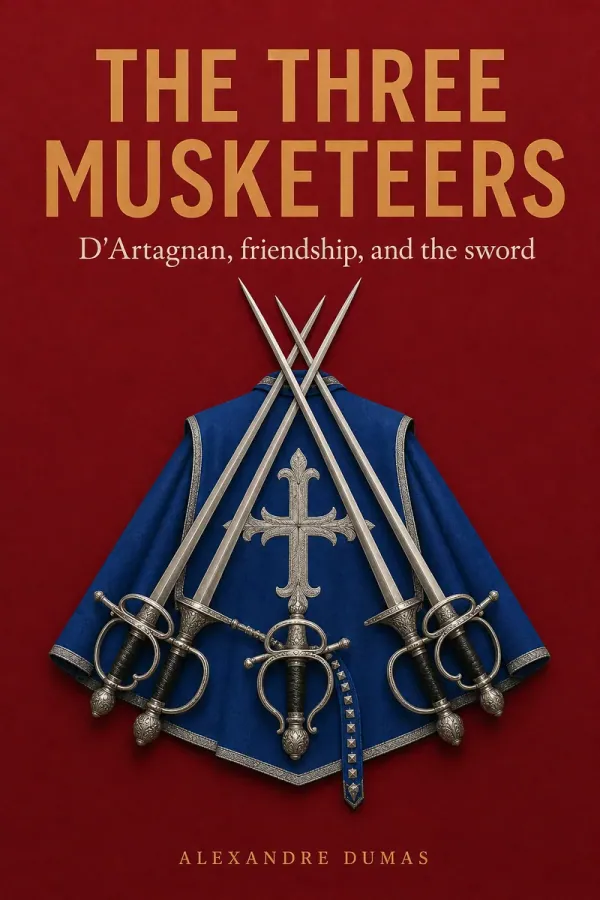
D'Artagnan, friendship, and the sword
Study this topic in OriaThe essentials
Published as a serial in 1844, The Three Musketeers tells how a poor young Gascon, d'Artagnan, comes to Paris, becomes friends with Athos, Porthos, and Aramis, and together with them faces off against Cardinal Richelieu and the formidable Milady. Written by Alexandre Dumas with his collaborator Auguste Maquet, it is the model for the swashbuckling novel. You'll discover its genesis, the plot of the queen's diamond studs through to the siege of La Rochelle, the four heroes and their real-life models, the novel's share of history, and the book's immense afterlife.
Key dates and facts
- Jul. 24, 1802
- Dumas born in Villers-Cotterêts
- June 1843
- Likely borrows the Mémoires in Marseille
- Mar. 14, 1844
- First installment in Le Siècle
- Jul. 14, 1844
- Serial ends
- 1845
- Twenty Years After
- 1847 – 1850
- The Vicomte of Bragelonne
- 1921
- Douglas Fairbanks as d'Artagnan
- Nov. 30, 2002
- Dumas enters the Panthéon
🖋️ An old book of memoirs and a newspaper
Alexandre Dumas, known as Dumas père, was born on July 24, 1802, in Villers-Cotterêts, in the Aisne. His father, General Thomas Alexandre Dumas, born in Saint-Domingue (today's Haiti), was the son of a Norman marquis and a Black woman, enslaved or freed, Marie-Cessette Dumas. The general died in 1806: the boy grew up poor, raised by his maternal grandparents. Around age twenty, he left for Paris with 53 francs in his pocket. He first triumphed in the theatre, with a historical drama, Henri III et sa cour, staged at the Comédie-Française in 1829, one of Romanticism's first great successes.
📰 The age of the serial novel
In the 1830s, a cheap press emerged, reaching a much wider public. In 1836, Émile de Girardin launched La Presse and invented the serial novel: a story published in installments, at the bottom of the newspaper's pages. Dumas tried his hand at it right away. In 1842-1843, Eugène Sue enjoyed immense success with Les Mystères de Paris. Dumas realized there was an audience to win over. On March 14, 1844, The Three Musketeers was a masterstroke: it drove up sales of the newspaper Le Siècle.
📚 The memoirs of a fake d'Artagnan
The idea came from an a 1700 book, the Mémoires de M. d'Artagnan, written by Gatien de Courtilz de Sandras. These fake memoirs, published twenty-seven years after the real d'Artagnan's death, already contain the names Athos, Porthos, and Aramis, and a great many details that Dumas rewrote. In his preface, Dumas claims to have discovered this book while preparing his work Louis XIV et son siècle, then invents another manuscript, the supposed memoirs of the Comte de La Fère. Another version, which scholar Claude Schopp considers plausible, holds that he borrowed the book from the Marseille library during a stay from June 21 to 24, 1843… and never returned it, despite the assistant librarian's letters. For the episode of the queen's diamond studs, Dumas and his collaborator Auguste Maquet also drew on La Rochefoucauld's Mémoires.
✏️ An absurd title, and all the better for it
The planned title was Athos, Porthos et Aramis. Desnoyers, in charge of the serial at Le Siècle, thought it evoked the three Fates and suggested The Three Musketeers. Dumas agreed, noting that the title's absurdity, since the heroes number four, would help the book's success. The serial ran from March 14 to July 14, 1844; the publisher Baudry brought out the novel in eight volumes between June and September of that same year. By 1846, three English translations were already in circulation.
🤝 Writing as a pair: Dumas and Maquet
The Three Musketeers is not the work of one man alone. Auguste Maquet, a young playwright introduced to Dumas by Gérard de Nerval in 1838, brought him in 1840 the manuscript of a short story. Greatly expanded by Dumas, it became Le Chevalier d'Harmental, published in 1842 under Dumas's name alone; Maquet received eight thousand francs. Their collaboration was underway.
⚙️ A two-step method
The division of labor is fairly well documented. Maquet did the historical research, proposed an outline, and wrote a first draft. Dumas chose the overall theme, took up this draft, cut or invented characters, and gave it his style, his pace, and his dialogue. In January and February 1844, Dumas thus asked Maquet, in his letters, for "the d'Artagnan volume" and the work prepared on Athos. Historian Simone Bertière, who studied Maquet's manuscript for this novel, found that a twelve-page passage in his hand ran to seventy pages after Dumas's rewriting.
The pace was frantic. Between 1844 and 1850, with Maquet, Dumas published in four newspapers all the great works that would make his name: The Count of Monte Cristo, La Reine Margot, Twenty Years After, La Dame de Monsoreau, The Vicomte of Bragelonne… Paid by the line, he claimed to write something like 24,000 letters a day, often juggling several novels at once.
🏭 "Novel factory"
In February 1845, a pamphleteer, Eugène de Mirecourt, published Fabrique de romans: Maison Alexandre Dumas et compagnie, in which he named Maquet as "the most prolific, the most skillful" of Dumas's collaborators. Sued, Mirecourt was convicted of libel in April 1845 and had to admit that one of his anecdotes was invented. But the debate was launched. Balzac, in a letter, called the pamphlet foolish, but sadly true.
⚖️ The 1858 lawsuit
Ruined by the 1848 revolution, Dumas owed Maquet more than a hundred thousand francs, and their collaboration ended in 1851. Maquet then sued him to be recognized as co-author and to receive half the royalties. On February 3, 1858, his claim was rejected: treated as a mere creditor, he was awarded a sum payable over several years, but gave up any claim to see his name alongside Dumas's. Today, scholars acknowledge Maquet's contribution without stripping Dumas of authorship of the work: it was Dumas who turned it into the novel we know.
The rest of the course
This page publishes the first 2 parts. The full course has 9: here is what the next ones cover.
- 🐴 A Gascon Don Quixote in Paris
The start of the novel: d'Artagnan's arrival in Meung and Paris, his meeting with Athos, Porthos, and Aramis, and the fight against the cardinal's guards.
- 💎 The queen's diamond studs
The first great adventure: Richelieu wants to compromise Anne of Austria, and d'Artagnan races to London to recover the diamond studs given to Buckingham.
- 🌹 Milady, the fleur-de-lis, and La Rochelle
The duel between d'Artagnan and Milady, Athos's secret, the siege of La Rochelle, the cardinal's signed order, and the bet at the Saint-Gervais bastion.
- ⚖️ Béthune, Armentières, and the lieutenancy
The end of the novel: Milady has Buckingham assassinated, poisons Constance, is tried by the musketeers, and Richelieu makes d'Artagnan a lieutenant.
- 👥 Four characters, one motto
The four heroes, their valets, and their historical models, and the real wording of the motto "All for one, one for all."
- 👑 Richelieu, Anne of Austria: history turned into fiction
How much historical truth lies in the novel: Louis XIII, Richelieu, Anne of Austria, Buckingham, and the way Dumas reshapes history.
- 🎬 Sequels, imitators, and adaptations
The musketeers trilogy, the novel's influence on the swashbuckling genre, the myth of friendship, and the countless adaptations.
Study “The Three Musketeers” with flashcards and quizzes
In Oria, you read the full course, then practice on it: flashcards, multiple-choice quizzes, open questions or the Feynman method. Cards and questions then come back in your daily review, paced by spaced repetition.
Study this topic in OriaSources
These notes draw on the sources below. If a point seems doubtful, refer back to them.