Classic novels
Romeo and Juliet by William Shakespeare: Summary and Study Notes
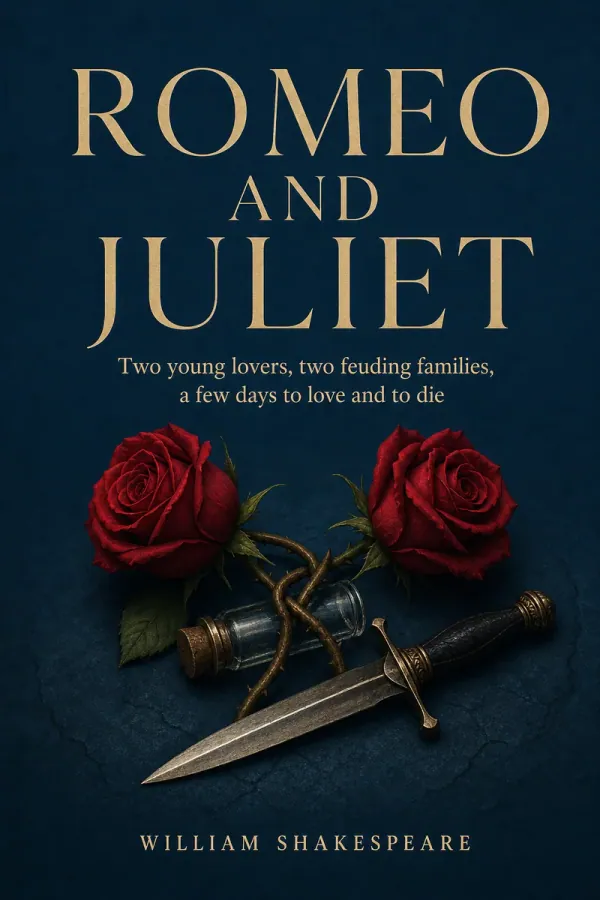
Two young lovers, two feuding families, a few days to love and to die
Study this topic in OriaThe essentials
Written by William Shakespeare early in his career and first printed in 1597, Romeo and Juliet tells of the sudden, overwhelming love between two teenagers from Verona whose families despise each other. In a matter of days, a ball, a moonlit scene, a secret wedding, two duels, a banishment and a potion lead the lovers to the tomb. You will discover the Italian sources behind the play, the plot act by act, great characters such as Mercutio, the Nurse and Friar Laurence, the themes of love, fate and hatred, and the play's immense afterlife, from opera to West Side Story.
Key dates and facts
- 1591-1595
- Likely period of composition
- 1597
- First quarto (Q1)
- 1599
- Second quarto (Q2), more complete
- 1623
- First Folio of Shakespeare's works
- 1867
- Gounod's opera
- 1957
- West Side Story opens on Broadway
- 1968
- Franco Zeffirelli's film
- 1996
- Baz Luhrmann's Romeo + Juliet
🎭 Shakespeare and the Birth of the Play
Romeo and Juliet is a tragedy by William Shakespeare, the English playwright, poet and actor born in April 1564 in Stratford-upon-Avon and who died in 1616. Nicknamed “the Bard”, he is considered one of the greatest writers in the English language. He wrote most of his plays in London between 1589 and 1613, first mainly comedies and history plays, then the great tragedies such as Hamlet, Othello and Macbeth. He was a shareholder in his company, the Lord Chamberlain's Men.
📅 An Early Play
Romeo and Juliet belongs to the early part of his career. Its exact date of composition is unknown. In the play, the Nurse recalls an earthquake that happened eleven years earlier: if this refers to the earthquake of 1580, that passage would date from 1591. Stylistic similarities with A Midsummer Night's Dream, usually dated 1594-1595, suggest the play was written between 1591 and 1595, perhaps sketched in 1591 and finished in 1595.
📖 A Text in Several Versions
During Shakespeare's lifetime, many of his plays were published in cheap, uneven-quality books known as quartos. The first edition of Romeo and Juliet, printed in early 1597 by John Danter, is of poor quality: it is known as the “bad quarto”. Some scholars see it as a reconstruction from memory by one or two actors, others as a version shortened for the stage. The second edition, in 1599, titled The Most Excellent and Lamentable Tragedie of Romeo and Juliet, is about 800 lines longer and claims to be “newly corrected, augmented, and amended”. Scholars believe it is based on Shakespeare's own drafts. It is this version that underlies modern editions, including the First Folio of 1623, the collection of Shakespeare's plays published by two of his friends after his death.
🎟️ An Immediate Success
The play was popular during its author's lifetime. The 1597 edition states that it had already “been often (and with great applause) plaid publiquely”. It was probably first staged by the Lord Chamberlain's Men, with the great actor Richard Burbage in the role of Romeo. As always in Elizabethan theatre, female roles were played by young boys: Juliet was likely played by Robert Goffe. As early as 1604, an abridged version was performed in Germany, in Nördlingen, making Romeo and Juliet one of the first Shakespeare plays staged outside England. Along with Hamlet, it remains one of his most performed plays today.
📜 An Old Italian Story
Shakespeare did not invent the story of Romeo and Juliet. He took up a plot that had circulated in Europe for a long time and that belongs to a tradition of tragic love stories reaching back to antiquity.
🏺 Ancient Roots
In the Metamorphoses of the Latin poet Ovid, in the 1st century, the myth of Pyramus and Thisbe already tells of the love of two young people whose parents hate each other; Pyramus kills himself after wrongly believing Thisbe is dead. A 3rd-century Greek romance, the Ephesiaca of Xenophon of Ephesus, likewise contains a separation of the lovers and a potion that creates the appearance of death. As for the family names, Montecchi and Capuleti, they appear as early as the 14th century in Dante's Divine Comedy, though without any love story.
🇮🇹 From Siena to Verona
- Masuccio Salernitano, in the second half of the 15th century, tells the story of Mariotto and Ganozza, set in Siena: it already contains the secret marriage, the complicit friar, the fatal brawl, the exile, the forced marriage, the potion and the lost message.
- Luigi da Porto, around 1524, gives the story almost its final shape: the first names Giulietta and Romeo, the rival families, the setting of Verona, the ball, the night-time scene beneath the window, the killing of the cousin, and characters who will become Mercutio, Tybalt, Paris and Friar Laurence. He presents his tale as a true story.
- Matteo Bandello publishes a version in his Novelle in 1554 and adds the Nurse and Benvolio.
- Pierre Boaistuau translates it into French in 1559, making it more moralising and sentimental.
- Arthur Brooke, in 1562, turns it into a long English poem, The Tragicall Historye of Romeus and Juliet.
- William Painter, in 1567, publishes a prose version in a collection of Italian tales, The Palace of Pleasure.
A short Italian Renaissance prose tale, shorter than a novel, often drawn from an event presented as true. Novellas were very fashionable in England at the time: The Merchant of Venice and Much Ado About Nothing are also drawn from them.
✒️ What Shakespeare Changes
The play is essentially a stage adaptation of Brooke's poem, which Shakespeare follows closely. But he transforms the story in three decisive ways. First, he deepens the secondary characters, especially Mercutio and the Nurse, as well as Count Paris. Second, he compresses time: in Brooke, the story spans nine months; in Shakespeare, it fits into four to six days. Finally, in the balcony scene, he lets Romeo overhear the confession Juliet believes she is making in private, which hastens their commitment. This compression turns a love story into a race against death.
The rest of the course
This page publishes the first 2 parts. The full course has 9: here is what the next ones cover.
- 🏰 Verona, Montague and Capulet
The setting and the characters: the city of Verona, the hatred between the two families, the prologue in the form of a sonnet, and the opening brawl.
- 🌙 Acts I and II: The Ball, the Balcony, the Wedding
The meeting at the Capulets' ball, the shared sonnet, the balcony scene (“What's in a name?”) and the secret wedding performed by Friar Laurence.
- ⚔️ Act III: The Deaths of Mercutio and Tybalt
The tragic turning point: the duel in which Mercutio then Tybalt die, Mercutio's curse, Romeo's exile and the single wedding night.
- ⚰️ Acts IV and V: The Potion and the Tomb
Friar Laurence's plan, Juliet's feigned death, the letter that never arrives, Romeo's poison and Juliet's suicide, then the families' reconciliation.
- 🧑🤝🧑 Mercutio, the Nurse, Friar Laurence
The main characters and the great supporting roles: Romeo and Juliet, Mercutio, the Nurse, Friar Laurence, Capulet and Paris.
- 🔥 Love, Fate and Hatred
The play's great themes: young love, fate and chance, the families' hatred, the contrast of light and darkness, and the race against time.
- 🎬 From Opera to West Side Story
The play's afterlife: adaptations for theatre, opera, music and ballet, West Side Story, and the great films by Cukor, Zeffirelli and Luhrmann.
Study “Romeo and Juliet” with flashcards and quizzes
In Oria, you read the full course, then practice on it: flashcards, multiple-choice quizzes, open questions or the Feynman method. Cards and questions then come back in your daily review, paced by spaced repetition.
Study this topic in OriaSources
These notes draw on the sources below. If a point seems doubtful, refer back to them.