Classic novels
Pride and Prejudice by Jane Austen: Summary and Study Notes
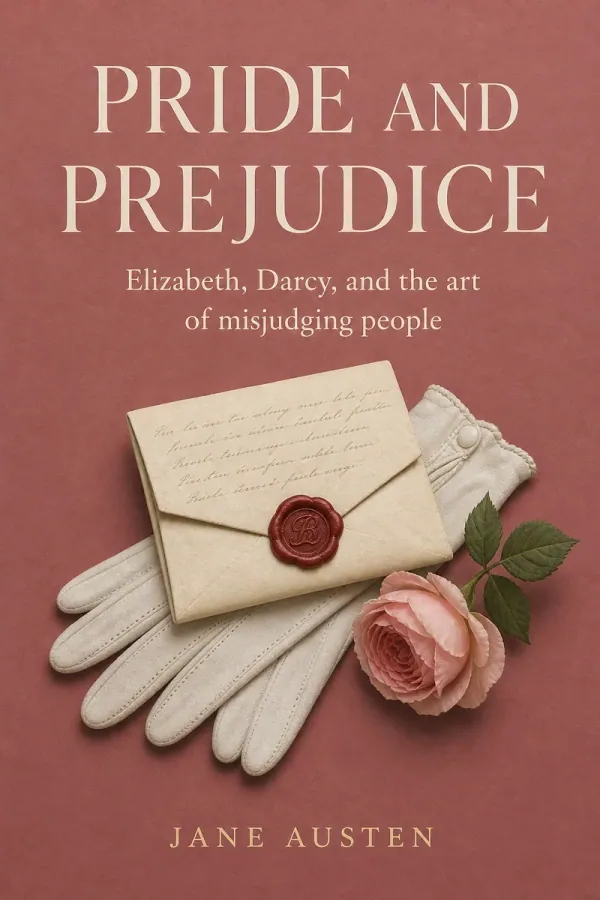
Elizabeth, Darcy, and the art of misjudging people
Study this topic in OriaThe essentials
Published anonymously in 1813, Pride and Prejudice follows Elizabeth Bennet, second of five sisters with no fortune, who dislikes the rich and haughty Mr Darcy on sight. Behind the romantic comedy, Jane Austen paints a sharp portrait of a society where a young woman has little future besides marriage. You'll discover who Jane Austen was, how the novel came to be, its three-part plot, its unforgettable characters, its themes, its irony, and its immense afterlife, from films to series.
Key dates and facts
- Dec. 16, 1775
- Born in Steventon
- 1809
- Settles at Chawton
- 1811
- First novel published
- Jul. 18, 1817
- Dies in Winchester
- Oct. 1796
- First Impressions begun
- Nov. 1797
- Rejected by publisher Cadell
- 1811 – 1812
- Revised, given a new title
- Jan. 28, 1813
- Published by Egerton
- 1813
- Anonymous publication
- 1870
- A Memoir revives interest
✒️ Jane Austen, the nameless novelist
Pride and Prejudice is the work of Jane Austen, born on December 16, 1775, at the rectory of Steventon, a small village in Hampshire, in the south of England. Her father, George Austen, was the Anglican parish rector there. The family belonged to the lesser gentry, that respectable but not wealthy country class she would portray in all her novels. Jane had six brothers and one sister, Cassandra, who remained her closest confidante her whole life.
📚 An education through books
Jane Austen spent only a short time at boarding school: lacking the money for it, her parents brought her home as early as December 1786. Her education then came mainly from reading. Her father gave her unrestricted access to his library of about 500 volumes, and her brothers James and Henry guided her reading. The family also loved putting on plays at home, mostly comedies, which fed her ear for dialogue and satire from an early age. From 1787 on, she wrote poems, stories, and parodies to entertain her family: these early pieces, copied into three notebooks, are known today as the Juvenilia.
💔 A life without marriage
In 1795-1796, Jane Austen spent a good deal of time with Tom Lefroy, a young Irishman visiting neighbors. Her letters to Cassandra hint at real closeness, but neither of them had money, and the Lefroy family sent the young man away. In 1802, she accepted a proposal from a wealthy heir, Harris Bigg-Wither, then took it back the very next morning. She never married. After her father's death in 1805, she lived with her mother and sister in precarious circumstances, dependent on her brothers' support, until they settled in 1809 in a cottage in the village of Chawton, given by her brother Edward.
📖 Four novels in five years
At Chawton, she wrote almost every day and finally got published. In quick succession came Sense and Sensibility (1811), Pride and Prejudice (1813), Mansfield Park (1814), and Emma (late 1815). All appeared without the author's name: it was not considered proper for a lady of her standing to put her name to a book sold for profit. The Prince Regent, the future George IV, admired her novels and had word sent that he wished her to dedicate Emma to him, which she did, reluctantly.
Ill from 1816 on, she died in Winchester on July 18, 1817, at age 41, and is buried in the city's cathedral. Her epitaph praises the gifts of her mind without mentioning that she was a writer. It was her brother Henry who revealed her name to the public, in a notice placed at the front of her two posthumous novels, Northanger Abbey and Persuasion.
📜 From First Impressions to Pride and Prejudice
Jane Austen began the novel in October 1796, at age 20, and finished a first draft in August 1797. At the time it was called First Impressions. As with all her manuscripts, she read it aloud to her family in the evenings, and it soon became a household favorite.
✉️ "Declined by return of post"
On November 1, 1797, her father wrote to a well-known London publisher, Thomas Cadell, offering a three-volume manuscript, about the length of Fanny Burney's Evelina. The letter came straight back with a curt note: "Declined by Return of Post." It is even possible Jane never learned her father had tried this. The manuscript then lay untouched for about fifteen years.
Since nothing survives of this first version, we are left with guesses. The large number of letters in the final novel (around forty are quoted or mentioned) suggests that First Impressions may have been an epistolary novel, made up entirely of letters, but there is no proof of this.
✂️ Pruning and cutting
After the success of Sense and Sensibility in 1811, Jane Austen picked her old manuscript back up between 1811 and the autumn of 1812. She tightened it considerably: in a letter to Cassandra dated January 29, 1813, she says she is delighted to have "lop't and crop't" it so well that it should now be shorter than her first novel. She also changed the title, since two other works called First Impressions, a novel by Margaret Holford and a comic play, had appeared in the meantime.
The new title, Pride and Prejudice, likely echoes the novel Cecilia (1782) by Fanny Burney, whose conclusion repeats the phrase in capital letters: the whole unhappy affair, says one character, has been the result of PRIDE and PREJUDICE. As with Sense and Sensibility, Austen liked the alliteration of the two words.
💷 £110 for a masterpiece
She sold the rights to publisher Thomas Egerton for £110, having asked for £150. The deal turned out badly for her: by researcher Jan Fergus's estimate, the publisher made about £450 from the first two editions alone. The novel appeared on January 28, 1813, in three volumes selling for 18 shillings. The title page carried no name, only the words "by the author of Sense and Sensibility." Austen received her own copy, which she called her "own darling child," on January 27.
Its success was real: the first print run, estimated at about 1,500 copies, sold out within months, and a second edition came out in the autumn of 1813. An abridged French translation appeared as early as July 1813 in Geneva, in the journal Bibliothèque britannique. It would not be until 1833 that Jane Austen's name appeared on an English edition.
The rest of the course
This page publishes the first 2 parts. The full course has 9: here is what the next ones cover.
- 💃 A ball at Meryton: first impressions
Volume I: the arrival of Bingley and Darcy, the insult at the ball, Wickham, Mr Collins's proposal, and Bingley's departure.
- ✉️ A refused proposal and a letter that changes everything
Volume II: Elizabeth's stay in Kent, Darcy's first proposal, her refusal, and then Darcy's letter revealing the truth about Wickham.
- 🏛️ Pemberley, Lydia's elopement, and the resolution
Volume III: the visit to Pemberley, Lydia's elopement with Wickham, Darcy's secret intervention, Lady Catherine's visit, and the two marriages.
- 👥 Elizabeth, Darcy, and a gallery of portraits
The main characters: Elizabeth and Darcy, the Bennet family, Mr Collins, Charlotte Lucas, Wickham, Lady Catherine, and the Bingleys.
- 💰 Money, marriage, and the condition of women
The novel's major themes: money, inheritance, marriage as women's only security, and the different kinds of marriages on display.
- 🎭 A famous opening line and the art of irony
Jane Austen's style: the novel's opening sentence, its irony, its dialogues, its free indirect discourse, and its letters.
- 🎬 Two centuries of readers, eclipses, and screens
The novel's reception from 1813 to today: early praise, nineteenth-century criticism, twentieth-century canonization, French translations, and adaptations.
Study “Pride and Prejudice” with flashcards and quizzes
In Oria, you read the full course, then practice on it: flashcards, multiple-choice quizzes, open questions or the Feynman method. Cards and questions then come back in your daily review, paced by spaced repetition.
Study this topic in OriaSources
These notes draw on the sources below. If a point seems doubtful, refer back to them.