Philosophy
Meditations by Marcus Aurelius: Summary and Study Notes
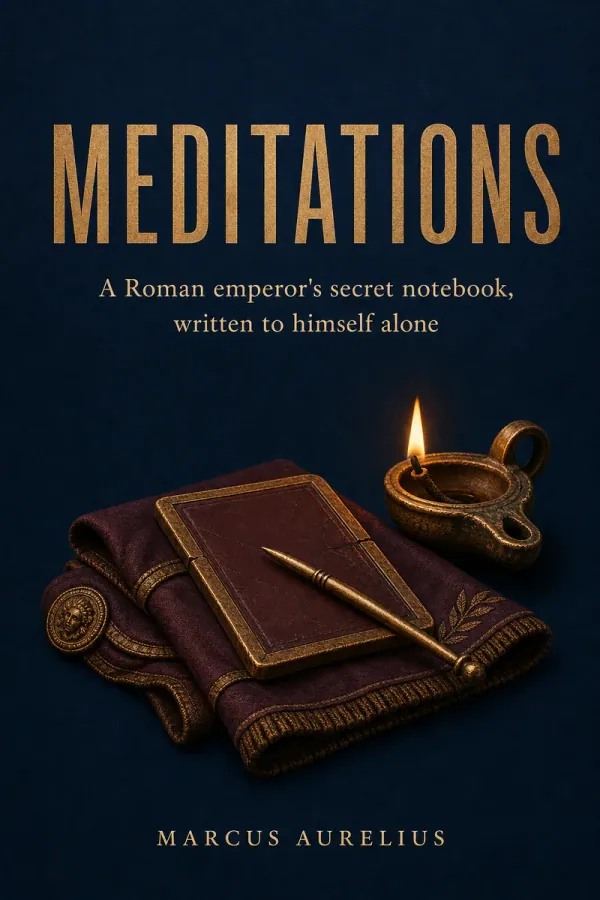
A Roman emperor's secret notebook, written to himself alone
Study this topic in OriaThe essentials
Between 170 and 180, the Roman emperor Marcus Aurelius jotted down, in Greek and for himself alone, his reflections on how to live well. That notebook, known as the Meditations, became the most famous text of Stoicism. You'll discover who this philosopher-emperor was, the wars and plague he was writing through, what his great themes say (what is up to us, impermanence, duty, nature, death), how the text nearly vanished, and why it still fascinates readers today.
Key dates and facts
- 121
- Born in Rome
- 138
- Adopted by Antoninus Pius
- 145
- Marries Faustina the Younger
- 161
- Marcus Aurelius becomes emperor
- 165
- The Antonine plague begins
- 168
- The emperors set out for Carnuntum
- 175
- Avidius Cassius's usurpation
- 180
- Death of Marcus Aurelius
- 907
- First certain mention, by Arethas of Caesarea
- 10th century
- Quoted in the Suda
👑 Young Marcus, student of philosophers
Marcus Aurelius, the author of the Meditations, was born in Rome on April 26, 121, under the reign of the emperor Hadrian. He was then called Marcus Annius Verus and belonged to a wealthy senatorial family of Spanish origin. His father died when he was still a child, and he was raised by his mother and his grandfathers. Hadrian noticed him very early and fondly nicknamed him Verissimus, “the most truthful.”
📚 An exceptional education
Like the children of the aristocracy, Marcus was tutored at home by many teachers. Among them, Diognetus, his painting teacher, introduced him to philosophy. In 132, around the age of eleven, the boy began adopting the lifestyle of philosophers, down to their rough Greek cloak. He then studied rhetoric with the famous orator Fronto, with whom he kept up a long correspondence, as well as with Herodes Atticus.
🏛️ A designated heir
In 138, Hadrian chose Antoninus, Marcus's uncle, as his successor, on condition that Antoninus in turn adopt Marcus, then seventeen, along with the young Lucius Verus. Marcus took the name Marcus Aelius Aurelius Verus. He became quaestor, then consul as early as 140, at eighteen, and in 145 married Faustina the Younger, Antoninus's daughter. For more than twenty years he prepared for power alongside his adoptive father, whose simplicity and gentleness he admired.
🦉 Turning to Stoicism
The teacher who left the deepest mark on him was the Stoic philosopher Quintus Junius Rusticus. He steered Marcus away from rhetoric and taught him to correct his character, to write plainly, and to read with care. In the first book of the Meditations, Marcus Aurelius thanks him above all for lending him, from his own library, the “Discourses of Epictetus,” the teachings of the former slave who had become a philosopher. Epictetus would remain his main point of reference.
Stoicism is a philosophical school founded in Athens around 300 BC by Zeno of Citium. It teaches that happiness comes from virtue and from living in accordance with reason, not from external goods.
⚔️ A reign spent in the storm
When Antoninus died in 161, Marcus Aurelius became emperor. He chose to share power with his adoptive brother Lucius Verus. The philosopher who had dreamed of study would spend most of his reign facing one crisis after another, and it is in that setting that he wrote the Meditations.
🏹 War in the East
From the very start of the reign, the Empire had to fight the Parthian Empire, its great rival in the East, and a rebellious kingdom of Armenia. The Roman armies prevailed: in 165 they took and burned the two great cities of Mesopotamia, Seleucia and Ctesiphon. In 166, the two emperors celebrated a triumph in Rome.
🦠 The Antonine plague
But starting in 165, a terrible epidemic struck the Empire. It is known as the Antonine plague, though according to today's historians it was most likely smallpox. It raged in waves until around 190 and killed a large share of the population. During a resurgence in 189, the historian Cassius Dio reports as many as 2,000 deaths a day in Rome.
❄️ The Danube wars
At the same time, Germanic and Sarmatian peoples crossed the Danube frontier: the Marcomanni, the Quadi, the Iazyges. These Marcomannic Wars began around 166–167 and occupied Marcus Aurelius almost until his death. In 168, the two emperors set out for the great fortress of Carnuntum on the Danube. Lucius Verus died in 169, and Marcus Aurelius likely set up his headquarters at Sirmium, in what is now Serbia. He thus spent long years in military camps, far from Rome.
👑 Betrayal and succession
In 175, the governor of Syria, Avidius Cassius, proclaimed himself emperor, believing Marcus Aurelius was dead. A few months later he was killed by his own soldiers. In 176, Marcus Aurelius made his son Commodus, the only one of his sons still living, co-ruler. A bronze equestrian statue was erected in his honor around 175–176.
Marcus Aurelius died on March 17, 180, in the midst of a campaign, at Vindobona (modern Vienna) or at Sirmium. The exact cause of his death, which came within about a week, is unknown. Commodus succeeded him. The decision to pass power to his son is still debated by historians, ancient and modern alike.
The rest of the course
This page publishes the first 2 parts. The full course has 8: here is what the next ones cover.
- 📓 A notebook written for himself alone
The nature of the Meditations: personal notes in Greek, in twelve books, partly written during military campaigns and never meant for publication.
- 🎯 What is up to us
The first great theme of the Meditations: telling apart what is up to us from what is not, and disciplining our judgments to stay at peace.
- ⏳ Everything passes: impermanence and death
Marcus Aurelius's meditations on fleeting time, the brevity of life, the value of the present moment, and death as a natural event.
- 🐝 Duty, other people, and nature
The sense of duty and community in the Meditations: acting for the common good, putting up with difficult people, living according to nature, and accepting fate.
- 📜 A manuscript that barely survived
How the Meditations were transmitted: a text almost unknown for centuries, saved by Byzantine scholars, printed in Zurich in 1558–1559 from a manuscript now lost.
- 🌍 From Rome to today
Marcus Aurelius's image as a “good emperor,” his monuments, the Meditations' influence on philosophy and modern psychology, and today's revival of Stoicism, with its limits.
Study “Meditations” with flashcards and quizzes
In Oria, you read the full course, then practice on it: flashcards, multiple-choice quizzes, open questions or the Feynman method. Cards and questions then come back in your daily review, paced by spaced repetition.
Study this topic in OriaSources
These notes draw on the sources below. If a point seems doubtful, refer back to them.