Philosophy
Plato: Biography and Study Notes
Socrates's disciple who wanted to lead men out of the cave
Study this topic in OriaThe essentials
Born into a great Athenian family during the Peloponnesian War, Plato dreamed of a life in politics before meeting Socrates, and then Socrates's death sentence in 399 BC, upended his life. A traveler, a failed adviser to the tyrants of Syracuse, and founder of the Academy, he wrote dialogues that rank among the founding texts of philosophy. You will discover his life step by step, his great ideas (the Ideas, the cave, the just city, the soul), and the immense legacy of a thinker of whom all of Western philosophy has, in a famous phrase, been said to be a series of footnotes.
Key dates and facts
- c. 428 BC
- Plato is born in Athens
- 409 BC
- His brothers fight at Megara
- c. 407 BC
- Meets Socrates
- 404 BC
- Athens's defeat, government of the Thirty
- c. 387 BC
- The Academy is founded
- 367 BC
- Aristotle arrives at the Academy
- 86 BC
- End of Plato's Academy
- 529 AD
- Closure of the Neoplatonic school of Athens
- c. 347 BC
- Plato dies in Athens
- 3rd century
- Plotinus founds Neoplatonism
🏛️ An aristocratic youth in Athens
Plato was born in Athens, in the deme of Collytus, around 428 or 427 BC, two years after the death of Pericles. The ancient biographer Diogenes Laërtius has him born on the island of Aegina instead. His life remains poorly documented: the main ancient biographies were written more than five centuries after his death, and must be read with caution.
👨👩👦 An illustrious family
Plato belonged to the Athenian aristocracy. His father, Ariston, claimed descent from Codrus, the last legendary king of Athens. His mother, Perictione, descended from a brother of the lawgiver Solon. She was also the cousin of Critias and the sister of Charmides, two men who would become members of the government of the Thirty in 404 BC. Plato had two brothers, Adeimantus and Glaucon, whom he would give voice to in The Republic, and a sister, Potone, mother of his future successor Speusippus. Once widowed, his mother remarried her uncle Pyrilampes.
💪 "Plato," a nickname?
According to a tradition reported by Diogenes Laërtius, he was given the name of his grandfather, Aristocles, and "Plato" was only a nickname, from the Greek platus, "broad": because of his broad wrestler's shoulders, his broad forehead, or the breadth of his style. Many modern scholars doubt this story, but it reflects the image the ancients had of him as a sturdy man.
🎭 A childhood in wartime
Plato grew up during the Peloponnesian War, which pitted Athens against Sparta. His brothers Glaucon and Adeimantus distinguished themselves at the Battle of Megara in 409 BC. Like every young Athenian of his rank, he received a traditional education grounded in gymnastics and music. One late author, Olympiodorus, even claims he competed as a wrestler at the great Greek games.
The young man first dreamed of being a poet. Ancient authors tell us he wrote dithyrambs, lyric poems, and tragedies. Like many young men of his station, he also thought of a career in politics: in Athens, taking part in the city's affairs was the natural path for a free, well-born man. Meeting a strange man who questioned everyone in the streets of Athens would change these plans.
🗣️ Socrates, the teacher, and his condemnation
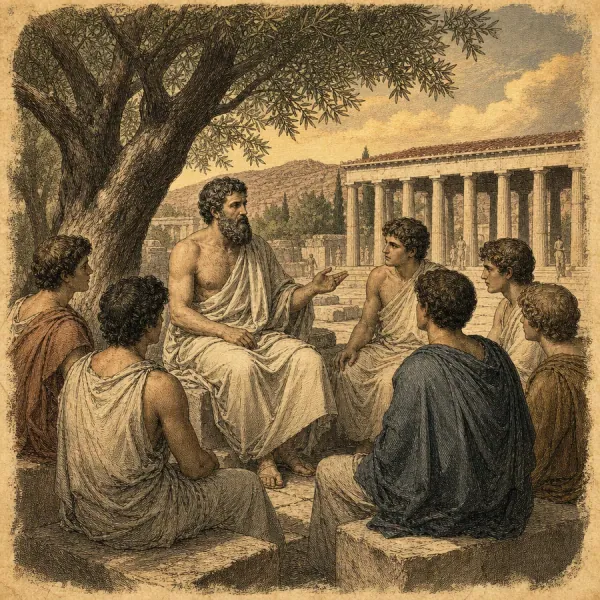
Around the age of twenty, around 407 BC, Plato became close to Socrates, the philosopher who wandered through Athens questioning his fellow citizens about justice, courage, or beauty. Socrates never wrote anything; he practiced the art of questioning, which Plato would later call dialectic. According to tradition, the young man then gave up competing for the tragedy prize and burned his poems. He would remain Socrates's disciple until the teacher's death.
🩸 The time of the Thirty
In 404 BC, Athens, defeated by Sparta, fell under the control of the Thirty, a violent oligarchy that included his relatives Critias and Charmides. According to Letter VII, attributed to Plato, he was invited to join the government. He recounts his state of mind at the time:
"In my youth I had the same experience as many others: I imagined that as soon as I was my own master, I would immediately go into public life."
Plato, Letter VII, 324 (translated)
But the crimes of the Thirty disgusted him, especially when they tried to involve Socrates in the unlawful arrest of a citizen. In 403 BC, democracy was restored. Plato regained hope… until his teacher's trial.
⚖️ The trial of 399 BC
In the spring of 399 BC, Socrates was accused by the poet Meletus, the politician Anytus, and the orator Lycon of not recognizing the city's gods, of introducing new deities, and of corrupting the youth. Before a court of 501 citizens chosen by lot, he refused to read a defense speech written for him and chose instead to tell the story of his life. He was found guilty by 281 votes. Invited to propose his own sentence, he first suggested being fed at the city's expense, then a fine of thirty minas, guaranteed in part by Plato and Crito. The judges voted for death.
In the Apology of Socrates, Plato has his teacher say that "a life without examination is not worth living." Imprisoned, Socrates refused to escape, out of respect for the laws.
🍵 The hemlock
Plato, ill, was not present at Socrates's death, but he recounts it in the Phaedo. Socrates drinks the hemlock with perfect calm, chides his friends for their tears, then feels the cold spreading through his body. His last words have become famous: "Crito, we owe a rooster to Asclepius; pay it, do not forget." The dialogue closes with a tribute to the man who was "the best and also the wisest and most just" of his time.
This death is the great turning point of his life. How could a city condemn its most just citizen? Plato's entire body of work would seek the answer: a city at last governed by knowledge and justice.
The rest of the course
This page publishes the first 2 parts. The full course has 9: here is what the next ones cover.
- ⛵ Years of travel: Megara, Italy, and Syracuse
Plato's travels after Socrates's death: refuge in Megara, encounters with the Pythagoreans of southern Italy, and his first stay in Syracuse with the tyrant Dionysius the Elder.
- 🫒 The Academy, the first great school of philosophy
The founding of the Academy in Athens around 387 BC: the place, its teaching grounded in mathematics, famous students such as Aristotle, and the school's long life.
- 🌋 The Sicilian dream of the philosopher-king
Plato's second and third journeys to Syracuse (around 367 and 361–360 BC) to educate the tyrant Dionysius II, the failure of the enterprise, and Dion's fate.
- 📜 The dialogues, philosophy staged
The distinctive form of Plato's work: dialogues in which Socrates questions his interlocutors, their number, their grouping into three periods, and Plato's relationship to writing.
- 🕯️ The theory of Ideas and the allegory of the cave
The heart of Plato's philosophy: the distinction between the sensible world and intelligible realities (the Ideas or Forms), the Idea of the Good, recollection, and the allegory of the cave.
- ⚖️ The Republic, the just city, and the soul
Plato's political and moral thought: the three parts of the soul, the just city in three classes, the philosopher-king, the five political regimes, and the criticism leveled at this model.
- 🌍 Final years and legacy
Plato's final years in Athens, his death around 347 BC, then the legacy of Platonism: Aristotle, Plotinus, the Middle Ages, the Renaissance, and modern philosophy.
Study “Plato” with flashcards and quizzes
In Oria, you read the full course, then practice on it: flashcards, multiple-choice quizzes, open questions or the Feynman method. Cards and questions then come back in your daily review, paced by spaced repetition.
Study this topic in OriaSources
These notes draw on the sources below. If a point seems doubtful, refer back to them.