Civilizations
Great Zimbabwe: Summary and Study Notes
The Shona stone city, capital of southern Africa's gold
Study this topic in OriaThe essentials
In the south of present-day Zimbabwe stand the largest stone structures of precolonial southern Africa: Great Zimbabwe, built between the 11th and 15th centuries by the ancestors of the Shona. You'll discover how this kingdom grew rich from gold and Indian Ocean trade, how these walls were built without mortar, what its famous stone birds mean, why the city was abandoned, and how colonists denied for decades that it had been built by Africans.
Key dates and facts
- c. 1000
- First settlements on the site
- 13th century
- Great Zimbabwe becomes a royal capital
- c. 1300
- It replaces Mapungubwe as the center of trade
- 1986
- Inscribed on the UNESCO World Heritage list
- 1980
- The independent country takes the name Zimbabwe
- 1981
- South Africa returns four stone birds
- 2003
- Berlin returns a fragment of a pedestal
- April 2026
- Return of the last bird, held in Cape Town
🏰 A “great house of stone” in southern Africa
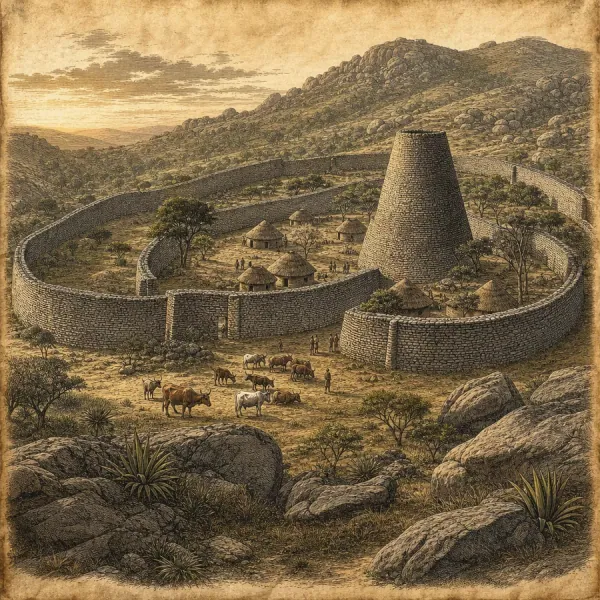
Great Zimbabwe is a ruined medieval city in the hills of southeastern Zimbabwe, about thirty kilometers from the town of Masvingo. Inhabited from around the year 1000, it became the capital of a kingdom in the 13th century, and its great granite walls were built between the 11th and 15th centuries. It is the largest stone structure in southern Africa from before colonization. The ruins cover about 7.2 km² (722 hectares) and have been a UNESCO World Heritage site since 1986.
🗣️ Where does the name come from?
“Zimbabwe” is a word in the Shona language. It contains dzimba, “houses.” There are two explanations: either it comes from dzimba dza mabwe, “great houses of stone,” or from dzimba-hwe, “venerated houses,” a phrase used for the dwellings or tombs of chiefs. The name was first recorded in 1531 by a Portuguese captain, Vicente Pegado, in the form “Symbaoe.” It is called “Great” Zimbabwe to distinguish it from hundreds of smaller sites of the same kind, also called zimbabwes: more than 400 have been identified in southern Africa, such as Bumbusi in Zimbabwe and Manyikeni in Mozambique.
👥 Who built it?
Archaeologists have agreed since the 1950s: the city was built by the ancestors of the Shona, a Bantu-speaking people who today make up at least 70% of Zimbabwe's population and also live in Mozambique and South Africa. More precisely, the builders are linked to the Karanga, the south-central Shona group around Masvingo. Yet this consensus took a long time to win acceptance: for decades, European colonists refused to admit that Africans could have raised such walls. That story is itself part of the site's history.
Great Zimbabwe was not an isolated fortress but the heart of a larger whole: a state that included more than 150 secondary zimbabwes and probably covered about 50,000 km², straddling present-day Zimbabwe and Mozambique.
🌾 From the first farmers to Mapungubwe
The region of Great Zimbabwe has been inhabited for a very long time. The San, hunter-gatherers, have lived there for some 100,000 years and left many rock paintings across southern Africa. From around 150 BC came peoples speaking Bantu languages, who from the 4th century formed farming chiefdoms.
⚒️ Iron Age villages
Between the 4th and 7th centuries, communities that archaeologists link to the Gokomere or Ziwa cultures farmed the valley and mined and worked iron, but did not yet build in stone. Later, the so-called Gumanye people are considered the ancestors of the Karanga, who would build Great Zimbabwe. Around the year 1000, speakers of a proto-Karanga language settled on the site itself. Cattle and farming were at the center of life: owning herds meant forging ties, paying tribute and making alliances.
🏔️ Mapungubwe, the forerunner kingdom
For a long time, the region's center of gravity lay farther south, at the confluence of the Limpopo and the Shashe, in present-day South Africa. Around the year 1000, people of the Leopard's Kopje culture, who spoke an early form of Shona, settled there and were already trading with the towns of the East African coast, exchanging ivory and gold for glass beads and cloth. Around 1220, the elite moved to the top of Mapungubwe hill, while the population lived below. The capital had about 5,000 inhabitants around 1250, and the state probably covered 30,000 km². In the royal cemetery, archaeologists found wooden objects covered in gold foil.
Mapungubwe already shows the ingredients of Great Zimbabwe: a sacred king, an elite that sets itself apart on high ground, and wealth based on cattle and the gold trade toward the Indian Ocean. In the 13th century, Great Zimbabwe was still only on the edge of this state. But around 1300, trade routes shifted north, toward the gold-bearing areas of the interior: Mapungubwe's population dispersed, and Great Zimbabwe took over.
The rest of the course
This page publishes the first 2 parts. The full course has 9: here is what the next ones cover.
- 👑 The capital of a kingdom
Great Zimbabwe at its height in the 13th–15th centuries: the size of the city and its population, the sacred king (mambo), the ancestors and Mwari, a hierarchical society.
- 🧱 Granite walls without mortar
The architecture of Great Zimbabwe: the Hill Complex, the Great Enclosure and its conical tower, the Valley Complex, the dry-stone technique and water management.
- 🪙 Plateau gold and the Indian Ocean
The economy of Great Zimbabwe: cattle, farming, goldworking, regional networks and trade with the Swahili coast (Sofala, Kilwa), the source of glass beads and Chinese porcelain.
- 🦅 The soapstone birds and the world of the ancestors
The eight birds carved from soapstone, their likely meaning (bateleur eagle, messenger of Mwari, or fish eagle), and the other objects found on the site.
- 🍂 Decline and the successor kingdoms
The debated causes of Great Zimbabwe's decline in the 15th century, the move north that founded the Mutapa empire, the rise of Khami, the Portuguese accounts and the final abandonment in the 17th century.
- 🔍 Who built the city? A colonial lie
The “Zimbabwe controversy”: colonial theories attributing the city to foreign builders (the Queen of Sheba, the Phoenicians), the plundering of the site, the excavations that proved its African origin, and censorship in Rhodesia.
- 🌍 A national symbol and a sacred place
Great Zimbabwe today: the name and flag of the country that became independent in 1980, the return of the stone birds (1981, 2003, April 2026), political uses, local communities and the conservation of the site.
Study “Great Zimbabwe” with flashcards and quizzes
In Oria, you read the full course, then practice on it: flashcards, multiple-choice quizzes, open questions or the Feynman method. Cards and questions then come back in your daily review, paced by spaced repetition.
Study this topic in OriaSources
These notes draw on the sources below. If a point seems doubtful, refer back to them.