Classic novels
William Shakespeare: Biography and Study Notes
The Bard of Stratford, between glory and mystery
Study this topic in OriaThe essentials
Born in Stratford-upon-Avon in 1564, married at eighteen, William Shakespeare vanishes from the records for seven years before resurfacing in London as a successful actor and author. Associated with the Globe theatre, over twenty-five years he wrote some forty plays and 154 sonnets that shaped the English language and theatre worldwide. You'll discover his documented life, the legends of the "lost years," the adventure of the Globe, his great works, the First Folio that saved them, and what historians really say about the authorship question.
Key dates and facts
- 1553
- Stratford's school founded
- 1564
- Baptized in Stratford-upon-Avon
- 1596
- Coat of arms granted to his father
- 1594
- Joins the Lord Chamberlain's Men
- 1599
- The Globe opens
- 1603
- The troupe becomes the King's Men
- 1623
- First Folio published
- 1769
- Garrick's jubilee in Stratford
- 1864
- Victor Hugo's essay William Shakespeare
- 1997
- New Globe opens in London
🧤 A childhood in Stratford-upon-Avon
William Shakespeare was born in Stratford-upon-Avon, a market town in Warwickshire, in the heart of England, about a hundred miles northwest of London. He was baptized on April 26, 1564, at Holy Trinity Church. His exact date of birth is unknown.
Tradition sets his birth on April 23, St George's Day, England's patron saint, and the day he died in 1616. This date goes back to 18th-century scholars and may stem from an error by the critic George Steevens. Biographers adopted it because the coincidence was too good to pass up.
👨👩👦 A prominent father, a mother of good family
His father, John Shakespeare, from the nearby village of Snitterfield, was a prosperous glover who became one of the town's leading citizens, holding the title of alderman, a member of the town council. His mother, Mary Arden, was the daughter of a wealthy landowner from Wilmcote, from an influential family among the Catholics who had stayed loyal to Rome even as their worship was banned. William was the third of the couple's eight children and the eldest son to survive infancy. Later, in 1596, the family was granted a coat of arms bearing a spear, a nod to the name "Shake-speare."
📚 The school of Latin
No school records from the period have survived. But most biographers believe he attended the King's New School, Stratford's free grammar school, founded by royal charter in 1553 and located less than a quarter mile from the family home. The curriculum, set by royal decree across England, rested on intensive study of Latin grammar and classical Latin authors. Ancient poets and historians, such as Ovid and Plutarch, would later feed many of his plays and poems. Shakespeare, however, never went to university, unlike several playwrights of his time.
💍 A hurried marriage and seven lost years
In November 1582, William Shakespeare, eighteen, married Anne Hathaway, twenty-six, the daughter of a well-off farmer from the nearby hamlet of Shottery. On November 27, the ecclesiastical court of the diocese of Worcester issued a license allowing the marriage to go ahead after a single reading of the banns instead of the usual three. The haste is easily explained: six months later a daughter, Susanna, was born, baptized on May 26, 1583.
👶 Hamnet and Judith
Twins, Hamnet and Judith, were baptized on February 2, 1585. Hamnet died at eleven, of unknown cause; he was buried in Stratford on August 11, 1596.
🌫️ The black hole
After the twins' birth, Shakespeare all but disappears from the records for seven years. The only trace is his name mentioned in a lawsuit before a Westminster court, in 1588-1589. When he resurfaces, in 1592, he is already a known figure of London theatre. Historians call this stretch, from 1585 to 1592, the "lost years."
🦌 The legends
Biographers have filled this gap with unverifiable stories:
- according to his first biographer, Nicholas Rowe, in the early 18th century, a Stratford legend claims he fled to London to escape prosecution after being caught poaching game on the land of a local notable, Thomas Lucy, before taking revenge with a satirical poem;
- another 18th-century story has him starting out minding playgoers' horses at the doors of London theatres;
- the antiquarian John Aubrey reports that he may have been a country schoolmaster;
- in the 20th century, some thought they recognized him in a certain "William Shakeshafte" named in the will of a Catholic landowner in Lancashire.
None of these theories rests on more than hearsay collected after his death, and "Shakeshafte" was a common name in Lancashire. The truth is simple: we do not know how Shakespeare became an actor and author, nor when he started writing, likely sometime between the mid-1580s and 1592.
The rest of the course
This page publishes the first 2 parts. The full course has 8: here is what the next ones cover.
- 🐦 London: the "upstart crow"
The first mention of Shakespeare in London (Robert Greene's 1592 attack), the poems of the plague years, the Lord Chamberlain's Men troupe, the early plays up to Romeo and Juliet and The Merchant of Venice, and his material success.
- 🌍 The Globe and the great tragedies
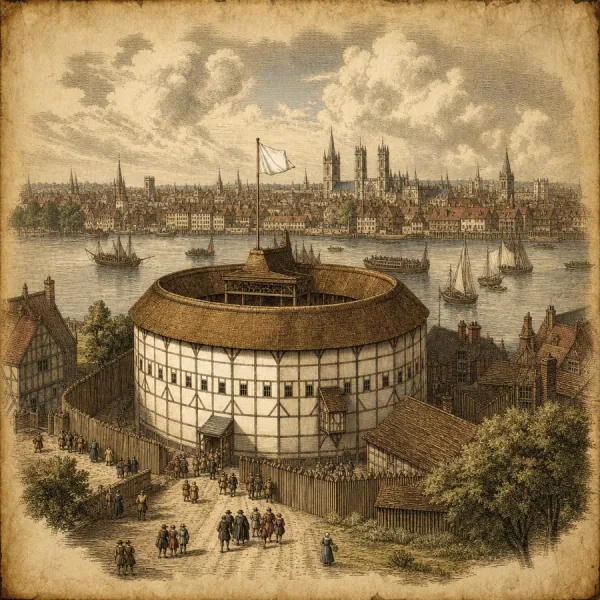
The building of the Globe theatre in 1599, how it worked and who attended, the troupe becoming the King's Men in 1603, and the great tragedies: Julius Caesar, Hamlet, Othello, King Lear, Macbeth.
- 🔥 The last plays and death
Blackfriars and the romances (The Winter's Tale, The Tempest), the collaborations with John Fletcher, the Globe fire in 1613, his will, his death on April 23, 1616, and the Stratford epitaph.
- ✒️ A body of work: 39 plays and 154 sonnets
The corpus (39 plays, sonnets, and poems), the categories (comedies, histories, tragedies, romances), the evolution of his style and blank verse, his dramatic innovations, and his contribution to the English language.
- 📕 The First Folio and posthumous glory
The 1623 publication of the First Folio by Heminges and Condell, Ben Jonson's tribute, the slow rise of Shakespeare's reputation up to "bardolatry," and his worldwide influence, from the French Enlightenment to cinema.
- 🕵️ Did he really write his own plays?
The origin of the "authorship question" in the 19th century, the proposed candidates (Bacon, Oxford, Marlowe), the skeptics' arguments, and the evidence behind the historians' consensus in favor of Shakespeare; debates over his religion and his portraits.
Study “William Shakespeare” with flashcards and quizzes
In Oria, you read the full course, then practice on it: flashcards, multiple-choice quizzes, open questions or the Feynman method. Cards and questions then come back in your daily review, paced by spaced repetition.
Study this topic in OriaSources
These notes draw on the sources below. If a point seems doubtful, refer back to them.