Great discoveries & mysteries
The Dead Sea Scrolls: Summary and Study Notes
From the caves of the Judaean Desert to the oldest known Bible
Study this topic in OriaThe essentials
Between 1946 and 1956, Bedouin shepherds and then archaeologists discovered hundreds of Jewish manuscripts near Qumran, on the shore of the Dead Sea, copied between the 3rd century BC and the 1st century AD. You'll follow the investigation: how they were found, what they contain, how they are dated, who wrote them and what we still don't know. You'll also see the controversies surrounding them, from publication delays to the dispute over ownership, all the way to the fake fragments exposed at the Museum of the Bible in Washington.
Key dates and facts
- 1946 – 1947
- The first seven scrolls are discovered
- December 1947
- Eleazar Sukenik recognizes their antiquity
- February 21, 1948
- John Trever photographs three scrolls
- April 11, 1948
- The discovery is announced to the public
- January 28, 1949
- Cave 1 is rediscovered
- 1951 – 1956
- Roland de Vaux's excavations at Qumran
- 1952
- Discovery of Cave 4, the richest
- 1956
- Cave 11, the last cave with manuscripts
- 1955
- First volume of the official publication
- 1991
- Open access to photographs of the manuscripts
🐐 Shepherds, a cave and some jars
The Dead Sea Scrolls are a collection of ancient Jewish texts, most of them written in Hebrew on parchment, found in caves in the Judaean Desert near the ruins of Qumran, about 1.5 km (1 mile) from the northwestern shore of the Dead Sea. The area was then Mandatory Palestine under British rule; it would later become part of the West Bank. Their discovery begins like a fairy tale, which is precisely why caution is in order.
🕳️ The story most often told
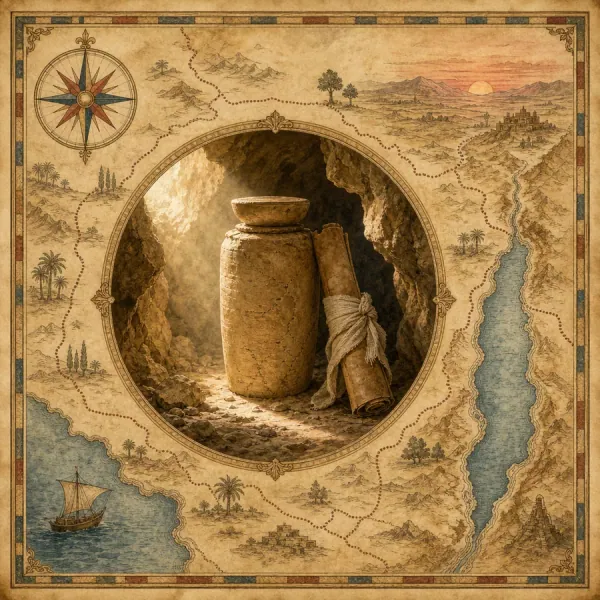
According to the investigation by the American scholar John C. Trever, who interviewed the shepherds, three Bedouin of the Ta'amireh tribe, Muhammed edh-Dhib, his cousin Jum'a Muhammed and Khalil Musa, came upon a cave between November 1946 and February 1947. Edh-Dhib was the first to go inside. In it, large clay jars held leather scrolls wrapped in linen. The shepherds took seven back to their camp, where for a while they hung from a tent pole.
Accounts differ, however, on the date and circumstances: some place the find in the spring of 1947, and historians point out that this tribe was already supplying antiquities to dealers in Bethlehem. The colorful tale of the shepherd searching for a stray goat may have been embellished. What is certain is the outcome: seven scrolls, taken from what is now called Cave 1.
💰 From the Bethlehem market to the scholars
A first antiquities dealer in Bethlehem turned the scrolls down, thinking them worthless. They ended up with Khalil Eskander Shahin, known as “Kando,” a cobbler and antiquities dealer. Four of them were bought by Mar Samuel, the metropolitan of the Syriac Orthodox Monastery of St. Mark in Jerusalem: the Great Isaiah Scroll, the Community Rule, the Habakkuk Commentary and the Genesis Apocryphon. The other three were acquired by the archaeologist Eleazar Sukenik, of the Hebrew University of Jerusalem, who confirmed their antiquity in December 1947.
Meanwhile, John Trever, of the American Schools of Oriental Research, compared the script of Mar Samuel's scrolls with that of the Nash Papyrus, then the oldest known Hebrew biblical manuscript, and found them similar. His 1948 photographs are invaluable: the ink on some scrolls later deteriorated. On April 11, 1948, in the middle of the Arab-Israeli war, the discovery was announced to the world.
The story of Mar Samuel's four scrolls has a surprising epilogue. On June 1, 1954, they were offered for sale in a classified ad in the Wall Street Journal. After discreet negotiations in New York, they were bought for $250,000 on Israel's behalf by the archaeologist Yigael Yadin, Sukenik's son, and Benjamin Mazar, then brought back to Jerusalem.
🏜️ The cave hunt: eleven hiding places in ten years
By late 1948, nearly two years after the discovery, no one knew exactly where the original cave was anymore. The region was at war and no search was possible. In early 1949, Jordan, which now controlled the West Bank, authorized the Arab Legion to search the area. On January 28, 1949, Cave 1 was found again by a Belgian United Nations observer, Captain Philippe Lippens, and an Arab Legion officer, Akkash el-Zebn.
⛏️ The archaeologists step in
The cave was excavated from February 15 to March 5, 1949, by Gerald Lankester Harding, the British director of Jordan's Department of Antiquities, and the Dominican priest Roland de Vaux, director of the French Biblical and Archaeological School of Jerusalem. They recovered some 600 fragments, linen cloth and jar shards. From 1951 to 1956, de Vaux also led the excavation of the nearby ruins of Khirbet Qumran.
Then a real race began. The value of the scrolls climbed as their importance became known, and Bedouin and archaeologists separately explored the cliffs over more than a kilometer.
- Cave 2 (February 1952), found by Bedouin: about 300 fragments from 33 manuscripts.
- Cave 3 (March 14, 1952), excavated by archaeologists: it yielded the strange Copper Scroll.
- Cave 4 (August 1952): by far the richest, with about 90% of the whole collection, some 15,000 fragments belonging to about 500 different texts.
- Caves 5 to 10 (from 1952): dozens of manuscripts, including Greek fragments on papyrus in Cave 7.
- Cave 11 (1956): the last, containing long scrolls, including the Temple Scroll.
🧩 A puzzle with tens of thousands of pieces
In Cave 4, the scrolls had decomposed into thousands of pieces, some just a few millimeters across. From 1953, an international team gathered them at the Palestine Archaeological Museum in East Jerusalem, in a room nicknamed the “scrollery.” Depending on the count, researchers have reconstructed between 870 and about 980 different manuscripts from the eleven caves.
The story isn't quite over. In February 2017, archaeologists from the Hebrew University announced a twelfth cave. They found only a blank piece of parchment in a jar, but broken jars and pickaxes from the 1950s show that it had been looted. Other texts have also been found elsewhere in the Judaean Desert, at Masada or Nahal Hever; that is why people sometimes speak, more broadly, of the “Judaean Desert manuscripts.”
The rest of the course
This page publishes the first 2 parts. The full course has 8: here is what the next ones cover.
- 📜 What the scrolls contain
The three main families of texts (biblical books, Jewish writings not included in the Bible, texts specific to one community), the languages, the writing materials and a few famous scrolls such as Isaiah, the Temple Scroll and the Copper Scroll.
- 🧪 Dating texts more than 2,000 years old
The methods used to date the manuscripts (handwriting, carbon-14, coins), the established results, the 2025 study combining radiocarbon and artificial intelligence, and the question of when they were hidden.
- 📖 A Bible a thousand years older
Why the manuscripts revolutionized the study of the Bible: they push back the oldest known Hebrew biblical texts by more than a thousand years, showing remarkably faithful transmission but also a wide variety of versions before AD 100.
- 🕵️ Who wrote the scrolls?
The dominant hypothesis of the Essenes of Qumran and its arguments, the objections and serious competing hypotheses (Sadducees, Jerusalem libraries, a Hasmonean fort), then the rejected theories, such as the Gospel of Mark in Cave 7.
- ⚖️ Delays, secrecy and ownership disputes
The decades of publication delays and the 1991 breakthrough, the damage caused by poor storage conditions, and the dispute between Israel, Jordan and the Palestinian Authority over ownership of the manuscripts.
- 🔬 Fake fragments and new technologies
The affair of the fake fragments that appeared on the market from 2002 and were exposed at the Museum of the Bible in Washington in 2018–2020, then the modern techniques (imaging, DNA, digitization, AI) that are moving the investigation forward today.
Study “The Dead Sea Scrolls” with flashcards and quizzes
In Oria, you read the full course, then practice on it: flashcards, multiple-choice quizzes, open questions or the Feynman method. Cards and questions then come back in your daily review, paced by spaced repetition.
Study this topic in OriaSources
These notes draw on the sources below. If a point seems doubtful, refer back to them.