Classic novels
The Metamorphosis by Franz Kafka: Summary and Study Notes
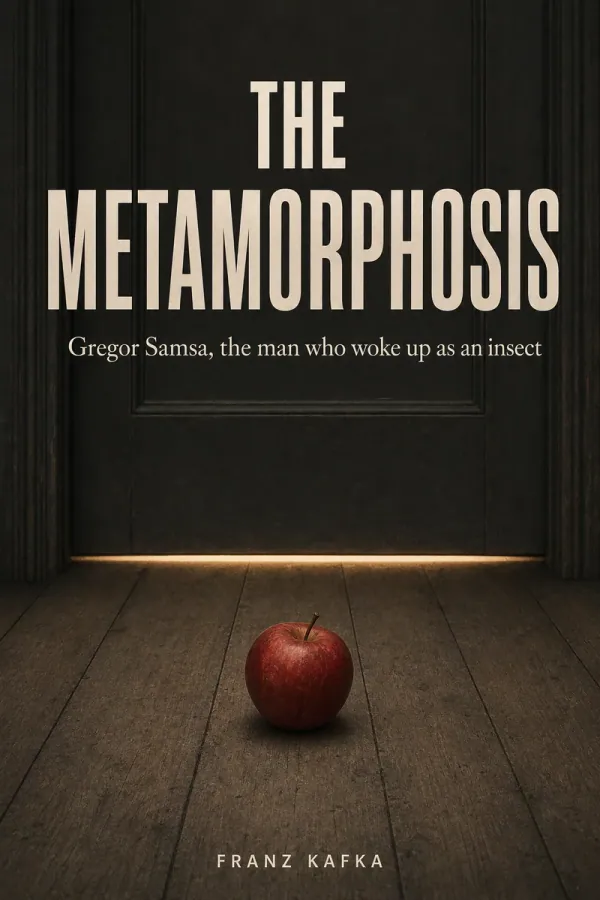
Gregor Samsa, the man who woke up as an insect
Study this topic in OriaThe essentials
Written in Prague in 1912 and published in 1915, The Metamorphosis tells the story of Gregor Samsa, a traveling salesman who wakes up one morning transformed into a “monstrous insect,” and of his family's slow reaction. Behind this absurd situation lie work, dependence, shame, loneliness, and a family that is transforming too. You'll discover who Kafka was, how he wrote the story in a few weeks, its plot part by part, the mystery of the German word Ungeziefer, and the major readings critics around the world have given it.
Key dates and facts
- 1883
- Born in Prague
- 1906
- Doctorate in law
- 1908
- Joins the Worker's Accident Insurance Institute
- 1912
- Meets Felice Bauer
- Nov. 17, 1912
- Idea for the story and start of writing
- Dec. 1912
- Text finished
- Oct. 1915
- Published in Die Weißen Blätter
- Dec. 1915
- First book edition from Kurt Wolff
- 1924
- Kafka dies near Vienna
- 1933
- First English translation
🏙️ Kafka, office worker by day, writer by night
Franz Kafka was born on July 3, 1883, in Prague, then the capital of the Kingdom of Bohemia, within the Austro-Hungarian Empire. His family was Jewish and spoke German, like only about a tenth of the city's inhabitants at the time; the majority spoke Czech. Kafka would write his entire body of work in German, but he also spoke Czech, which he had studied for eight years at school.
👨👦 An overbearing father
His father, Hermann Kafka, the son of a kosher butcher from a village, opened a shop in Prague selling haberdashery and fancy goods for women. Its sign showed a jackdaw, kavka in Czech, which is where the family name comes from. Franz was the eldest of six children: his two brothers died in infancy, and he grew up with three younger sisters, Elli, Valli, and Ottla. Kafka described his father, and his biographers have followed him, as a domineering, self-assured man. In 1919 he wrote him a long Letter to His Father, which he never sent. This strained relationship fed several of his stories.
⚖️ Law school and a “bread job”
After the German high school in the Old Town, Kafka entered the German University of Prague in 1901. He started out in chemistry, switched to law after two weeks, and took courses in German literature and art history on the side. That's where he met Max Brod, who would become his closest friend. He earned his doctorate in law on June 18, 1906.
On November 1, 1907, he joined an Italian insurance company, Assicurazioni Generali, but his hours (8 a.m. to 6 p.m.) kept him from writing. He resigned in July 1908 and joined the Worker's Accident Insurance Institute of the Kingdom of Bohemia. There he reviewed compensation claims from workers injured by machines, ranked factories by their risks, and wrote reports his superiors valued highly, earning him several promotions. His father called the post a Brotberuf, a “job to earn one's bread,” and Kafka often spoke of it with contempt.
🌙 Writing at night
His day followed a regular schedule: the office in the morning (he left around 2 p.m.), a few hours of sleep in the afternoon, a walk, dinner, then writing in the evening and late into the night. His first prose pieces appeared in 1909 in a Munich magazine. On August 13, 1912, at Max Brod's home, he met Felice Bauer, a young woman from Berlin who worked for a dictaphone company. Their intense correspondence began on September 20. Two days later, during the night of September 22–23, 1912, Kafka wrote the story The Judgment in a single sitting. He was also working on a novel, The Man Who Disappeared. It was in this period of feverish writing that The Metamorphosis would be born.
🛏️ A story born in bed, one Sunday in November
On Sunday, November 17, 1912, Kafka, twenty-nine, was sleeping in at his parents' apartment in Prague. The night before, he had worked late on his novel The Man Who Disappeared and gone to bed feeling he had damaged it rather than moved it forward. He was also waiting for a letter from Felice Bauer that hadn't come, and decided not to get up until it did. The mail arrived around noon. That evening he wrote back to Felice, and ended his letter by announcing a new project.
“Today I am going to write down a little story that came to me in bed in the depths of my misery and that haunts me in my innermost self.”
Franz Kafka, letter to Felice Bauer, November 17, 1912 (translated)
That little story was The Metamorphosis. The nod is obvious: like its author that morning, the hero has incredible difficulty getting out of bed in the opening pages. Kafka's bedroom, like Gregor Samsa's, also had three doors. He started that very evening. Whereas he had written The Judgment in one night, this story took him longer than expected: he finished it only after several weeks, in November and December 1912.
📰 A late publication
The text waited almost three years. It first appeared in October 1915 in Leipzig, in the Expressionist magazine Die Weißen Blätter, edited by René Schickele. In December 1915, the publisher Kurt Wolff brought it out as a book in his series “Der jüngste Tag” (“The Last Judgment”); the cover bears the date 1916. At about seventy printed pages, it is the longest of the stories Kafka considered finished and published in his lifetime.
🚫 “The insect itself is not to be drawn”
Before publication, Kafka learned that an illustrator was preparing the cover. On October 25, 1915, he sent his publisher a very precise request: the insect itself must not be drawn, or even shown from a distance. According to the critic Fernando Bermejo-Rubio, Kafka wanted readers to have no ready-made image before they read. This refusal, which some critics consider essential to understanding the story, partly explains why the creature remains so mysterious more than a century later.
The rest of the course
This page publishes the first 2 parts. The full course has 9: here is what the next ones cover.
- ⏰ Part I: Gregor wakes up
Part one: Gregor wakes up transformed, cannot get out of bed, the chief clerk arrives, and his father violently drives him back into his room.
- 🍎 Part II: the room, the picture, and the apple
Part two: Grete feeds Gregor, the family's finances come to light, the room is emptied, and the father wounds Gregor by pelting him with apples.
- 🎻 Part III: the violin and the end of Gregor
Part three: the family works and forgets him, three lodgers move in, Gregor comes out drawn by the violin, Grete demands they get rid of him, and he dies.
- 👨👩👧 The Samsas, a family in metamorphosis
The characters: Gregor, Grete, the father, the mother, the cleaning woman, and the lodgers, and the idea that the real metamorphosis is the family's.
- 🪲 What insect? The untranslatable word
The meaning of the German word Ungeziefer, the dozens of English translations, Nabokov's view on the beetle, and the debate over the title Verwandlung.
- 🧠 One hundred twenty-eight readings: what does The Metamorphosis mean?
The major interpretations of the story: the father, religion, society and work, Nabokov's artistic reading, the feminist reading, illness and disability, humor.
- 🌍 From Prague to the world: the story's legacy
Kafka's death, the survival of his work thanks to Max Brod, the word “Kafkaesque,” the influence on García Márquez and Murakami, and adaptations around the world.
Study “The Metamorphosis” with flashcards and quizzes
In Oria, you read the full course, then practice on it: flashcards, multiple-choice quizzes, open questions or the Feynman method. Cards and questions then come back in your daily review, paced by spaced repetition.
Study this topic in OriaSources
These notes draw on the sources below. If a point seems doubtful, refer back to them.