Classic novels
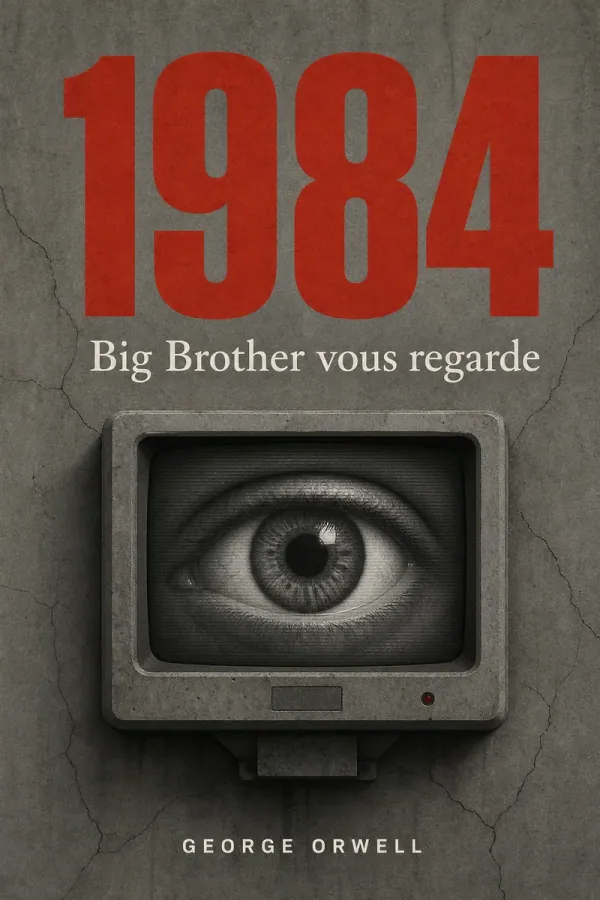
1984 by George Orwell: Summary and Study Notes
Big Brother is watching you
Study this topic in OriaThe essentials
Published in 1949, a few months before its author's death, 1984 imagines a Britain turned into a province of Oceania, a totalitarian state where the Party watches every move, rewrites the past and impoverishes language to make rebellion unthinkable. Winston Smith, a minor official at the Ministry of Truth, dares to love Julia and to doubt, until Room 101. You'll discover the book's background, Orwell himself, the plot part by part, its key concepts, its themes and its huge afterlife.
Key dates and facts
- 1944
- First notes and first pages
- May 1946
- Moves to the Isle of Jura
- 4 Dec 1948
- Manuscript sent to the publisher
- 8 Jun 1949
- Published in London
- 13 Jun 1949
- US release
- 1950
- First French translation
- 1988
- Ban lifted in the USSR
- 1 Jan 2021
- Enters the public domain
🖋️ A book written against the clock
Nineteen Eighty-Four, often written 1984, is a dystopian novel by the British writer George Orwell, published on 8 June 1949 by the London publisher Secker & Warburg. It is the last book he completed. In it he describes a totalitarian society where surveillance is constant, history is rewritten and thought itself is controlled.
💡 An idea born of the war
Orwell's first notes for the project date to at least January 1944, and perhaps to the start of the war. In a 1948 letter, he explains that he got the idea in 1944, following the Tehran Conference, where the Allies had begun carving up the world into zones of influence. The book, he wrote, was meant to discuss the consequences of this partition and to show, by parodying them, the intellectual implications of totalitarianism. In January 1944 he was introduced to the Russian Yevgeny Zamyatin's We, a 1920s dystopia he would review in 1946 and from which 1984 borrows heavily. His other influences include Arthur Koestler's Darkness at Noon, the Swedish writer Karin Boye's Kallocain, and James Burnham's The Managerial Revolution, which predicted perpetual war between three totalitarian super-states.
🏝️ Alone on the Isle of Jura
In June 1944, Orwell told his publisher Fredric Warburg that he had written the first twelve pages. The success of Animal Farm in 1945 made him famous and encouraged him to write his own dystopia. In May 1946 he moved to Barnhill, an isolated farmhouse with no electricity or hot water on the Scottish island of Jura. His health declined: by the autumn of 1947 he was bedridden, had lost nearly 13 kilos, but refused to see a doctor and kept writing. He finished the first draft in bed on 7 November 1947. At a hospital near Glasgow, he was diagnosed with chronic tuberculosis.
⌨️ A race against illness
Discharged from hospital in the summer of 1948, he returned to Jura and finished a second draft in November. The manuscript was so heavily corrected that only he could decipher it: with no typist available, he retyped it himself, at a rate of roughly 4,000 words a day, between bouts of fever and coughing blood. He sent it to his publisher on 4 December 1948 and left Jura for good in January 1949.
🔢 Why "1984"?
Orwell wavered for a long time between two titles: The Last Man in Europe and 1984. Warburg pushed him toward the latter, judging it more commercial. It has often been said that 1984 was simply 1948, the year he finished the book, turned around, but the biographer Dorian Lynskey doubts this explanation: in the drafts, Orwell had first written 1980, then 1982, before settling on 1984.
✊ George Orwell, a socialist against totalitarianism
George Orwell is the pen name of Eric Arthur Blair, born on 25 June 1903 in Motihari, India, then under British rule. His father was an official in the opium department there. His entire body of work bears the mark of his personal experiences and commitments.
🌏 The colonial experience
As a young man, he served in the Imperial Police in Burma. There he saw the violence of colonial rule from the inside, and came back deeply opposed to British imperialism.
🏚️ Among the poor
Back in Europe, he shared the life of the poorest people in Paris and London, then, at the request of the publisher Victor Gollancz, investigated the living conditions of coal miners in the north of England: the result was The Road to Wigan Pier. These experiences made him a champion of social justice and socialism, but a socialist "from the ground up", deeply impatient with the intellectual left. In June 1936, he married Eileen O'Shaughnessy.
🇪🇸 The Spanish Civil War
In late December 1936, he left to fight Franco in Spain, in the militias of the POUM, the Workers' Party of Marxist Unification. Shot through the throat, he then had to flee the country in secret: in June 1937 the POUM, branded a "fascist party" by communist propaganda, was declared illegal, and Orwell had to leave to avoid arrest. He recounted this experience in Homage to Catalonia (1938). It left him with a lasting distrust of Stalinism and political lying.
📻 The war and the BBC
During the Second World War, he joined the Home Guard, then in 1941 became a producer at the BBC, broadcasting to India. There he observed wartime propaganda and censorship up close. 1945 saw the publication of Animal Farm, a fable about a betrayed revolution, which made him famous. That same year, his wife Eileen died.
✍️ Why he wrote
In 1946, in the essay Why I Write, Orwell summed up the meaning of his work since Spain: since 1936, he explained, everything he had written that was serious had been written, directly or indirectly, against totalitarianism and in support of democratic socialism, as he understood it.
🕯️ An early end
Gravely ill, he was hospitalized in London in September 1949. There he married Sonia Brownell on 13 October, and there he died of tuberculosis on 21 January 1950, aged 46, just seven months after 1984 was published.
The rest of the course
This page publishes the first 2 parts. The full course has 9: here is what the next ones cover.
- 🌐 Oceania, the Party and Big Brother
The world of the novel: three super-states locked in perpetual war, Oceania and its ideology Ingsoc, society split into Inner Party, Outer Party and proles, Big Brother, telescreens, Goldstein and the four ministries.
- 🗂️ Winston Smith, falsifier of the past
The hero and his work at the Ministry of Truth: rewriting archives, memory holes, "unpersons", Comrade Ogilvy, the secret diary and Winston's first doubts.
- ❤️ Julia: love as rebellion
Winston and Julia's secret affair, the room above Charrington's shop, the meeting with O'Brien, Goldstein's book and the arrest.
- 🔤 Newspeak and doublethink
The novel's two great intellectual inventions: Newspeak, the impoverished language meant to make dissent unthinkable, and doublethink, the art of believing two contradictory things at once; plus the appendix on Newspeak.
- 🐀 O'Brien and Room 101
Part Three: imprisonment at the Ministry of Love, O'Brien's betrayal, torture, the doctrine of power for its own sake, Room 101 and the rats, Julia's betrayal and the novel's ending.
- 🔍 Surveillance, truth, language
The novel's big themes and their real-world sources: total surveillance, the manipulation of truth and history, language, power and poverty, drawn from Stalinism, Nazism and wartime Britain.
- 📡 Afterlife: Big Brother and "Orwellian"
The novel's reception, its sales and translations, its underground circulation in the Eastern Bloc, its adaptations and how its vocabulary (Big Brother, Newspeak, Orwellian) entered everyday language and public debate.
Study “1984” with flashcards and quizzes
In Oria, you read the full course, then practice on it: flashcards, multiple-choice quizzes, open questions or the Feynman method. Cards and questions then come back in your daily review, paced by spaced repetition.
Study this topic in OriaSources
These notes draw on the sources below. If a point seems doubtful, refer back to them.