Classic novels
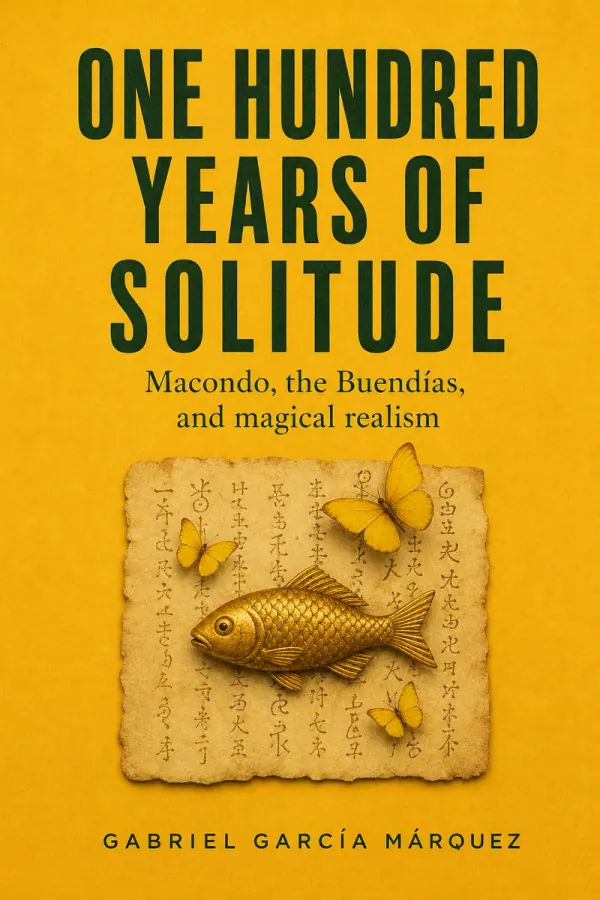
One Hundred Years of Solitude by Gabriel García Márquez: Summary and Study Notes
Macondo, the Buendías, and magical realism
Study this topic in OriaThe essentials
Published in Buenos Aires in 1967, One Hundred Years of Solitude tells of the founding, glory, and disappearance of Macondo, an imaginary village in Colombia, through seven generations of the Buendía family. Gabriel García Márquez blends civil wars, a banana company, ghosts, and wonders told as though perfectly ordinary: it is the flagship book of magical realism. You'll discover how it was written, who "Gabo" was, a clear family tree so you never confuse one Aureliano for another, the plot part by part, its major themes, and its immense legacy.
Key dates and facts
- 1952
- Trip to Aracataca with his mother
- 1965
- Epiphany on the road to Acapulco
- 1967
- Published in Buenos Aires
- 1970
- English translation by Gregory Rabassa
- 1927
- Born in Aracataca
- 1947
- First short story published
- 1982
- Nobel Prize in Literature
- 2014
- Dies in Mexico City
- 1906
- Railroad reaches the Caribbean coast
- Nov. 1928
- Banana workers go on strike
🖋️ Eighteen months in "the mafia's cave"
One Hundred Years of Solitude (Cien años de soledad) is the novel by the Colombian writer Gabriel García Márquez that tells the story of the Buendía family and the imaginary village of Macondo. The idea took years to take shape. From age eighteen, the author dreamed of writing a book about his grandparents' house in Aracataca, the Caribbean coast village where he grew up. In 1952, a trip to his home village with his mother revived the project, and the name Macondo first appeared in a short story published in 1954. Several characters from the future novel also pass through his earlier books.
🚗 A U-turn on the road to Acapulco
For a long time, García Márquez could not find the right tone. The solution came to him in 1965, while driving his family toward Acapulco for a vacation. He turned around, went back home to Mexico City, where he had lived since 1961, and got to work. He first planned to call his book The House, then dropped the idea to avoid confusion with La Grande Maison, a novel by his friend Álvaro Cepeda Samudio.
💸 Writing without money
The writing took about eighteen months, between 1965 and 1966. The author had quit his job and sold his car to support his family. His wife, Mercedes Barcha, bought bread and meat on credit, and the couple fell nine months behind on rent. García Márquez typed on an Olivetti typewriter, in a room ten feet by six that the family nicknamed "the mafia's cave." He wrote all day, smoked heavily, and listened to Bartók, Debussy, and the Beatles. In the evenings, he met friends and told them how the book was coming along; the novel would be dedicated to two of them, Jomí García Ascot and María Luisa Elío.
📮 The manuscript cut in half
A famous anecdote, reported by his biographer Gerald Martin, sums up these months of hardship. To mail the typescript to the Argentine publisher, the writer and his wife went to the post office, but postage cost 82 pesos, which they didn't have. They sent only half the text, then sold their heater, hair dryer, and blender to pay to mail the other half.
📚 A publication in Buenos Aires
The book was published in Buenos Aires by Editorial Sudamericana, in late spring 1967: sources give late May or early June. The first print run numbered close to eight thousand copies. The novel is made up of twenty untitled chapters: the first three tell of the founders' exodus and the birth of Macondo, chapters 4 through 16 its economic, political, and social rise, and the last four its decline.
🌴 Gabo, from Aracataca to the Nobel Prize
Gabriel García Márquez, nicknamed "Gabo" throughout Latin America, was born on March 6, 1927, in Aracataca, in Colombia's Caribbean region (some sources give 1928). The eldest of eleven children, he was raised not by his parents, who had moved to Barranquilla, but by his maternal grandparents. It is they who, thirty years later, gave birth to the world of Macondo.
👴 The colonel and the storyteller
His grandfather, Colonel Nicolás Ricardo Márquez Mejía, was a liberal veteran of the Thousand Days' War, an excellent storyteller, who refused to stay silent about the 1928 banana plantation massacre. It was he who took the boy to the circus every year and introduced him to ice, a "miracle" found at the banana company's store. His grandmother, Tranquilina Iguarán Cotes, filled the house with ghosts, omens, and prophecies, and told the extraordinary as though it were perfectly natural. García Márquez would say she was the source of his magical, superstitious view of reality: this deadpan tone would become that of One Hundred Years of Solitude.
📰 A journalist above all
Enrolled in law school in Bogotá to please his father, he preferred literature. After reading Kafka's The Metamorphosis, he published his first short story in 1947 in the newspaper El Espectador. The riots of the Bogotazo, in April 1948, closed the university: he left for Cartagena, then Barranquilla, where he became a journalist and discovered Faulkner and Virginia Woolf. In 1955, an investigation into a Colombian navy shipwreck caused a scandal; his paper sent him to Europe. He married Mercedes Barcha in 1958 and settled with her in Mexico City in 1961.
🏆 Fame and the Nobel Prize
The success of One Hundred Years of Solitude made him famous worldwide. He lived for several years in Barcelona, published The Autumn of the Patriarch (1975), Chronicle of a Death Foretold (1981), and Love in the Time of Cholera (1985). In 1982, he received the Nobel Prize in Literature "for his novels and short stories, in which the fantastic and the realistic are combined in a richly composed world of imagination, reflecting a continent's life and conflicts." In Stockholm, he wore a liquiliqui, a traditional white garment from Venezuela and parts of Colombia, instead of formal dress. A man of the left and a friend of Fidel Castro, he also played a mediating role between the Colombian government and guerrilla groups.
🕯️ The final years
Diagnosed with lymphatic cancer in 1999, he undertook his memoirs, Living to Tell the Tale (2002). He died in Mexico City on April 17, 2014; Colombia declared three days of national mourning. His ashes have rested since 2016 in Cartagena de Indias.
The rest of the course
This page publishes the first 2 parts. The full course has 9: here is what the next ones cover.
- 🌳 Seven generations of Buendías, without getting lost
The Buendía family tree explained generation by generation, with landmarks so you never confuse one José Arcadio or Aureliano for another.
- 🧲 The founding of Macondo and the gypsies
The novel's beginnings: the murder of Prudencio Aguilar, the founders' exodus, the dream of the city of mirrors, Melquíades's gypsies' inventions, and the insomnia plague.
- ⚔️ Colonel Aureliano and the civil wars
The novel's war section: politics arrives in Macondo, Aureliano becomes the liberal colonel of the civil wars, Arcadio turns tyrant, then peace leaves the colonel alone with his little gold fish.
- 🍌 The train, the banana company, and the massacre
Prosperity, then tragedy: the arrival of the train and the American banana company, the loves of the fourth and fifth generations, Remedios the Beauty's ascension, and the massacre of strikers inspired by the one in 1928.
- 🌧️ The deluge and the end of the Buendías
The final chapters: four years of rain, Macondo's ruin, Úrsula's death, the love of Aureliano Babilonia and Amaranta Úrsula, the child with a pig's tail, and the deciphering of Melquíades's parchments.
- 🔮 Magical realism, solitude, and circular time
The major themes: magical realism and its deadpan tone, solitude as a family curse, time turning in circles, incest, biblical echoes, and the allegory of Latin American history.
- 🌍 A world-novel, from Neruda to Netflix
Reception and legacy: immediate, worldwide success, awards, influence on writers around the globe, the author's ambivalent view of his own book, and the 2024 TV adaptation.
Study “One Hundred Years of Solitude” with flashcards and quizzes
In Oria, you read the full course, then practice on it: flashcards, multiple-choice quizzes, open questions or the Feynman method. Cards and questions then come back in your daily review, paced by spaced repetition.
Study this topic in OriaSources
These notes draw on the sources below. If a point seems doubtful, refer back to them.