Classic novels
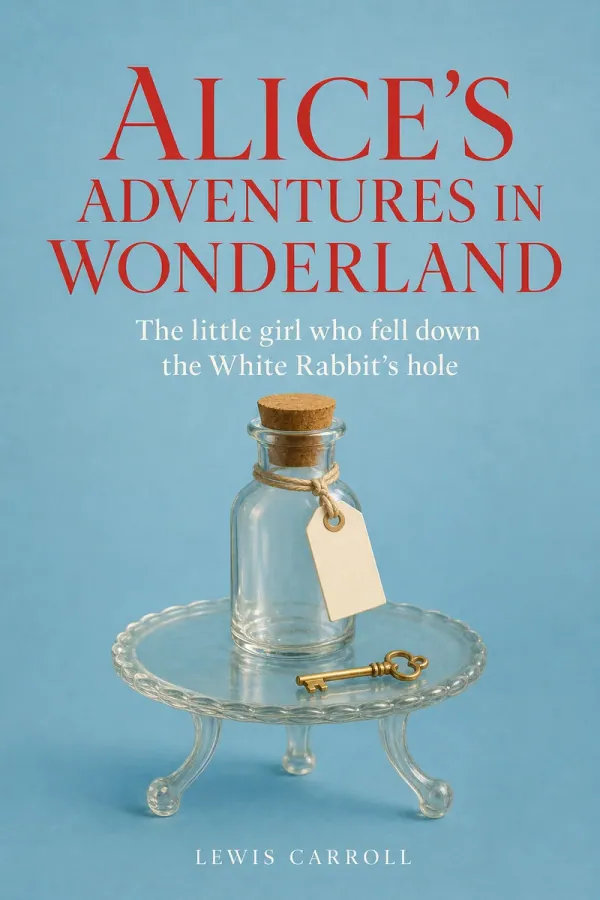
Alice's Adventures in Wonderland by Lewis Carroll: Summary and Study Notes
The little girl who fell down the White Rabbit's hole
Study this topic in OriaThe essentials
Invented one July afternoon in 1862 in a rowing boat near Oxford and published in 1865, Alice's Adventures in Wonderland tells the dream of a little girl who follows a White Rabbit underground and discovers a world where the rules no longer obey common sense. Behind the children's story is an Oxford mathematician, Charles Dodgson, a master of wordplay and logic. You'll discover how the book came about, its author, its famous episodes, the real people behind its characters, “nonsense” and Alice's immense legacy around the world.
Key dates and facts
- July 4, 1862
- The boat trip and the first telling
- Nov. 26, 1864
- Manuscript given to Alice Liddell
- July 1865
- First printing withdrawn at Tenniel's request
- Nov. 1865
- Published by Macmillan
- 1871
- Sequel: Through the Looking-Glass
- 1907
- The book enters the public domain in the UK
- 1928
- The manuscript sells for £15,400, a record at the time
- 1951
- Disney animated film
🚣 A golden afternoon on the Isis
It all began on July 4, 1862. That day, a young Oxford mathematics lecturer, Charles Dodgson, and his friend the Reverend Robinson Duckworth rowed up the Isis, as the Thames is called at Oxford. With them were three little girls: the Liddell sisters, daughters of the dean of Christ Church college. Lorina was 13, Alice 10 and Edith 8. Setting off from Folly Bridge, the little expedition stopped at Godstow, about five miles upriver. Along the way, Dodgson made up a story for them: the story of a little girl named Alice who falls down a rabbit hole.
The book would keep the memory of that day in its opening poem, “All in the golden afternoon,” in which the three sisters appear as Prima, Secunda and Tertia. A funny detail: according to the scholar Martin Gardner, the weather that day was actually rather cool and damp, although others dispute this. And researchers still debate whether the whole story was really born in a single afternoon or ripened over a longer time.
📜 From spoken tale to manuscript
Alice Liddell asked Dodgson to write her story down: unlike the other tales he told them, she wanted to keep this one. He started the very next day, then in earnest from November. On November 26, 1864, he gave Alice a handwritten manuscript decorated with 37 of his own drawings, Alice's Adventures Under Ground, with this dedication: “A Christmas Gift to a Dear Child in Memory of a Summer's Day.” This unique manuscript is now held at the British Library in London.
Meanwhile, the children of the writer George MacDonald, who had read the text and loved it, persuaded Dodgson to publish it. The London publisher Macmillan agreed. The title was settled after other attempts, such as Alice Among the Fairies. The published version is about twice as long as the manuscript and adds entire episodes, including the famous tea party at the Hatter's.
🖋️ Tenniel and a scrapped first edition
For the illustrations, Dodgson turned to John Tenniel, a renowned cartoonist for the satirical magazine Punch, who produced 42 drawings engraved on wood. In July 1865, 2,000 copies were printed, but Tenniel judged the printing too poor. Dodgson halted distribution and paid out of his own pocket, 600 pounds, for a new printing by the printer Richard Clay. The book finally came out in November 1865, bound in red, a color chosen to appeal to children. The sheets of the first printing were sold to a New York publisher. Only about twenty copies of that first edition are known to survive today.
🎓 Charles Dodgson, Oxford mathematician
Lewis Carroll is the pen name of Charles Lutwidge Dodgson, born on January 27, 1832, at the parsonage in Daresbury, Cheshire, in northwest England. He was the third of eleven children and the eldest son of a very conservative Anglican clergyman. When he was 11, the family moved to the large rectory at Croft-on-Tees, in Yorkshire, where they would live for twenty-five years. As a child, he was already writing and illustrating little family magazines to amuse his brothers and sisters. He also had a stammer, shared by several of his siblings, which would trouble him all his life.
📐 A whole life at Christ Church
After Rugby School, where he was unhappy, he entered Christ Church, one of the colleges of the University of Oxford, in 1850. A brilliant student, he took first place in mathematics in 1854. He would stay there all his life, as a student, a mathematics lecturer and then a resident. In 1856, to sign pieces in a magazine, he made up a pseudonym: he translated his first names, Charles Lutwidge, into Latin (Carolus Ludovicus), reversed them, then turned them back into English. The result was Lewis Carroll. Ordained a deacon in 1861, as his post then required, he declined to become a priest, for reasons that are still debated.
Under his real name, Dodgson published works on geometry, algebra and logic, such as Euclid and His Modern Rivals (1879) and Symbolic Logic. Historians of science credit him with original ideas, notably a “tree” method in logic and work on voting systems. He also loved inventing puzzles, games and secret codes.
📷 The photographer
In 1856, Dodgson took up photography, then a brand-new art. He set up a studio on the roof of a Christ Church building and took about 3,000 pictures over twenty-four years, fewer than a thousand of which have survived. He photographed writers, painters, scientists and many children, including some twenty portraits of Alice Liddell. He stopped abruptly in 1880. His portraits of children and his friendships with young girls fueled suspicions in the 20th century and long debates among biographers: some, like Morton Cohen, see repressed feelings in them, while others, like Karoline Leach and Jenny Woolf, point to the artistic conventions of the time and the absence of evidence. Dodgson's break with the Liddell family, in June 1863, also remains unexplained: the corresponding pages of his diary have disappeared.
📚 After Alice
Alice's success made him famous around the world without changing his orderly life in Oxford. He published a sequel, Through the Looking-Glass (1871), the long nonsense poem The Hunting of the Snark (1876) and a two-volume novel, Sylvie and Bruno (1889 and 1893), which was far less popular. He died of pneumonia on January 14, 1898, at his sisters' home in Guildford, southwest of London, shortly before his 66th birthday.
The rest of the course
This page publishes the first 2 parts. The full course has 8: here is what the next ones cover.
- 🐇 The fall and the transformations
The first five chapters: Alice follows the White Rabbit, falls down the rabbit hole, keeps changing size, swims in her own tears and meets the Caterpillar.
- 🎩 The Cat, the Duchess and the mad tea party
Chapters 6 and 7: the Duchess's kitchen, the baby that turns into a pig, the Cheshire Cat and the endless tea party of the Hatter and the March Hare.
- 👑 The Queen of Hearts and the trial
Chapters 8 to 12: the garden of playing cards, the croquet game, the Mock Turtle and the Gryphon, the trial of the Knave of Hearts and Alice's awakening.
- 🦤 Characters, parodies and inside jokes
The book's characters and the real people they evoke, the parodied poems and the role of John Tenniel's illustrations.
- 🧩 Nonsense, logic and mathematics
What literary “nonsense” means, how Carroll plays with rules, language and mathematics, and the major interpretations of the book.
- 🌍 A worldwide success that never stops
Alice's reception since 1865, its sequel, its translations, its records, and its adaptations for the stage, the screen and popular culture in many countries.
Study “Alice's Adventures in Wonderland” with flashcards and quizzes
In Oria, you read the full course, then practice on it: flashcards, multiple-choice quizzes, open questions or the Feynman method. Cards and questions then come back in your daily review, paced by spaced repetition.
Study this topic in OriaSources
These notes draw on the sources below. If a point seems doubtful, refer back to them.