Classic novels
Candide, or Optimism by Voltaire: Summary and Study Notes
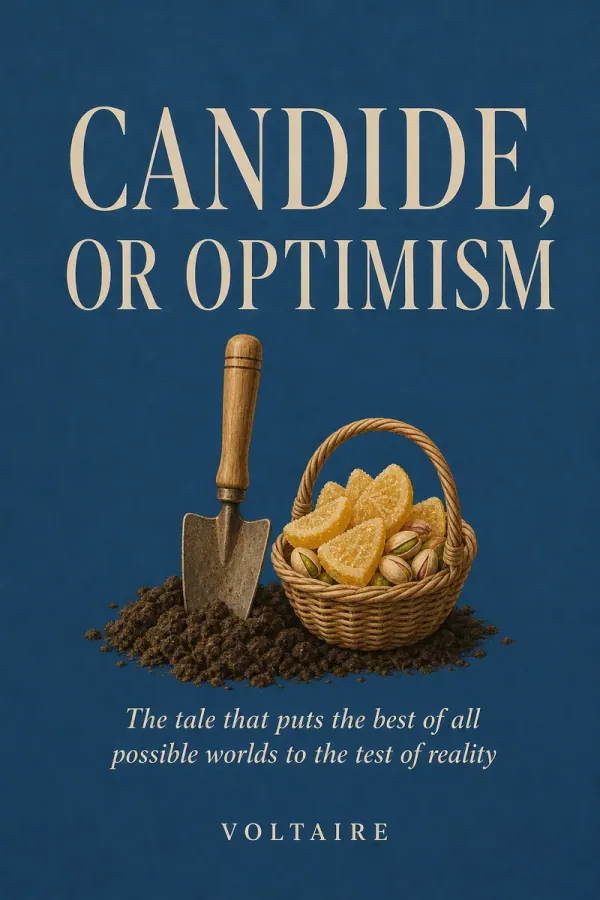
The tale that puts the best of all possible worlds to the test of reality
Study this topic in OriaThe essentials
Thrown out of a castle in Westphalia for a kiss, young Candide travels across Europe, the Americas, and Turkey, repeating the lesson taught by his tutor Pangloss: everything is for the best in the best of all possible worlds. Published secretly in 1759, four years after the Lisbon earthquake, this philosophical tale by Voltaire mocks Leibniz's optimism with devastating irony. You'll see where the book comes from, how the journey unfolds step by step, who Pangloss, Cunégonde, Martin, and Cacambo are, and what the famous closing line means: "we must cultivate our garden."
Key dates and facts
- 1710
- Leibniz publishes the Theodicy
- Nov. 1, 1755
- The Lisbon earthquake
- 1756
- The Seven Years' War begins
- March 14, 1757
- Admiral Byng is executed
- 1694
- François-Marie Arouet is born in Paris
- 1758
- Candide is written; Voltaire settles at Ferney
- January 1759
- Candide is published anonymously
- 1762
- Candide placed on the Index
- 1760
- A fake "part two" appears
- 1929
- Copies seized by Boston customs
🌋 Lisbon, Leibniz, and war
Candide, or Optimism, the philosophical tale Voltaire published in 1759, answers a question that stirred the whole 18th century: if God is good and all-powerful, why does evil exist? To understand this short book's joyful anger, one needs to know the philosophy it attacks and the disasters that made it necessary.
🧠 The "best of all possible worlds"
The phrase comes from the German philosopher and mathematician Gottfried Wilhelm Leibniz, in his Theodicy, published in 1710. In his view, God chose, among all the possible worlds he could have created, the one containing the greatest possible amount of good. Evil exists, but it is part of the best overall combination: the world could not be improved in one respect without being made worse in another. Leibniz adds to this the principle of sufficient reason (nothing happens without a cause) and the idea of pre-established harmony.
Voltaire saw in this philosophy an encouragement to fatalism: if everything is necessary and for the best, what is the point of fighting against misfortune? He himself had once believed it: in his Elements of Newton's Philosophy (1738), he wrote that "what is bad in relation to you is good within the general order." His former companion, the scholar Émilie du Châtelet, who died in 1749, was a committed reader of Leibniz.
🌊 November 1, 1755
On the morning of All Saints' Day 1755, around 9:40 a.m., an earthquake estimated at magnitude 8.5 to 9 struck Lisbon. A tsunami then swamped the harbor, and fires ravaged the city for five days. An estimated 50,000 to 70,000 people died out of a population of 275,000. All of Europe was shaken: how could thousands of victims, killed on a day of religious celebration, be reconciled with the work of a benevolent Providence?
Voltaire responded first with a poem, the Poem on the Lisbon Disaster (1756). Jean-Jacques Rousseau sent him a letter, known as the Letter on Providence, defending the idea of a divine order. In his Confessions, Rousseau would later claim that Candide was the long-delayed answer to that letter. The German philosopher Theodor Adorno summed up the shock in 1966, writing that the Lisbon earthquake was enough to "cure Voltaire of Leibniz's theodicy" (translated).
⚔️ The Seven Years' War
To this natural disaster was added a man-made one: the Seven Years' War, which broke out in 1756 and pitted Frederick II's Prussia against France, among others. In the tale, the "Bulgars" stand for the Prussians and the "Abares" for the French, according to the notes of the Garnier edition of Voltaire's works. The execution of the English admiral John Byng, shot at Portsmouth on March 14, 1757, for not having fought hard enough, inspired a famous episode. Voltaire had tried, in vain, to save him.
🪶 Voltaire, the writer of Les Délices
Behind Candide stands Voltaire, born François-Marie Arouet in Paris on November 21, 1694, and who died in Paris on May 30, 1778. During his lifetime, he was famous above all as a poet and author of tragedies. Today, it is his philosophical tales, Candide foremost among them, that remain the most widely read.
🏛️ A life of struggles and exile
Educated by the Jesuits at the Collège Louis-le-Grand, the young Arouet quickly drew notice for his skill at writing verse. His insolence twice landed him in the Bastille, and then sent him to England from 1726 to 1728, where he admired English liberty and discovered Newton. His Philosophical Letters (1734), a tribute to that liberty, caused a scandal in France. He then lived mostly at the Château de Cirey, with Émilie du Châtelet.
In 1750, he joined the court of Frederick II of Prussia, who admired him. But relations soured; Voltaire left Prussia in March 1753, and the king even had him arrested in Frankfurt. Forbidden from approaching Paris, he settled near Geneva, in the handsome house called Les Délices, then bought the château of Ferney, on French territory, where he moved in October 1758. Some critics see in the "king of the Bulgars" in Candide a kind of revenge on Frederick II.
✍️ A tale written in secret
The exact date of composition is unknown. Scholars believe Voltaire wrote most of it in late 1758, perhaps as early as 1757, at Les Délices and during a three-week stay at Schwetzingen, at the court of the Elector Palatine, in the summer of 1758. The legend that the book was written in three days rests on nothing solid. Only one manuscript predating publication has survived, the La Vallière manuscript, rediscovered in 1956.
The book appeared in January 1759, simultaneously in five countries, notably published by Cramer in Geneva and Marc-Michel Rey in Amsterdam. Voltaire did not sign it: the title page presents it as "translated from the German of Mr. Doctor Ralph," with additions found in his pocket "when he died at Minden, in the year of grace 1759." No one was fooled. Within a month, six thousand copies were sold, then 20,000 to 30,000 within the year, across more than twenty editions.
⛔ A banned book
Success came with scandal. As early as late February 1759, the Grand Council of Geneva and the authorities in Paris banned the book, accusing it of blasphemy and sedition. In 1762, the Catholic Church placed it on the Index of forbidden books. At the same time, the great Encyclopédie of Diderot and d'Alembert, to which Voltaire contributed, was also banned. A short, funny tale thus became an effective way of spreading Enlightenment ideas far beyond an educated elite.
The rest of the course
This page publishes the first 2 parts. The full course has 9: here is what the next ones cover.
- 🏰 From Westphalia to Lisbon (chapters I to X)
The start of the story: expulsion from the castle of Thunder-ten-Tronckh, the Bulgar army, Jacques the Anabaptist, the shipwreck, the earthquake, and the Lisbon auto-da-fé.
- 🌎 The Americas and El Dorado (chapters XI to XVIII)
The American part: the old woman's story, the flight to Paraguay with Cacambo, Cunégonde's Jesuit brother, the Oreillons, and the utopian land of El Dorado.
- ⛓️ From Suriname to Constantinople (chapters XIX to XXIX)
The return to Europe: the slave of Suriname, meeting Martin, Paris, the admiral shot in England, Venice and its disillusioned elite, and the final reunion in Constantinople.
- 🌱 The farm: "we must cultivate our garden" (chapter XXX)
The resolution of Candide: boredom on the farm, the dervish, the old Turk, and the meaning of the final line, "we must cultivate our garden."
- 🎭 Pangloss, Cunégonde, Martin, Cacambo: the characters
Portraits of the main characters of Candide and what they represent: Candide, Pangloss, Cunégonde, Martin, Cacambo, the old woman, and the secondary figures.
- 😏 A philosophical tale armed with irony
The genre and techniques of Candide: philosophical tale, irony, antiphrasis, accumulation, fast pacing, and the targets of its satire (war, religion, nobility, slavery).
- 🌍 Legacy: from scandal to classic
The reception of Candide since 1759: success, censorship, its influence on literature, the word "Panglossian," and adaptations, including Bernstein's operetta.
Study “Candide, or Optimism” with flashcards and quizzes
In Oria, you read the full course, then practice on it: flashcards, multiple-choice quizzes, open questions or the Feynman method. Cards and questions then come back in your daily review, paced by spaced repetition.
Study this topic in OriaSources
These notes draw on the sources below. If a point seems doubtful, refer back to them.