Classic novels
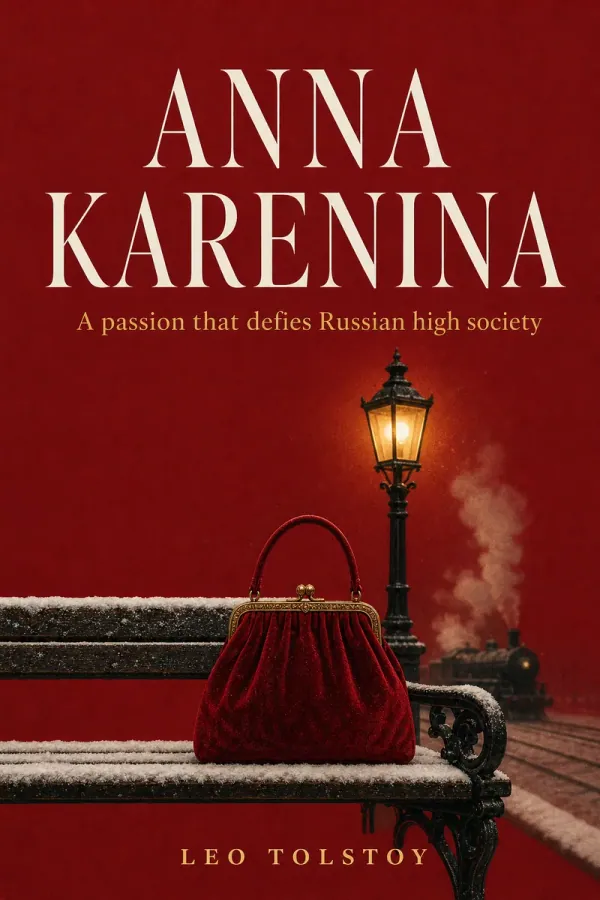
Anna Karenina by Leo Tolstoy: Summary and Study Notes
A passion that defies Russian high society
Study this topic in OriaThe essentials
Serialized from 1875 to 1877 and published as a book in 1878, Leo Tolstoy's Anna Karenina follows two parallel lives in 1870s Russia: that of Anna, wife of a senior St. Petersburg official, whose affair with Count Vronsky leads to her ostracism, and that of Levin, a landowner seeking happiness in marriage and the meaning of life. You'll discover Tolstoy before the novel, how the book came to be, the plot part by part, its great characters and themes, the Russia of Alexander II's reforms, and the worldwide reception of a novel that Faulkner named three times among the greatest.
Key dates and facts
- 1828
- Born at Yasnaya Polyana
- 1855
- Siege of Sevastopol
- 1862
- Marries Sophia Behrs
- 1869
- Completes War and Peace
- Mar. 1873
- Begins writing
- 1875
- Serialization begins
- June 1877
- The journal refuses Part Eight
- 1878
- First edition in book form
- 1861
- Emancipation of the serfs
- 1876
- Serbian uprising and Russian volunteers
🏡 Tolstoy before Anna
Count Lev Nikolayevich Tolstoy, known in English as Leo and in French as Léon, was born on September 9, 1828 (August 28 in the Julian calendar then used in Russia) at Yasnaya Polyana, the family estate, about 200 kilometers south of Moscow. He came from an old family of the Russian nobility. His mother died when he was two and his father when he was nine: he was raised by relatives.
⚔️ The young nobleman and war
In 1844, he entered Kazan University to study law and Oriental languages; his teachers judged him “both unable and unwilling to learn,” and he dropped out. He then led a life of pleasure in Moscow and St. Petersburg, piled up gambling debts and, in 1851, joined the army in the Caucasus. As an artillery officer during the Crimean War, he lived through the siege of Sevastopol (1854–1855) and drew from it his Sevastopol Sketches. His first book, Childhood (1852), a story inspired by his youth, had already made his name.
🌍 Europe and the peasants
Two trips to Europe, in 1857 and 1860–1861, transformed him. In Paris, he witnessed a public execution, an experience that marked him for life. He met Victor Hugo and the anarchist thinker Proudhon. Back in Russia just as Alexander II abolished serfdom in 1861, he founded thirteen schools for the children of newly freed peasants, run on principles that were very liberal for the time. These experiments were short-lived, partly because of harassment by the tsar's secret police.
💍 Sophia and War and Peace
On September 23, 1862, he married Sophia Behrs, the daughter of a court physician, sixteen years his junior. On the eve of the wedding, he had her read his diaries, in which he detailed his past, including a child born to a peasant woman on his estate. The couple would have thirteen children, eight of whom survived childhood. The early years were happy: Sophia was at once his secretary, proofreader and business manager, and she copied out his enormous manuscripts by hand.
It was in this calm that he wrote War and Peace, completed in 1869, a vast panorama of Russia facing Napoleon. But this summit left him empty. He became fascinated by the German philosopher Schopenhauer, worked on a primer for children, reopened a school. He was looking for a new subject.
✍️ An unfaithful wife and four years of writing
Tolstoy wanted to write a “novel of contemporary life whose subject would be an unfaithful wife.” The spark came in March 1873, as he was leafing through Pushkin's Tales of the Late Ivan Petrovich Belkin, which his son Sergei was reading. He began writing at once. His first drafts were titled Two Marriages, Two Couples: from the start, he conceived the book as a comparison.
🚉 Real-life sources
Two real-life elements fed the character. Anna is thought to have been partly inspired by Maria Hartung (1832–1919), the eldest daughter of the poet Alexander Pushkin. And for the ending, Tolstoy remembered a tragedy that had occurred near his home in January 1872: the mistress of his neighbor Bibikov had thrown herself under a train. Tolstoy had gone to see her body.
😩 “I hate what I have written”
The writing was slow, interrupted by bereavements: in November 1873, his youngest child, Pyotr, died at eighteen months; the following year, another son, Nikolai, lived little more than a year. Tolstoy doubted his book. In 1876, he lamented over the proofs he had to correct:
“I hate what I have written. The proofs of Anna Karenina for the April issue of The Russian Messenger are lying on my desk, and I truly do not have the heart to correct them.”
Leo Tolstoy, 1876, quoted by Ruth Benson (translated)
📰 A hit serial, a censored ending
The novel appeared in installments in the journal The Russian Messenger from January 1875 to May 1877. It was an enormous success: society ladies reportedly sent their servants to the printing house to learn what happened next before anyone else. But Tolstoy fell out with the editor, Mikhail Katkov, over the content of the final part. In June 1877, the journal published instead a brief note summarizing the ending. Tolstoy brought out this eighth part separately, then the complete novel in book form in 1878.
📖 A monumental architecture
The book has eight parts and 239 chapters, nearly a thousand pages. Its epigraph comes from the Epistle to the Romans (12:19), which itself quotes Deuteronomy: “Vengeance is mine; I will repay.” Tolstoy, who did not consider War and Peace a novel, called Anna Karenina his “first true novel.”
The rest of the course
This page publishes the first 2 parts. The full course has 9: here is what the next ones cover.
- 🚂 “All happy families are alike”
Part One: the crisis in the Oblonsky household, Anna's arrival in Moscow, her meeting with Vronsky at the station, the ball and Kitty's refusal.
- 🐎 The affair, the race and the confession
Parts Two to Four: the affair begins, the steeplechase, Anna's confession to Karenin, the birth of Annie, Karenin's forgiveness and the flight to Italy.
- 🌾 Levin and Kitty, the other novel
Levin's parallel story: the land and the peasants, his marriage to Kitty, his brother's death, the birth of his son and his spiritual crisis.
- 🌫️ Exclusion, jealousy and Obiralovka station
Parts Five to Seven: boredom in Italy, the return to Russia, Anna shunned by society, jealousy, morphine and her death.
- 🎭 Two couples, two paths
The novel's mirror structure and its great themes: marriage, passion, social hypocrisy, inequality between men and women, town and country, faith.
- 🇷🇺 The Russia of Alexander II
The novel's historical context: the great reforms of the 1860s and 1870s, railways, zemstvos, the “woman question” and Pan-Slavism.
- 🌍 “The greatest novel of society”
The novel's reception in Russia and around the world, Tolstoy's evolution after 1878, the translations and the adaptations on every continent.
Study “Anna Karenina” with flashcards and quizzes
In Oria, you read the full course, then practice on it: flashcards, multiple-choice quizzes, open questions or the Feynman method. Cards and questions then come back in your daily review, paced by spaced repetition.
Study this topic in OriaSources
These notes draw on the sources below. If a point seems doubtful, refer back to them.