Classic novels
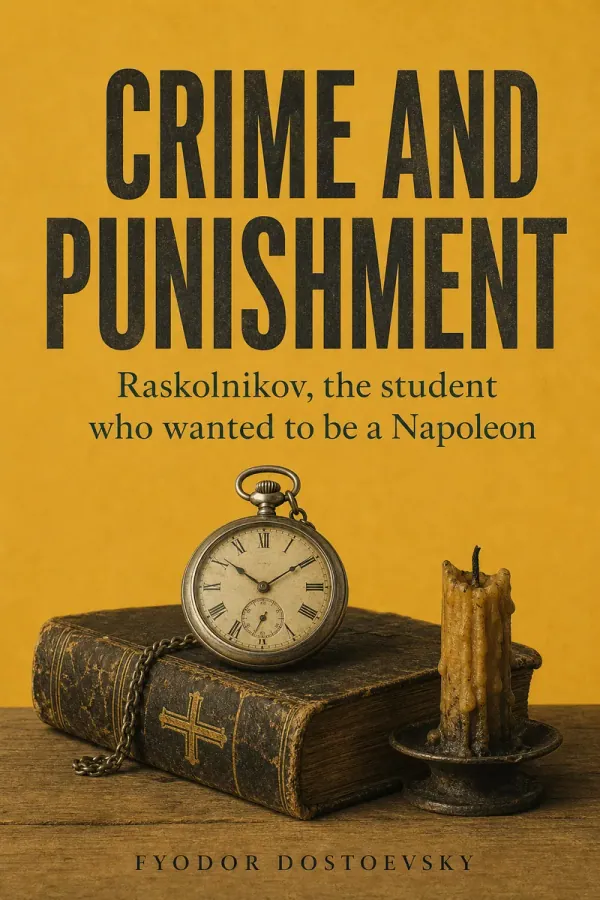
Crime and Punishment by Fyodor Dostoevsky: Summary and Study Notes
Raskolnikov, the student who wanted to be a Napoleon
Study this topic in OriaThe essentials
Published in serial form in 1866, Crime and Punishment follows Rodion Raskolnikov, a destitute former student in Saint Petersburg who murders an old pawnbroker, believing himself an "extraordinary" man above ordinary morality. His real punishment is not Siberia: it is the fever, fear, and doubt that consume him, under the eye of the investigator Porfiry and Sonia, a young prostitute full of faith. You'll discover Dostoevsky's life, sentenced to death and then sent to a labor camp, the novel's genesis, its plot part by part, its characters, its ideas, and its immense influence.
Key dates and facts
- Nov. 11, 1821
- Born in Moscow
- 1846
- Poor Folk, his first success
- Dec. 22, 1849
- Mock execution
- 1850 – 1854
- Omsk labor camp
- Sept. 1865
- Letter to Katkov proposing the story
- Nov. 1865
- Shift to third-person narration
- Jan. – Dec. 1866
- Serialized in The Russian Messenger
- 1867
- First edition in book form
⛓️ Dostoevsky, from the firing squad to the labor camp
Crime and Punishment is the work of Fyodor Dostoevsky, regarded alongside Leo Tolstoy as one of the greatest Russian novelists. He was born in Moscow on November 11, 1821. His father was a doctor at the city's hospital for the poor, and the child grew up in housing inside the hospital grounds, close to its most wretched patients. His mother died of tuberculosis in 1837; his father, a grim and harsh man, died two years later. Young Fyodor, who dreamed of literature, was sent to the Saint Petersburg School of Military Engineering, where he was bored.
📖 An early fame
In 1844, he resigned his post as a draftsman to write. His first novel, Poor Folk, published in January 1846, was praised to the skies by the poet Nekrasov and the great critic Belinsky. People hailed him as a new Gogol. But his following stories disappointed, and the literary salons mocked his awkwardness. It was around this time that he likely had his first seizures of epilepsy, a condition that would stay with him his whole life. He also discovered the French socialists, Fourier, Proudhon, Saint-Simon, and joined a discussion circle gathered around the official Mikhail Petrashevsky, hostile to the absolutism of Tsar Nicholas I.
🎯 December 22, 1849
In April 1849, the members of the circle were arrested. Dostoevsky was held in the Peter and Paul Fortress, then sentenced to death. On December 22, 1849, in bitter cold, the condemned men were led to Semyonovsky Square in Saint Petersburg; they were tied in groups of three before the firing squad. At the last moment, a messenger brought the emperor's pardon: the sentence was commuted to a labor camp. The execution had only ever been a mock execution. Dostoevsky would later recount it through the voice of Prince Myshkin, in The Idiot.
🏚️ Four years in Omsk
On January 23, 1850, he arrived at the Omsk labor camp, in Siberia, in chains. Along the way, the wife of an exiled Decembrist had given him a Bible, which he would never part with. For four years he lived among common criminals and changed profoundly. He would later write in his correspondence:
"I did not waste my time there: I came to know the Russian people well, as perhaps few know them."
Fyodor Dostoevsky, correspondence, on the labor camp (translated)
Released in 1854, he still had to serve as an ordinary soldier in Siberia. There, in 1857, he married a young widow, Maria Isaeva, and did not return to Saint Petersburg until 1859, under police surveillance, after ten years of exile. The former revolutionary had drawn closer to the Orthodox faith and now distrusted socialist ideas.
🕯️ The dark years
With his brother Mikhail, he founded the journal Time, in which Memoirs from the House of the Dead, drawn from his experience of the labor camp, appeared. The journal was banned in 1863. On trips to Europe, he ruined himself at the roulette tables of Wiesbaden and Baden-Baden. In 1864 he lost his wife, on April 14, and then his brother, on July 10. That year he wrote Notes from Underground, an angry response to the revolutionary Chernyshevsky's novel What Is to Be Done?, which foreshadows the great novels to come.
💸 A novel written to pay off debts
Dostoevsky said he had conceived the idea of a "confessional novel" as early as his time in the labor camp. On October 9, 1859, he wrote to his brother Mikhail that he had imagined it there, "lying on the plank bed," in a moment of grief and discouragement, and that he would pour his heart and blood into it. Scholars do not all agree in linking this project directly to Crime and Punishment, but his experience among convicts fed the novel, particularly its Siberian epilogue.
💰 Summer 1865: ruin
In 1865, Dostoevsky's situation was desperate. Deep in debt, he was also helping his late brother's family; he risked debtors' prison. He sold in advance the rights to works not yet written and signed a punishing, one-sided contract with the publisher Fyodor Stellovsky. In September 1865, from Wiesbaden, he proposed to Mikhail Katkov, editor of the prestigious journal The Russian Messenger, a long story: the psychological account of a crime.
"A young man, expelled from the university, of modest origins, and living in extreme poverty, through frivolity and a lack of firmness in his principles, and under the influence of certain strange, half-baked ideas that are floating in the air, has resolved to escape his wretched situation at a single stroke."
Fyodor Dostoevsky, letter to Mikhail Katkov (September 1865, translated)
✍️ From diary to novel
The project was first meant to take the form of a first-person confession: the writer's notebooks contain several versions — memoirs, a diary, the murderer's own confession. By November 1865, the "story" had become a novel, and Dostoevsky decided to rewrite the whole thing in the third person, with a narrator who stays as close as possible to his hero's consciousness. He would later claim to have burned everything and started over; his biographer Joseph Frank believes he actually reused part of his drafts.
📰 Very real news stories
Dostoevsky read the newspapers avidly. Among the possible models for his hero, historians point to a twenty-seven-year-old Moscow clerk, Gerasim Chistov, who had killed two elderly women in January 1865 to rob their employer, and the French criminal Lacenaire, who claimed to have killed in the name of social justice and whose trial Dostoevsky had covered in his journal in 1861.
⏱️ Two novels at once
Crime and Punishment appeared in The Russian Messenger in twelve installments, from January to December 1866; the same journal was publishing Tolstoy's War and Peace at the same time. But Dostoevsky had also promised Stellovsky another novel, The Gambler, for November. On a friend's advice, he hired a twenty-year-old stenographer, Anna Snitkina, and dictated the novel to her, finishing it on October 30, 1866, after 26 days of work. He married her on February 15, 1867. The same year saw the first edition of the novel in book form, lightly revised; there would be four during the author's lifetime.
The rest of the course
This page publishes the first 2 parts. The full course has 9: here is what the next ones cover.
- 🪓 July in Petersburg: the crime
The first part: Raskolnikov, a destitute former student, his meeting with Marmeladov, his mother's letter about Dunya's marriage, the dream of the mare, and the double murder of the pawnbroker and her sister.
- 🌡️ After the crime: fever and suspicion
The second and third parts: the summons to the police station, the fainting spell, hiding the loot under a stone, delirium, his friend Razumikhin, Marmeladov's death, and the arrival of his mother and sister.
- 🧠 The extraordinary man and the investigator Porfiry
Raskolnikov's theory of "ordinary" and "extraordinary" men, Napoleon, and the psychological duel with the investigator Porfiry Petrovich, up to Mikolka's false confession.
- 🕯️ Sonia, Lazarus, and the confession
The fourth, fifth, and sixth parts: the reading of the raising of Lazarus at Sonia's room, Luzhin's scheme, the confession to Sonia, Katerina Ivanovna's death, Svidrigailov's fate, and the confession at the police station.
- 🌅 Epilogue: Siberia and resurrection
The epilogue: the eight-year sentence, the fates of Dunya, Razumikhin, and the mother, Sonia in Siberia, the dream of the epidemic, Raskolnikov's rebirth, and the debate over this ending.
- 🏙️ Petersburg, nihilism, and polyphony
The novel's major themes and form: its critique of nihilism and utilitarianism, the city of Saint Petersburg, the meaning of the Russian names, the narration kept close to the characters' consciousness, and polyphony according to Bakhtin.
- 🌍 Reception and legacy
The success of 1866, criticism at the time, French translations, the novel's influence on psychoanalysis, existentialism, literature, and film.
Study “Crime and Punishment” with flashcards and quizzes
In Oria, you read the full course, then practice on it: flashcards, multiple-choice quizzes, open questions or the Feynman method. Cards and questions then come back in your daily review, paced by spaced repetition.
Study this topic in OriaSources
These notes draw on the sources below. If a point seems doubtful, refer back to them.