Classic novels
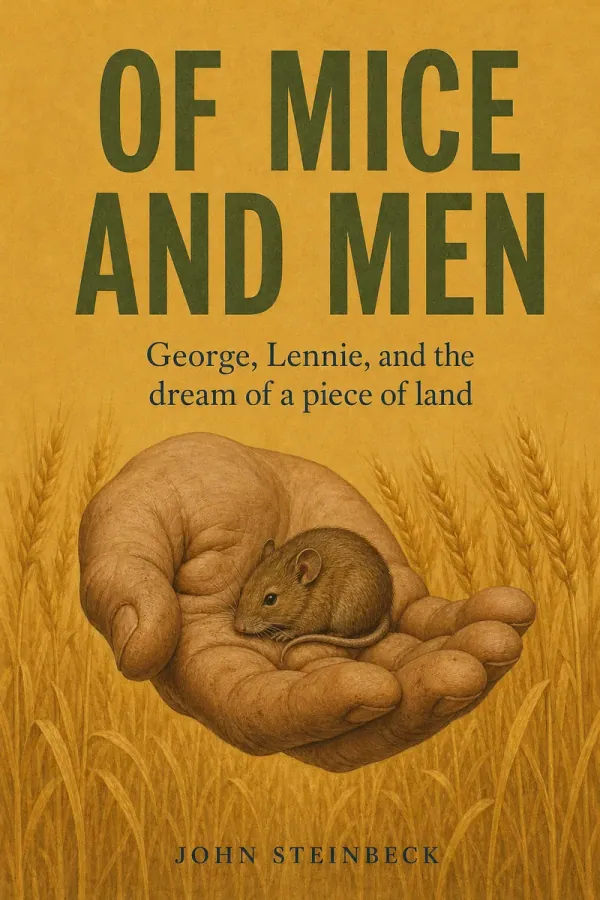
Of Mice and Men by John Steinbeck: Summary and Study Notes
George, Lennie, and the dream of a piece of land
Study this topic in OriaThe essentials
Published in 1937, Of Mice and Men follows George and Lennie, two seasonal workers drifting from ranch to ranch in Depression-era California, dreaming of a small farm of their own. In fewer than two hundred pages, John Steinbeck tells of friendship, loneliness, and injustice with a force that has made it one of the most widely read books in schools, and one of the most challenged. You'll discover its background, Steinbeck's life, the plot step by step, the ranch's outcasts, its major themes, its stage-like form, and its reception.
Key dates and facts
- 1929
- Stock market crash, start of the Great Depression
- 1936
- The novel is written
- 1937
- Published in the United States
- 1939
- French translation from Gallimard
- 1902
- Born in Salinas
- 1940
- Pulitzer Prize for The Grapes of Wrath
- 1962
- Nobel Prize in Literature
- 1968
- Dies in New York
- 1937
- Play opens on Broadway
- 1939
- First film, by Lewis Milestone
🌾 The seasonal workers of the Great Depression
Of Mice and Men is a short novel by the American writer John Steinbeck, published in 1937. It tells the story of George and Lennie, two farmhands who move from ranch to ranch in California during the Great Depression, the severe economic crisis that followed the 1929 crash.
🚜 The world of seasonal workers
In the 1930s, many itinerant farmhands crisscrossed California, bedrolls on their backs, looking for work on ranches as the seasons demanded. These are the men Steinbeck portrays. He knew them well: as a teenager, then a young man, he had himself worked alongside migrant laborers on ranches and in the sugar-beet fields of the Salinas area. In 1937, he told The New York Times that he had been a tramp of that sort himself for quite a while, and that his characters were partly drawn from real people.
📚 A "labor trilogy"
Together with In Dubious Battle (1936) and The Grapes of Wrath (1939), the book forms what critics sometimes call Steinbeck's "labor trilogy" or "Dust Bowl trilogy": three novels devoted to farmworkers and the social struggles of the era. In 1936, he also wrote a series of articles for the San Francisco News about the migrants' hardship.
🐭 A title borrowed from a poem
Steinbeck had first titled his text Something That Happened, to suggest that no one was really to blame for the tragedy he told. He changed his mind after reading the Scottish poet Robert Burns's poem "To a Mouse" (1785), in which a plowman unintentionally destroys a field mouse's nest. Two lines, in Scots, say that the best-laid plans of mice and men often go wrong. The whole novel is contained in that idea.
🐶 A devoured draft
Steinbeck wrote the book at home, in Monte Sereno, near Los Gatos, south of San Francisco. A famous anecdote, told in a 1936 letter: his young setter puppy, left alone one night, shredded about half the manuscript, of which no copy existed. It took him two months to rewrite it all; he joked that the puppy might have been acting as a critic. The final text, about 30,000 words long, was chosen by the Book of the Month Club even before publication, then released by Covici Friede in early 1937.
✍️ John Steinbeck, voice of the forgotten
John Steinbeck was born on February 27, 1902, in Salinas, California, in a farming valley about twenty-five miles from the Pacific. His father was treasurer of Monterey County, his mother a schoolteacher who passed on to him a love of reading. In the summers, young John worked on neighboring ranches, then alongside migrant workers in the Spreckels sugar-beet fields. There he discovered the harshness of their lives and the darker side of human nature, material for his future novels. The Salinas Valley and the Monterey coast would serve as the setting for most of his books.
📖 A difficult start
He studied English literature at Stanford University, which he left in 1925 without a degree. He tried his luck in New York, failed to get published, and returned to California, where he worked a string of odd jobs. Married in 1930 to Carol Henning, he lived frugally in Pacific Grove, in a cottage lent by his father. That same year, he met marine biologist Ed Ricketts, who became his friend and mentor and passed on to him an ecological view of the world. His first novel, published in 1929, drew little attention.
🌟 The 1930s, recognition
Success came in 1935 with Tortilla Flat, a comic chronicle of a band of Monterey outcasts. In Dubious Battle, Of Mice and Men, and above all The Grapes of Wrath (1939) followed, the odyssey of a farm family driven from Oklahoma, considered his masterpiece. The book won the Pulitzer Prize in 1940 but caused an uproar: accused of slandering California, Steinbeck received threats, and one county banned the book from its libraries.
🌍 War correspondent and novelist
During the Second World War, then the Vietnam War, he worked as a war correspondent. He published Cannery Row (1945) and the great family saga East of Eden (1952), partly inspired by his own family's history.
🏅 A disputed Nobel
In 1962, he received the Nobel Prize in Literature "for his realistic and imaginative writings, combining as they do sympathetic humour and keen social perception." The choice was sharply criticized by part of the American and Swedish press, who found him outdated. In 2012, the opening of the archives revealed he had been a compromise choice. Hurt, Steinbeck published no more fiction. He died of heart disease in New York on December 20, 1968, and is buried in Salinas.
The rest of the course
This page publishes the first 2 parts. The full course has 9: here is what the next ones cover.
- 🔥 By the river: George and Lennie
The novel's opening: George and Lennie stop by a river before heading to a new ranch; we meet the pair, the escape from Weed, Lennie's love of soft things, and their dream of a farm.
- 🐴 The ranch: Curley, Slim, and Candy
Arrival at the ranch: the boss's son, Curley, aggressive and jealous; Slim, the respected one; Candy and his old dog; then the sudden hope of making the dream real with Candy's savings, and Curley's crushed hand.
- 🃏 Crooks and Curley's wife, the outcasts
The ranch's marginalized characters: Crooks, the Black stable hand confined to the barn, and Curley's wife, a young, nameless bride who dreamed of the movies; the scene where each confides their loneliness.
- 🌑 The barn, then the river
The ending: Lennie accidentally kills Curley's wife in the barn, flees toward the river; George finds him before the lynch mob and shoots him, after telling him the dream one last time.
- 🤝 Friendship, loneliness, and a broken dream
The major themes: the loneliness of itinerant workers and friendship as the exception, the American dream of land of one's own, the characters' powerlessness against fate, and the symbols that foreshadow the tragedy.
- 🎭 A novel built like a stage play
The book's form: a "play-novelette" in six chapters conceived as three acts, an objective style of writing, and its many adaptations for the stage, screen, and comics.
- 📚 A school classic and a challenged book
The book's reception: immediate success, a "little masterpiece" according to the Nobel committee, a central place in school curricula, but also many attempts at censorship, and its French translations.
Study “Of Mice and Men” with flashcards and quizzes
In Oria, you read the full course, then practice on it: flashcards, multiple-choice quizzes, open questions or the Feynman method. Cards and questions then come back in your daily review, paced by spaced repetition.
Study this topic in OriaSources
These notes draw on the sources below. If a point seems doubtful, refer back to them.