Personal growth
Atomic Habits by James Clear: Summary and Study Notes
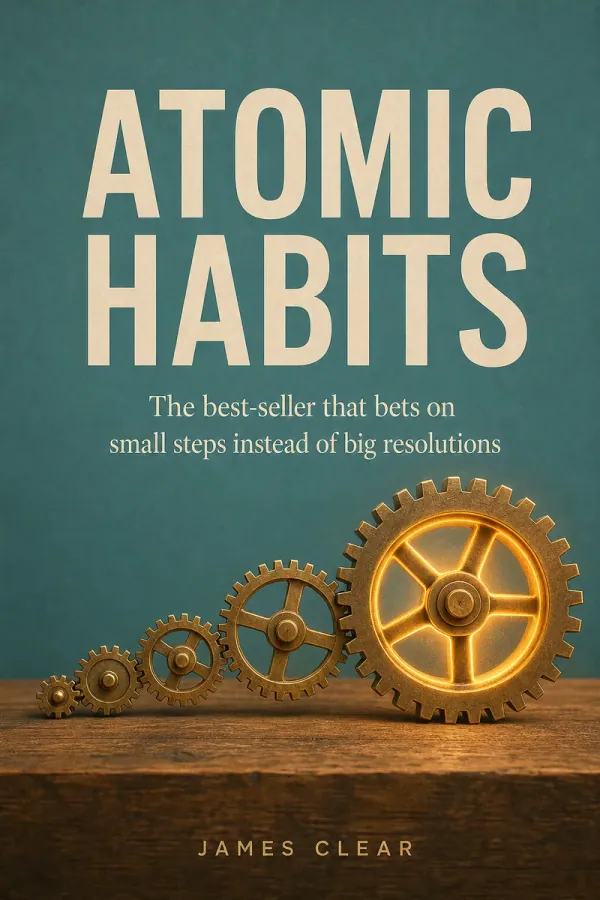
The best-seller that bets on small steps instead of big resolutions
Study this topic in OriaThe essentials
Published in 2018, James Clear's Atomic Habits became one of the best-selling self-help books of the decade. Its idea: it's not big goals that change a life, but tiny habits repeated every day. You'll discover 1% gains, the difference between systems and goals, the link between habits and identity, the habit loop and its four laws, and what critics and research say about its limits.
Key dates and facts
- 2012
- Clear starts publishing articles on his website
- 2018
- US publication of Atomic Habits
- 2019
- French edition, Un rien peut tout changer
- 2024
- Launch of the Atoms app
- 1908
- The start of a century of mediocre results
- 2003
- Dave Brailsford arrives
- 2008
- Dominance at the Beijing Olympics
- 2012
- Wiggins wins the Tour de France
- 1986
- Born in Ohio
- 2008
- Graduates from Denison and receives athletic honor
📘 A slow starter that became a phenomenon
Atomic Habits is a self-help book by the American writer James Clear, published on October 16, 2018 by Avery, an imprint of Penguin. Its subtitle promises an "easy and proven way" to build good habits and break bad ones.
🧩 A simple idea: the "atomic" habit
The word "atomic" plays on two meanings. An atomic habit is first of all tiny, like an atom: a gesture so small it takes almost no effort. But it is also a considerable source of energy once these small acts add up over months. According to Wikipedia, the book's central thesis is that the willpower needed to break a bad habit is built more easily by gradually replacing it with a small positive one, rather than by relying on a single heroic burst of effort.
For Clear, if we fail to change, it is not for lack of character: it is because the system we live in pushes us to repeat the same behaviors. The book therefore proposes changing that system rather than blaming ourselves.
📚 A wave of books about habits
Atomic Habits arrived in an already crowded field. In 2012, journalist Charles Duhigg had published The Power of Habit, a synthesis of scientific research on habit formation that Clear often cites. Almost at the same time as Atomic Habits, researcher BJ Fogg published Tiny Habits, which likewise champions very small changes. Clear acknowledges on his website that most of the ideas he presents are not his own: he discovers them through his reading, then rephrases them to make them easy to apply.
🚀 A success that built slowly
The book was not an instant triumph. As The Guardian noted in 2022, it won readers over gradually before climbing to the top of the bestseller lists. By February 2024, it had sold close to 20 million copies according to Forbes; the author's official website now reports more than 30 million copies sold and translations into more than 60 languages. It has spent more than five years on the New York Times bestseller list.
After the book came a tracking notebook, the Clear Habit Journal, then in 2024 a smartphone app called Atoms, designed to support the same approach day to day.
📈 The power of 1% gains
The first chapter of Atomic Habits, James Clear's book on habits, starts from an observation: we tend to overrate the importance of one big decisive moment and underrate the value of small progress repeated every day. The book suggests aiming for a tiny improvement, around 1%, but every single day.
🧮 The math of small steps
The calculation Clear highlights is simple. If you improve by 1% each day for a year, you multiply your level by about 37: 1.01^365 ≈ 37.8. Conversely, declining by 1% each day brings you nearly to zero: 0.99^365 ≈ 0.03. At first, the difference between a slightly better choice and a slightly worse one is unnoticeable. But over time, the gap widens until it becomes enormous.
That is why Clear compares habits to compound interest in finance: their effects multiply over time, for better or worse.
"Habits are the compound interest of self-improvement."
James Clear, Atomic Habits (2018)
🚴 The example of British cycling
To illustrate this idea, Clear tells the story of British cycling. In 2003, the federation hired Dave Brailsford as performance director. Since 1908, British riders had won only a single Olympic gold medal, and none had ever won the Tour de France. Brailsford applied a strategy he called the aggregation of marginal gains: break down everything involved in cycling and improve each element by a small percentage.
The adjustments covered saddles and wind-tunnel-tested kit, but also unexpected details: the right way to wash hands to avoid colds, each rider's pillow and mattress, or the inside of the team truck painted white to spot dust. According to Clear's account, the British team dominated the road and track cycling events at the 2008 Beijing Olympics, and then Bradley Wiggins became the first Briton to win the Tour de France in 2012. His teammate Chris Froome then won it in 2013, 2015, 2016, and 2017.
🌱 Progress is a process, not an event
The lesson Clear draws from this goes beyond sport. We often talk about success as an event: losing twenty pounds, launching a company, winning a race. For him, these results are instead the sum of many small choices, made slightly better or slightly worse. It does not matter where you stand today: what matters is the trajectory your habits are putting you on. A daily act that seems insignificant can, in the long run, weigh more than a grand resolution abandoned after three weeks.
The rest of the course
This page publishes the first 2 parts. The full course has 9: here is what the next ones cover.
- 🎯 Systems rather than goals
Why James Clear, in Atomic Habits, advises focusing on your systems (your daily processes) rather than your goals, with the four problems he identifies with goals.
- 🪞 Habits and identity
The psychological core of Atomic Habits: the three layers of change (outcomes, processes, identity), and the idea that every action is a vote for the person you want to become.
- 🔁 The habit loop and the four laws
The mechanism described in Atomic Habits: the cue, craving, response, reward loop, and the four laws of behavior change (make it obvious, attractive, easy, satisfying) with their reversals.
- 🏠 Environment, stacking, and the two-minute rule
The practical tools of Atomic Habits: shaping your environment, stacking a new habit onto an old one, pairing effort with pleasure, and shrinking every habit down to two minutes.
- ✅ Tracking habits and never missing twice
Habit tracking in Atomic Habits: the calendar where you mark off each success, its three benefits, its limits, and the rule 'never miss twice.'
- ✍️ James Clear, the author
Who is James Clear, the author of Atomic Habits: a former college baseball player, a blogger from 2012 on, author of the 3-2-1 newsletter, and a speaker.
- ⚖️ Reception, criticism, and limits
The success of Atomic Habits, the praise it received, then criticism from The Guardian, The New Yorker, and Slate, and what research on habit formation helps put in perspective.
Study “Atomic Habits” with flashcards and quizzes
In Oria, you read the full course, then practice on it: flashcards, multiple-choice quizzes, open questions or the Feynman method. Cards and questions then come back in your daily review, paced by spaced repetition.
Study this topic in OriaSources
These notes draw on the sources below. If a point seems doubtful, refer back to them.