Personal growth
Getting Things Done by David Allen: Summary and Study Notes
The GTD method: clear your head to get more done
Study this topic in OriaThe essentials
Published in 2001, David Allen's Getting Things Done gave rise to one of the best-known personal organization methods in the world, abbreviated as GTD. Its core idea: our brain is built to have ideas, not to hold an endless to-do list in memory. You'll discover the method's five steps, the two-minute rule, the “next action,” the weekly review, the surprising life of its author, and what research and critics have said about it.
Key dates and facts
- 2001
- Publication of Getting Things Done
- 2005
- Wired calls it a “cult” of the digital age
- 2008
- French translation, S'organiser pour réussir
- 2015
- Revised edition
- 1945
- David Allen is born
- 1971
- Brief psychiatric hospitalization
- 1983
- Consultant at Lockheed
- 2014
- Moves to Amsterdam
📘 A book that became a method
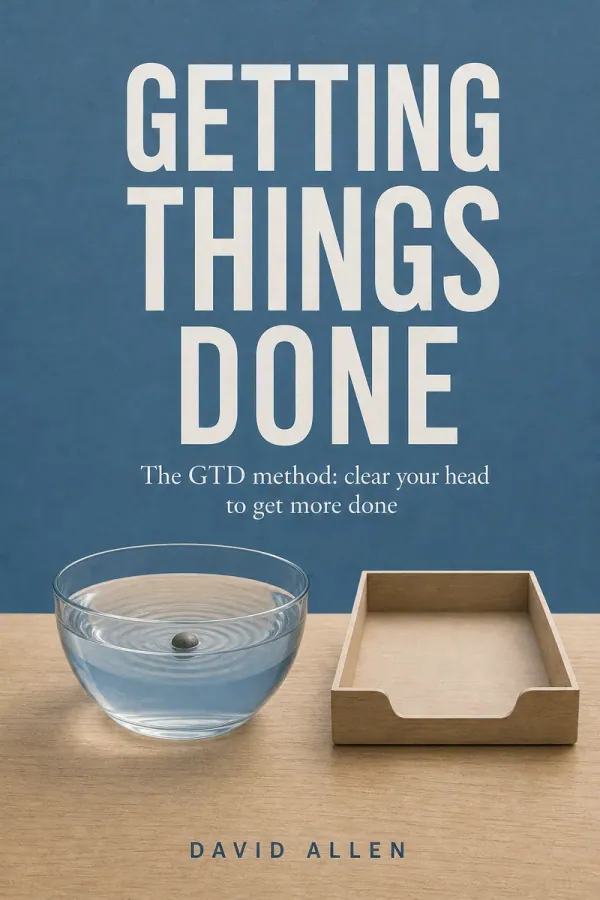
Getting Things Done, often shortened to GTD, is a book by American consultant David Allen, published in 2001 by Penguin. Its subtitle promises “the art of stress-free productivity.” It was translated into French in 2008 under the title S'organiser pour réussir. The book's name also became the name of the method it describes, trademarked since 2005.
🗂️ A problem of its time
At the turn of the 2000s, email, mobile phones and networked computers multiply the demands on our attention. So-called “knowledge workers” keep receiving new requests, with no one telling them how to handle them. Allen's book answers this very concrete question: what do you do with everything that lands on you during the day, and how do you make sure nothing slips through without having to think about it constantly?
Allen is not an academic: he built his method over roughly twenty years of corporate consulting. His book is anything but an inspirational speech. It is precise, almost technical, and its most famous passage is a diagram — an actual flowchart showing where each item should be filed depending on its nature.
🚀 A viral spread
The book climbs the bestseller lists slowly, but it quickly becomes a cult favorite, especially among programmers. In 2005, Wired magazine runs a piece calling it a “new cult for the info age.” Widely read blogs such as 43 Folders and Lifehacker spread the method and adapt it. In 2007, Wired estimates that 600,000 copies are in circulation and notes that a whole ecosystem of software, guides and online commentary has grown up around it. The same year, Time magazine presents it as the self-help book for its era's working world.
In 2015, Allen publishes a revised edition to account for the previous decade's technological upheavals, without changing the core of the method. The names of some steps are updated, but their content stays the same.
🧠 Clearing your head: “open loops”
David Allen's Getting Things Done method starts from a simple psychological observation: what stresses us out is not so much the amount of work as the number of unresolved things spinning around in our head.
🔄 “Open loops” everywhere
Allen calls stuff everything that has caught our attention and that we haven't yet decided what to do with: an email, a bill, a gift idea, an internship project, an argument with a friend. As long as these things are neither written down nor clarified, they are open loops: the mind keeps reminding us of them, often at the worst possible moment, without actually helping us move forward.
“There is usually an inverse relationship between how much something is on your mind and how much it's getting done.”
David Allen, Getting Things Done (2001)
📥 A trusted external system
Allen's solution is to get everything out of your head and hand it over to a trusted external system: a notebook, lists, a calendar, folders or an app. The condition is strict: the system has to be complete and checked regularly. Otherwise, the brain, which doesn't trust it, starts holding on to everything again. His company sums up the idea with a trademarked line: your mind is for having ideas, not for holding them.
An image Allen borrows from the martial arts. Throw a small pebble into a pond and the water makes a small splash; throw a big rock and it makes a big one. Either way, it settles back to calm afterward. A mind “like water” reacts to each demand in proportion, then returns to calm, instead of staying agitated all the time.
Allen claims this approach both reduces stress and increases effectiveness: you can focus on the task at hand because everything else is written down elsewhere. Early in the book, he even offers an exercise: pick whatever is bothering you most, write in one sentence what the problem would look like solved, then write down the very next step. He then invites the reader to notice the relief that this simple act brings.
The rest of the course
This page publishes the first 2 parts. The full course has 8: here is what the next ones cover.
- 🔁 The five steps of the method
The core of Getting Things Done: capture, clarify, organize, reflect and engage, and the eight possible destinations for each item.
- ⏱️ The two-minute rule and the “next action”
Two flagship tools from Getting Things Done: doing immediately whatever takes less than two minutes, and always framing the next action as physical and concrete.
- 📅 The weekly review and the horizons
The weekly review, the keystone of Getting Things Done, and the six “horizons” of thinking, from the day's actions to the meaning of one's life.
- 📱 From paper notebooks to apps
The technological neutrality of Getting Things Done, the many pieces of software built around it, and the method's influence on productivity culture.
- 👤 David Allen, an unexpected path
The life of David Allen, the author of Getting Things Done: a childhood in Louisiana, history studies, a personal crisis, spirituality, then a consulting career.
- ⚖️ What research and critics say
The reception of Getting Things Done, the support cognitive science lends to its ideas, the lack of direct testing, and criticism of its complexity and view of work.
Study “Getting Things Done” with flashcards and quizzes
In Oria, you read the full course, then practice on it: flashcards, multiple-choice quizzes, open questions or the Feynman method. Cards and questions then come back in your daily review, paced by spaced repetition.
Study this topic in OriaSources
These notes draw on the sources below. If a point seems doubtful, refer back to them.