Personal growth
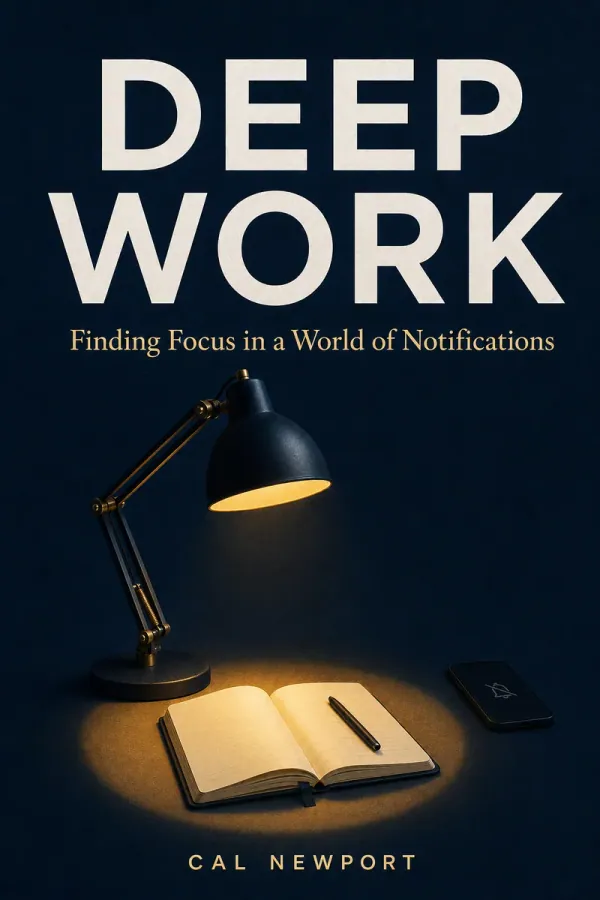
Deep Work by Cal Newport: Summary and Study Notes
Finding Focus in a World of Notifications
Study this topic in OriaThe essentials
Published in 2016 by Cal Newport, a computer science professor at Georgetown, Deep Work makes a simple case: the ability to concentrate for long stretches without distraction is becoming both rarer and more valuable. You'll see what sets deep work apart from shallow work, why companies unintentionally discourage it, and the book's four rules: work deeply, embrace boredom, quit social media, and drain the shallows. You'll also meet the author and the criticism aimed at the book.
Key dates and facts
- 2016
- Publication of Deep Work in the United States
- 2017
- French edition from Alisio
- 2019
- Digital Minimalism , the second installment
- 2021
- A World Without Email , the third installment
- 1982
- Born
- 2007
- Launches the Study Hacks blog
- 2009
- PhD in computer science from MIT
- 2011
- Joins Georgetown
- 2016
- Publishes Deep Work
📵 A book born in the age of notifications
Deep Work, subtitled Rules for Focused Success in a Distracted World, is an essay by the American Cal Newport, a computer scientist and professor at Georgetown University. It was published on January 5, 2016 by Grand Central Publishing. In France, it appeared in 2017 from Éditions Alisio under the title Deep work : retrouver la concentration dans un monde de distractions; in French it is sometimes called "travail profond."
📱 A world of small interruptions
The book arrives at a moment when smartphones, email, messaging apps, and social media have taken over the workday. In a 2016 interview with Entrepreneur magazine, Newport explains that most people don't go five or ten minutes without checking their phone or inbox. For him, the pull of digital devices has fractured our attention in a lasting way, to the point of making us less able to concentrate.
The phrase deep work already existed in psychological or religious contexts. Newport gives it a precise meaning: studying or working for long stretches on an intellectually demanding task, without distraction.
🗂️ Two parts: persuade, then equip
The book is split into two parts. The first, in three chapters, sets out to show that deep work is valuable, that it's becoming rare, and that it gives meaning to professional life. The second lays out four rules for turning it into a habit: work deeply, embrace boredom, quit social media, and drain the shallows. The conclusion returns to Bill Gates's rise, presented as an outstanding practitioner of deep work.
On his blog, Newport notes that his book is not a cranky pamphlet against young people spending too much time on Facebook, nor a worn-out list of tips like "turn off your notifications." He calls for a radical shift: making intense concentration the central activity of work, not an occasional luxury.
📈 A lasting success
On release, the book entered the Wall Street Journal bestseller list. According to the author's website, it has sold more than 1.5 million copies. Newport presents it as the first installment of a trilogy on technology and society, continued with Digital Minimalism (2019) and A World Without Email (2021).
🧠 Deep work versus shallow work
The whole of Cal Newport's Deep Work rests on an opposition between two ways of working. Understanding this distinction reveals where our time actually goes.
Activity carried out in a state of total concentration, free of distraction, that pushes our intellectual abilities to their limit. According to Newport, this kind of effort creates new value, improves our skills, and is hard to replicate.
Logistical tasks that demand little from the mind, often done while distracted: answering emails, filling out forms, organizing meetings. They create little value, and anyone could do them.
"Professional activities performed in a state of distraction-free concentration that push your cognitive capabilities to their limit."
Cal Newport, Deep Work (2016)
🔀 The "quick glance" trap
Why is it so hard to concentrate? Newport draws on the work of management researcher Sophie Leroy, who identified a phenomenon called attention residue. When we switch from task A to task B, the mind doesn't fully follow: part of our attention stays stuck on task A. This residue lowers performance for a non-trivial stretch of time, even if the interruption was brief.
Newport draws an unsettling conclusion from this. Many people think they're doing only one thing at a time, but they punctuate their work with multiple quick checks: a message, an inbox, a news feed, "just in case." Each of these checks shifts attention and leaves a residue. If you never go more than ten or fifteen minutes without looking at your phone, he argues, you put yourself in a permanent, self-imposed state of intellectual handicap.
On his blog, he illustrates the idea with a reader who was an amateur player of the video game Snake: every time he paused the game to answer a message, he lost much more often right after resuming. The same effect, Newport argues, hits anyone who writes, codes, or thinks through a complex problem.
⏳ Long, protected blocks
The proposed answer is simple to state: work in long blocks with zero interruption, not even a glance. In the interview with Entrepreneur, Newport recommends stretches of at least ninety minutes for a demanding task, booked in the calendar like an important appointment. He compares attention to a professional athlete's body: a resource that must be respected and trained.
For a student, the difference is familiar. An hour of revision interrupted every five minutes by notifications isn't worth an hour of genuinely focused work, even though both last sixty minutes on paper.
The rest of the course
This page publishes the first 2 parts. The full course has 9: here is what the next ones cover.
- 💎 Why it's rare and valuable
Deep Work's thesis: deep work is becoming more valuable in today's economy and rarer because of hyperconnected culture, while also making work more satisfying.
- 🏔️ Rule 1: choose your depth philosophy
Deep Work's first rule, "work deeply," and the four ways to schedule deep work: monastic, bimodal, rhythmic, and journalistic.
- 🕯️ Rituals, grand gestures, and end of day
Deep Work's tools for the first rule: concentration rituals, grand gestures, the "hub-and-spoke" model, four execution disciplines, and the end-of-day shutdown ritual.
- 📴 Rules 2 and 3: embrace boredom, quit social media
Deep Work's second and third rules: training your concentration by embracing boredom, and choosing your digital tools using the craftsman approach rather than the "any-benefit" approach.
- 🌊 Rule 4: drain the shallows
Deep Work's fourth rule: reducing and organizing shallow work through time blocking, a fixed end time, a negotiated ratio, and stricter email habits.
- 👨💻 Cal Newport, the author
Who is Cal Newport, the author of Deep Work: a computer scientist trained at MIT, a professor at Georgetown, a blogger since 2007, and the author of books on attention and work.
- ⚖️ Reception and criticism
How the press (The New York Times, The Guardian, The New Yorker) received Deep Work, and the main criticisms: a thesis that isn't especially new, a radical stance on social media, privileged examples, and definitions that steer the conclusion.
Study “Deep Work” with flashcards and quizzes
In Oria, you read the full course, then practice on it: flashcards, multiple-choice quizzes, open questions or the Feynman method. Cards and questions then come back in your daily review, paced by spaced repetition.
Study this topic in OriaSources
These notes draw on the sources below. If a point seems doubtful, refer back to them.