Personal growth
Essentialism by Greg McKeown: Summary and Study Notes
The book that argues for doing less, but better
Study this topic in OriaThe essentials
Published in 2014, Greg McKeown's Essentialism has become a classic of personal-organization books, selling more than two million copies. Its thesis: you cannot do everything, so you might as well deliberately choose the few things that matter. You'll discover the paradox of success, the book's three steps (explore, eliminate, execute), the art of saying no, the author's personal story, and why some critics say this message is aimed only at people who have the luxury of choosing.
Key dates and facts
- 2012
- Article on the paradox of success
- 2014
- Essentialism published in the United States
- 2018
- French edition by Contre-Dires
- 2024
- Tenth-anniversary edition
- 1977
- Born in London
- 2008
- Stanford MBA
- 2012
- World Economic Forum Young Global Leader
- 2014
- Essentialism published
📘 A manifesto against the urge to do it all
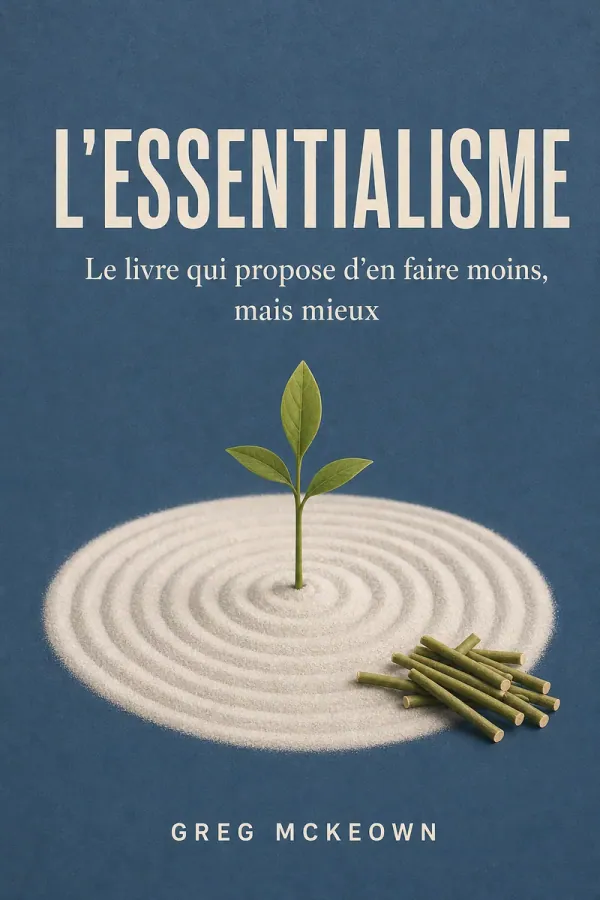
Essentialism: The Disciplined Pursuit of Less is a book by the British author Greg McKeown, published in April 2014 by Crown Business, an imprint of Penguin Random House. It is a personal-organization and leadership book that defends a countercurrent idea: to succeed and live better, you should not do more, but do less, but better.
🫧 The “more bubble”
McKeown starts from a diagnosis of our era. In his view, we live inside a bubble comparable to a financial bubble, except that what is overvalued is the idea that we can do it all, have it all, and succeed at it all. He accuses an “alliance” between smartphones, social media, and consumer society of producing not only information overload but opinion overload: we constantly know what everyone else is doing, and therefore what we “should” be doing. Being overwhelmed even becomes a badge of honor, and people boast about sleeping four hours a night.
📝 From an article to a bestseller
The book grew out of articles McKeown had been publishing since 2012 on the Harvard Business Review blog and on LinkedIn. In one of them, “The Disciplined Pursuit of Less” (2012), he describes what he calls the paradox of success, in four phases:
- when you have real clarity about an objective, it leads to success;
- success brings more options and opportunities;
- those options splinter effort in every direction;
- that scattering destroys the very clarity that made success possible.
Exaggerating to make his point, McKeown concludes that success can become a catalyst for failure. He borrows the phrase from author Jim Collins, who saw “the undisciplined pursuit of more” as one cause of the decline of once-admired companies. His book offers the antidote: the disciplined pursuit of less.
The book becomes a New York Times bestseller and surpasses two million copies sold, according to its publisher. It is published in French in 2018 by Éditions Contre-Dires, translated by Elisa Guenon, under the title L'Essentialisme: la quête pour aller à l'essentiel et en faire moins… mais mieux. In 2024, a tenth-anniversary edition adds a new introduction and a 21-day challenge.
⚖️ Less, but better: the essentialist mindset
The heart of Greg McKeown's Essentialism is not a time-management technique but a mindset. He contrasts two ways of living: that of the “nonessentialist,” who says yes to everything and ends up moving a millimeter in a million directions, and that of the essentialist, who deliberately chooses the small number of things that truly matter.
The disciplined pursuit of less: distinguishing what is absolutely essential, then eliminating everything else, in order to make the highest possible contribution to what matters. It is not about getting more done in less time, nor simply about doing less; it is about doing only the right things, in the right way, at the right time. The word does not carry its philosophical meaning here.
🔀 There is no escaping trade-offs
The book's first idea is that trade-offs are unavoidable. Time and energy are limited: saying yes to one thing means saying no to another. Guardian columnist Oliver Burkeman sums up this point by quoting McKeown: a question like “How can I fit it all into my schedule?” is fundamentally dishonest, because it assumes choosing can be avoided. The honest question would instead be: which problems do I want to have? Rather than asking how to make everything fit, McKeown advises asking which trade-offs you want to make, and making them deliberately.
☝️ One priority, not priorities
McKeown notes that the English word priority, which entered the language in the 15th century, originally referred in the singular to the very first thing, and stayed singular for centuries before people began speaking of “priorities” in the plural in the 20th century. He also notes that the verb “decide” comes from a Latin root meaning “to cut.” Finally, he draws on the Pareto principle, which engineer Joseph Juran called the “rule of the vital few”: a small share of effort produces most of the results. If almost everything matters a little and very few things matter enormously, it is better to identify those few things than to spread yourself thin.
🗝️ The power to choose
The essentialist refuses to say “I have no choice.” For McKeown, the ability to choose can never be taken away or given — it can only be forgotten. When you give up deciding, you implicitly give others permission to decide for you.
“If you don't prioritize your life, someone else will.”
Greg McKeown, Essentialism (2014)
The rest of the course
This page publishes the first 2 parts. The full course has 7: here is what the next ones cover.
- 🔭 First step: explore and evaluate
The first part of Essentialism: escaping to think, looking, playing, sleeping, and selecting with extreme criteria, including the 90 percent rule.
- ✂️ Second step: eliminate
The second part of Essentialism: clarifying an essential intent, daring to say no gracefully, uncommitting despite the endowment effect, editing, and setting boundaries.
- ⚙️ Third step: execute effortlessly
The third part of Essentialism: building in a buffer against the planning fallacy, removing obstacles, moving forward with small wins, relying on routines like 'monk mode,' and focusing on the present.
- ✍️ Greg McKeown, the author
The life of Greg McKeown: born in London in 1977, studies at Brigham Young and Stanford, leadership consulting, the story of his daughter's birth, then Effortless, podcast, and other activities.
- ⚖️ Reception, criticism, and limits
The reception of Essentialism: lasting success and awards, criticism that its message is reserved for those with a choice (NPR, Jia Tolentino in The New Yorker), and what its scientific grounding is worth.
Study “Essentialism” with flashcards and quizzes
In Oria, you read the full course, then practice on it: flashcards, multiple-choice quizzes, open questions or the Feynman method. Cards and questions then come back in your daily review, paced by spaced repetition.
Study this topic in OriaSources
These notes draw on the sources below. If a point seems doubtful, refer back to them.