Personal growth
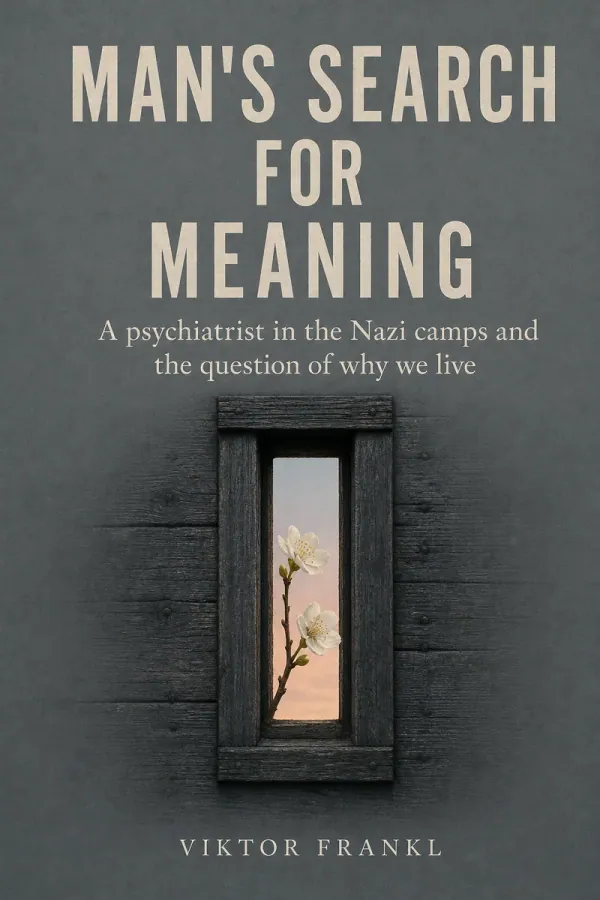
Man's Search for Meaning by Viktor Frankl: Summary and Study Notes
A psychiatrist in the Nazi camps and the question of why we live
Study this topic in OriaThe essentials
Deported from 1942 to 1945, the Viennese psychiatrist Viktor Frankl lost almost his entire family in the Nazi camps. In 1946 he dictated, in nine days, a book that observes from the inside how prisoners held on or broke down, then lays out his method, logotherapy, built on the search for meaning. You'll discover his life before the war, the three phases of camp life he describes, his ideas about inner freedom and the three paths to meaning, and the criticism his account has drawn.
Key dates and facts
- 1905
- Born in Vienna
- 1926
- First uses the word "logotherapy"
- 1933
- Ward for suicidal women at the Steinhof
- 1940
- Head of neurology at Rothschild Hospital
- Sept. 1942
- Deported to Theresienstadt
- Oct. 1944
- Auschwitz, then Kaufering III (Dachau)
- March 1945
- Transferred to the Türkheim camp
- April 27, 1945
- Liberated by American troops
- 1946
- Book dictated in nine days in Vienna
- 1959
- First English translation
🩺 A young psychiatrist obsessed with meaning
Viktor Frankl, the author of Man's Search for Meaning, was born on March 26, 1905, in Vienna, into a Jewish family. He was the second of three children; his father, a civil servant at the Ministry of Social Affairs, was a socialist who named him after Viktor Adler, founder of the Austrian Social Democratic Party. During the First World War, the family endured severe hardship.
✉️ Between Freud and Adler
As a high-school student, Frankl took evening classes in psychology and began corresponding with Sigmund Freud, who had one of his texts published in his psychoanalytic journal. At 15, in 1921, he gave his first public lecture, titled "On the Meaning of Life." As a medical student, he then grew close to Alfred Adler, the founder of individual psychology, but was expelled from his circle (in 1927, according to the Viktor Frankl Institute) for arguing that the search for meaning is the force that drives human beings above all else. As early as 1926, he was using the word logotherapy, from the Greek logos, "meaning."
🆘 At the bedside of the despairing
Still a student, he began in 1928 to organize free counseling centers for Viennese teenagers, with renowned psychologists such as Charlotte Bühler. In 1930, a special program run at the end of the school year, a period when student suicides were common, sharply reduced their number. Qualifying as a doctor in 1930, he ran the ward for suicidal women at the Steinhof psychiatric hospital from 1933 to 1937, where he saw about 3,000 patients a year.
⚠️ Under the Anschluss
In 1937 he opened a private practice, but Nazi Germany's annexation of Austria in 1938 barred Jewish doctors from almost everything. In 1940 he took charge of the neurology department at Rothschild Hospital, the only hospital in Vienna still admitting Jews. At the risk of his life, he filed false diagnoses there to shield mentally ill patients from the Nazi euthanasia program. That same year he obtained a visa for the United States but let it expire, unwilling to abandon his elderly parents.
In 1941 he married Tilly Grosser, a nurse at Rothschild Hospital; shortly after, the Nazis forced the young couple to terminate Tilly's pregnancy. He also began writing his first book on logotherapy, Ärztliche Seelsorge (known in English as The Doctor and the Soul), whose manuscript he would carry with him all the way to the camps.
🚂 Theresienstadt, Auschwitz, Dachau
Before writing Man's Search for Meaning, Viktor Frankl, a Viennese Jewish psychiatrist, spent nearly three years in the Nazi camps. His book does not follow this timeline step by step, but it helps explain where he was speaking from.
🏚️ The Theresienstadt ghetto
In September 1942, Frankl, his wife Tilly, and his parents were arrested and deported to Theresienstadt (Terezín), a ghetto-camp north of Prague. His sister Stella had managed shortly before to flee to Australia. His father, 81 years old, died there of starvation and pneumonia in February 1943. At the ghetto, Frankl organized a team to support newcomers in shock and to fight suicide, together with Regina Jonas, the world's first female rabbi.
🔥 Auschwitz, then the Bavarian camps
On October 19, 1944, Frankl and Tilly were sent to Auschwitz-Birkenau, followed shortly after by his mother. She was murdered in a gas chamber upon arrival. Tilly was transferred to Bergen-Belsen, where she would die. His brother Walter was also killed at Auschwitz. Frankl himself stayed at Auschwitz only a few days: he was selected for forced labor and sent to Kaufering III, a subcamp of Dachau in Bavaria, where he was given prisoner number 119,104. After about five months, he was transferred in March 1945 to the Türkheim camp (Kaufering VI), another Dachau subcamp.
📝 A manuscript to stay alive
At Türkheim, Frankl contracted typhus. To keep from giving in during feverish nights, he stayed awake reconstructing from memory the manuscript of his lost book, on scraps of paper stolen from the camp office. He would later say this effort helped him hold on.
The camp was liberated on April 27, 1945, by American troops. Frankl returned to Vienna, anxious about his wife's fate. Within days he learned of the deaths of Tilly, his mother, and his brother. His friends and his determination to rewrite his book then helped him overcome his despair.
The rest of the course
This page publishes the first 2 parts. The full course has 9: here is what the next ones cover.
- 📖 A book dictated in nine days
The book's history: written in 1946, its successive titles in German, English and French, its two-part structure, and its aim of observing the camp through the mind of the ordinary prisoner.
- 😶 In the camp: shock, then apathy
The first two psychological phases Frankl describes: the shock of arrival, then the apathy of daily camp life, and the decisive role of hope.
- 🌄 What kept people alive: inner freedom
What, according to Frankl, helped some prisoners hold on: inner life, love, beauty, and above all the freedom to choose one's attitude toward what one endures.
- 🕊️ After liberation: the third phase
The third phase Frankl describes: the depersonalization of liberated prisoners, the risk of moral disfigurement, bitterness and disillusionment, and the gradual return to life.
- 🧠 Logotherapy, a therapy of meaning
The book's second part: logotherapy, the "third Viennese school of psychotherapy," its principles (will to meaning, existential vacuum) and its techniques (paradoxical intention, dereflection).
- 🧭 Three paths to meaning
The three ways to find meaning according to Frankl: creating or acting, loving or experiencing something, and adopting an attitude toward unavoidable suffering.
- 🌍 Legacy and criticism
The book's worldwide success and its influence on psychology, followed by criticism: the accuracy of the Auschwitz account, the origins of logotherapy, and the idea that survival depended on attitude.
Study “Man's Search for Meaning” with flashcards and quizzes
In Oria, you read the full course, then practice on it: flashcards, multiple-choice quizzes, open questions or the Feynman method. Cards and questions then come back in your daily review, paced by spaced repetition.
Study this topic in OriaSources
These notes draw on the sources below. If a point seems doubtful, refer back to them.