Philosophy
Blaise Pascal: Biography and Study Notes
The scientific genius who wagered on God
Study this topic in OriaThe essentials
A child prodigy taught by his father, Blaise Pascal invented a calculating machine at 19, proved the existence of the vacuum, and founded probability theory with Fermat. Then one night in 1654 overturned his life: he turned to God, defended Port-Royal in the Provincial Letters, and prepared a defense of Christianity that remained unfinished, the Pensées. You'll discover his life, his discoveries, his great ideas (the thinking reed, diversion, the wager, heart and reason), and his legacy, from the unit of pressure to literature.
Key dates and facts
- 1623
- Born in Clermont
- 1626
- His mother dies
- 1631
- Moves to Paris
- 1640
- Essay on Conics
- 1654
- Night of fire, November 23
- 1656
- First Provincial Letter
- 1657
- The Provincial Letters condemned
- 1661
- Jacqueline dies
- 1662
- Five-sol carriages
- Aug. 19, 1662
- Dies in Paris
📐 A child prodigy
Blaise Pascal was born on June 19, 1623, in Clermont (now Clermont-Ferrand), in Auvergne, in central France. His family belonged to the bourgeoisie close to the noblesse de robe, the nobility of magistrates. His father, Étienne Pascal, was a judge in tax matters and passionate about mathematics, science, and ancient languages. Blaise lost his mother, Antoinette Begon, in 1626, at the age of three. He had two sisters who would matter greatly in his life: the elder, Gilberte, born in 1620, and the younger, Jacqueline, born in 1625, a precocious poet.
👨🏫 Taught by his father
Widowed, Étienne Pascal did not remarry and decided to educate his children himself. In 1631 he sold his office and moved with them to Paris. He welcomed the great scholars of the day into his home, such as the mathematician Roberval, the friar Marin Mersenne, Girard Desargues, and Pierre Gassendi, who met to discuss their work. Despite his young age, Blaise attended these sessions: he grew up at the heart of science in the making.
✏️ Geometry rediscovered alone
His father wanted him first to learn Latin and Greek, and forbade him mathematics until fifteen. But the child was irresistibly drawn to it. At eleven, he wrote a short Treatise on Sounds about vibrating bodies. Around twelve, drawing figures in charcoal on the tiled floor, he is said to have rediscovered on his own the first propositions of Euclid's geometry, up to the thirty-second, which establishes that the angles of a triangle add up to two right angles. Impressed, his father then gave him Euclid's Elements.
🔺 A theorem at sixteen
Fascinated by Desargues's work on conics (the curves obtained by cutting a cone with a plane, like the ellipse), Pascal wrote at sixteen a short Essay on Conics, printed in 1640. In it he states a result that bears his name, Pascal's theorem: if six points are placed on a conic and joined into a hexagon, the opposite sides meet at three points that lie on a straight line. The work was so precocious that Descartes, on reading it, at first believed it was the father's.
🎭 A pardon won at the theater
In 1638, in the midst of the Thirty Years' War, Étienne Pascal joined other bondholders in protesting the tax policy of Cardinal Richelieu, who had just sharply cut their income. Threatened with the Bastille, he had to flee Paris. It was little Jacqueline who saved him: in April 1639 she acted in a play before Richelieu and addressed him with such a well-turned compliment that he granted her father a pardon. Étienne was even appointed to Rouen to organize tax collection there.
🧮 The Pascaline and the vacuum experiments
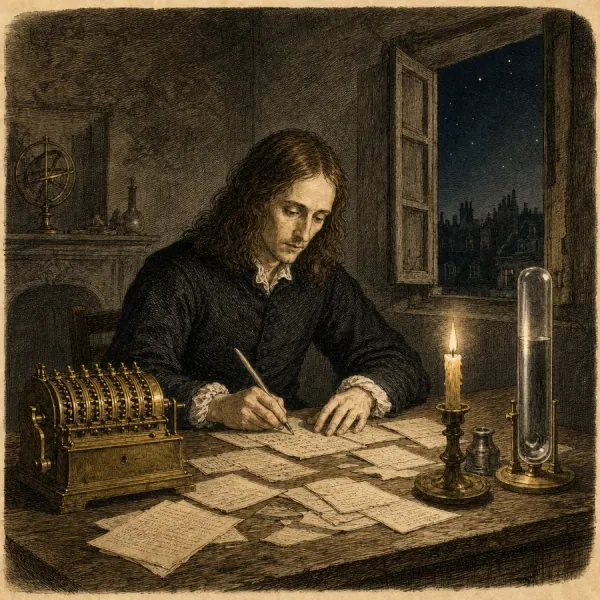
In Rouen, Étienne Pascal was buried under tax calculations, and his son helped him. To spare him this exhausting work, Blaise, not yet nineteen, designed around 1641–1642 a calculating machine that could add and subtract using toothed wheels. It took him years of refinement and some fifty prototypes. The Pascaline received a royal privilege in 1649, but it was too expensive to sell: it became mostly a prestige object for the rich. Pascal gave one to Queen Christina of Sweden in 1652. About twenty were built, and several still survive, notably at the Musée des Arts et Métiers in Paris.
🫙 Does nature abhor a vacuum?
Since Aristotle, most scholars had believed that a vacuum was impossible: some invisible matter supposedly filled all of space. Descartes himself believed so. But the Italian Torricelli had upended a tube full of mercury into a basin: the mercury fell and stopped at a certain height, leaving an apparently empty space at the top of the tube. In October 1646, Pascal and his father repeated the experiment in Rouen. In 1647 he published his New Experiments Concerning the Vacuum: in his view, what lay above the liquid was indeed a vacuum, and it was the weight of the air that held up the column.
⛰️ The Puy de Dôme experiment
To prove it, he devised a decisive experiment: if it was the air pressing on the mercury, the column should be lower on a mountain, where there is less air above. Too ill to climb himself, he entrusted it to his brother-in-law Florin Périer. On September 19, 1648, before clergymen and local notables, Périer measured the mercury at the foot of the Puy de Dôme, at Clermont, then at the summit, about five hundred toises (nearly a thousand meters, or some 3,300 feet) higher, while a control tube stayed in town. At the bottom, the column measured about 26 inches; at the top, barely more than 23. The proof was made: air has weight, and pressure decreases with altitude. Pascal repeated the experiment in Paris, at the top of the Saint-Jacques Tower.
Against a Jesuit who defended the invisible matter, Pascal set out a strikingly modern principle of method: to show that a hypothesis is true, it is not enough that all the phenomena follow from it; but if it contradicts a single phenomenon, that is enough to prove it false. His treatises on the equilibrium of liquids also established Pascal's principle and the principle of the hydraulic press: one man pushing a small piston can match a hundred men pushing a large one.
In tribute to this work, the International System's unit of pressure bears his name: one pascal (Pa) corresponds to a force of one newton applied over one square meter.
🙏 A first conversion
In 1646 his father badly injured his hip falling on ice. For three months he was cared for by two doctors who were disciples of the Abbé de Saint-Cyran, who had introduced into France the religious movement later called Jansenism, a demanding reading of Saint Augustine on divine grace. Blaise borrowed books from them, and the whole family moved from a lukewarm faith to a fervent one: this is called his “first conversion.” Since the age of eighteen, he had also suffered from a mysterious illness, with violent migraines and pains that rarely left him a day without suffering; in 1647 a paralysis forced him for a time to walk on crutches.
The rest of the course
This page publishes the first 2 parts. The full course has 9: here is what the next ones cover.
- 🎲 Society life and the geometry of chance
His father's death (1651), Jacqueline's entry into Port-Royal, the society years in Paris salons, the correspondence with Fermat on the “problem of points,” and the arithmetical triangle of 1654, the origin of probability theory.
- 🔥 The night of fire
The crisis of 1654, the mystical experience of November 23, 1654, recorded in the Memorial sewn into his clothing, the retreat at Port-Royal des Champs in January 1655, and the context of Jansenism.
- ✒️ The Provincial Letters against the Jesuits
The eighteen Provincial Letters (1656–1657) defending Arnauld and attacking the morality of the Jesuit casuists, their success, their condemnation, the miracle of the Holy Thorn, the contest on the cycloid, and the fight against the Formulary until Jacqueline's death in 1661.
- 🌌 The Pensées: the wretchedness and greatness of man
The planned Apology for the Christian Religion that became the Pensées: man between two infinities, the thinking reed, diversion, deceptive powers such as imagination, justice and force, the three orders, and the heart.
- 🎯 The wager and the hidden God
The wager argument (the “Infinite–nothing” fragment), which applies the geometry of chance to the question of God, its real purpose, the notion of the hidden God, and the major critiques of the wager, from Diderot to Simone Weil.
- 🕊️ Carriages for the poor, and death
The last years (1661–1662): charity, the “five-sol carriages,” Paris's first public transit, the worsening illness, his death on August 19, 1662, and the posthumous publication of the Pensées in 1670.
- 🌍 The legacy of a “frightening genius”
Pascal's legacy: in science (probability, the unit of pressure, a programming language), in literature (a master of French prose, Chateaubriand, Giono), in philosophy (Enlightenment critiques, Nietzsche, Simone Weil, Bourdieu), in film, and in the Church.
Study “Blaise Pascal” with flashcards and quizzes
In Oria, you read the full course, then practice on it: flashcards, multiple-choice quizzes, open questions or the Feynman method. Cards and questions then come back in your daily review, paced by spaced repetition.
Study this topic in OriaSources
These notes draw on the sources below. If a point seems doubtful, refer back to them.