Business & money
Blue Ocean Strategy by W. Chan Kim and Renée Mauborgne: Summary and Study Notes
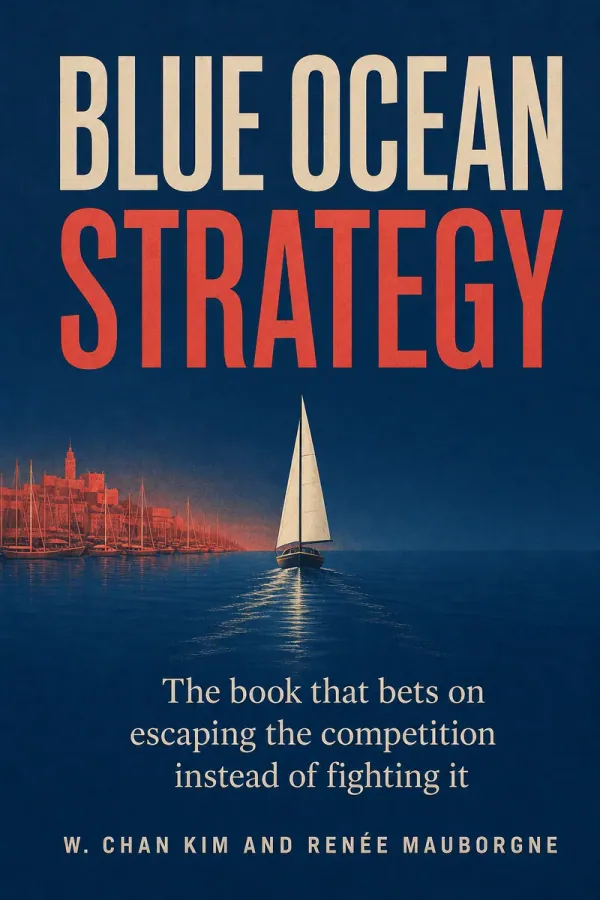
The book that bets on escaping the competition instead of fighting it
Study this topic in OriaThe essentials
Published in 2005 by two INSEAD professors, W. Chan Kim and Renée Mauborgne, Blue Ocean Strategy became one of the best-selling strategy books in the world. Its idea: instead of fighting over customers in saturated markets, the "red oceans," companies should create new market spaces, the "blue oceans." You'll discover value innovation, the case of Cirque du Soleil, the strategy canvas and the four actions framework, the six paths and noncustomers, how to win people over to change, and the criticism the method has drawn.
Key dates and facts
- 1997
- "Value Innovation" article in the Harvard Business Review
- 2005
- Publication of Blue Ocean Strategy
- 2015
- Expanded edition
- 2017
- Sequel: Blue Ocean Shift
- 1984
- Founded in Baie-Saint-Paul, Quebec
- 40 million
- Spectators in 90 cities by around 2004
- ×22
- Revenue multiplied over ten years, according to the authors
- 2006
- Launch of the Wii
- 101.6 million
- Total Wii consoles sold
- 2017
- Launch of the Switch, another example cited by the authors
📘 A book born at INSEAD
Blue Ocean Strategy is a book on business strategy written by W. Chan Kim and Renée Mauborgne, two professors at INSEAD, a major business school based in Fontainebleau, France. It came out in 2005, published by Harvard Business School Press. Its subtitle sums up its ambition: to create market space with no competitors, making the competition irrelevant.
🌱 An idea fifteen years in the making
The concept emerged in the 1990s. W. Chan Kim was then working on a consulting assignment for the Dutch group Philips, led by the well-known management researcher C. K. Prahalad. While working with consultants, he developed strategic analysis tools that led to a series of articles in the Harvard Business Review. The first, "Value Innovation," appeared in 1997; the article "Blue Ocean Strategy," which gave the book its name, was published in October 2004.
The authors present their work as data-driven research: a study of more than 150 strategic moves, across more than 30 industries, spanning over 100 years. Their starting idea was original: the right thing to study is neither the company nor the industry, but the strategic move itself, since the same company can be brilliant at one moment and badly wrong at another.
"Company and industry are the wrong units of analysis."
W. Chan Kim and Renée Mauborgne, "Blue Ocean Strategy," Harvard Business Review (2004)
🌍 A worldwide success
The book became a global best-seller. Depending on the source, it has sold between 3.5 million and more than 4 million copies and has been translated into 43 to 49 languages. In 2005 it won the Frankfurt Book Fair's award for best business book of the year and was named among Fast Company magazine's best books of the year. In 2009, in China, it was even listed among the 40 most influential books in the history of the People's Republic, alongside Adam Smith's The Wealth of Nations.
An expanded edition came out in 2015, followed by a twentieth-anniversary edition in 2026, with case studies on the chipmaker NVIDIA and singer Taylor Swift. In the meantime, the authors published two sequels: Blue Ocean Shift (2017), published in French as Cap sur l'Océan Bleu, and Beyond Disruption (2023).
🌊 Red oceans and blue oceans
The book by W. Chan Kim and Renée Mauborgne rests on a simple image that made its fortune: the world of markets splits into two kinds of oceans.
All the industries that already exist: the known market space. Boundaries are defined, the rules of the game are accepted, and every company tries to beat its rivals to grab a bigger share of existing demand. The more competitors there are, the more profits and growth shrink: competition turns bloody, hence the color red.
All the industries that don't exist yet: unknown market space, untouched by competition. Here demand is created rather than fought over, and the rules of the game are still to be written. The blue ocean evokes the vastness of a still-untapped potential.
⚔️ Breaking away from military logic
For the authors, classic strategic thinking is inherited from military vocabulary: people talk of rivals, market share to conquer, territory to defend. In a red ocean, one side's gain is the other's loss; it's a zero-sum game. Products end up looking alike, become commodities, and a price war sets in.
Blue ocean strategists think differently. According to Kim and Mauborgne, a market's boundaries exist only in the minds of managers: they can be redrawn by what companies do. So there's no such thing, strictly speaking, as an inherently attractive or unattractive industry. The question is no longer how to beat the competition, but how to create new demand.
| Red ocean strategy | Blue ocean strategy |
|---|---|
| Compete in existing market space | Create uncontested market space |
| Beat the competition | Make the competition irrelevant |
| Exploit existing demand | Create and capture new demand |
| Choose between value and cost | Break the value-cost trade-off |
| Choose differentiation or low cost | Pursue differentiation and low cost at the same time |
⏳ Oceans that change color
The authors don't claim you can stay in a blue ocean forever. As soon as a new market succeeds, imitators show up and it eventually turns red too. They also argue that no company is excellent forever: that's why they study strategic moves rather than companies. The goal, then, should be to keep creating new blue oceans.
According to them, these invented markets are where the best opportunities for growth that is both fast and profitable are found.
The rest of the course
This page publishes the first 2 parts. The full course has 9: here is what the next ones cover.
- 💎 Value innovation: breaking the trade-off
The cornerstone of Blue Ocean Strategy: value innovation, which means pursuing differentiation and low cost at the same time, against Michael Porter's generic strategies.
- 🎪 The case of Cirque du Soleil
The flagship example in Blue Ocean Strategy: Cirque du Soleil, founded in Quebec in 1984, which reinvented the circus by blending it with the richness of theater, with no animals, for a new adult audience.
- 🧰 The strategy canvas and the four actions framework
The practical tools of Blue Ocean Strategy: the strategy canvas and the value curve, the four actions framework (eliminate, reduce, raise, create), illustrated by the Australian wine [yellow tail].
- 🧭 Six paths and three tiers of noncustomers
The principles of Blue Ocean Strategy for finding a new market: the six paths for redrawing an industry's boundaries, the three tiers of noncustomers, and the example of Nintendo's Wii.
- 🚦 Winning people over to the change
The third part of Blue Ocean Strategy: the four hurdles to executing a strategy, tipping point leadership illustrated by William Bratton at the New York police department, and fair process.
- ✍️ W. Chan Kim and Renée Mauborgne
The authors of Blue Ocean Strategy: W. Chan Kim, born in Korea in 1951, and Renée Mauborgne, an American born in 1963, both INSEAD professors, their joint work, and their later books.
- ⚖️ Reception, criticism, and limits
What critics say about Blue Ocean Strategy: examples picked after the fact, no control group, ideas already present in Hamel and Prahalad, difficulty of application, and blue oceans that don't last, from Cirque du Soleil to Nintendo.
Study “Blue Ocean Strategy” with flashcards and quizzes
In Oria, you read the full course, then practice on it: flashcards, multiple-choice quizzes, open questions or the Feynman method. Cards and questions then come back in your daily review, paced by spaced repetition.
Study this topic in OriaSources
These notes draw on the sources below. If a point seems doubtful, refer back to them.