Business & money
Built to Last by Jim Collins and Jerry Porras: Summary and Study Notes
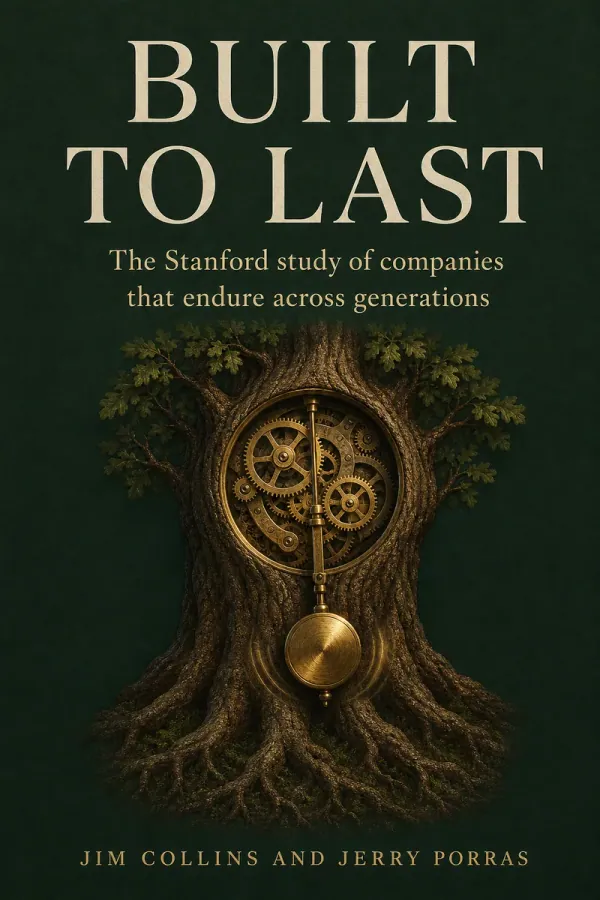
The Stanford study of companies that endure across generations
Study this topic in OriaThe essentials
Published in 1994, Built to Last is the product of six years of research at Stanford by Jim Collins and Jerry Porras into eighteen “visionary” companies, from Boeing to Sony. You'll discover the idea of building a clock rather than telling the time, core ideology, the famous BHAGs, cult-like cultures and homegrown leaders, the two authors, the book's enormous success, and the harsh criticism it has drawn over luck and the halo effect.
Key dates and facts
- 1926
- Starting point of the stock market comparison
- 1950
- Cutoff date for the founding of the companies studied
- 1994
- US publication
- 1996
- French translation, Bâties pour durer
- 1972
- Jerry Porras joins Stanford
- 1988
- Jim Collins starts teaching there
- 1994
- Publication of Built to Last
- 2001
- Publication of Good to Great
🔬 Six years of research into century-old companies
Built to Last: Successful Habits of Visionary Companies was published on October 26, 1994 by HarperBusiness. Its authors, Jim Collins and Jerry Porras, were then teaching at the business school of Stanford University, in California. The book presents the results of a six-year research project built around an ambitious question: what sets apart companies that remain exceptional for generations? The French translation, Bâties pour durer, came out in 1996 from Éditions First.
🏛️ What is a “visionary” company?
Collins and Porras set six criteria. The company had to be a premier institution in its industry, widely admired by knowledgeable businesspeople, to have made an indelible imprint on the world, to have had multiple generations of chief executives and multiple product life cycles, and to have been founded before 1950. To choose them, they surveyed hundreds of CEOs of large and midsize American companies, asking them to name the most visionary companies.
The eighteen companies selected were on average nearly a hundred years old. According to the authors, their stocks had outperformed the market roughly fifteen times over since 1926.
⚖️ The power of comparison
The originality of the method is that it doesn't look only at the winners. Each visionary company is compared with a rival in the same industry, founded in the same era, that was successful without reaching the same level. Over the same period, these comparison companies outperformed the market only about twice over.
| Visionary company | Comparison company |
|---|---|
| 3M | Norton |
| American Express | Wells Fargo |
| Boeing | McDonnell Douglas |
| Citicorp | Chase Manhattan |
| Ford | General Motors |
| General Electric | Westinghouse |
| Hewlett-Packard | Texas Instruments |
| IBM | Burroughs |
| Johnson & Johnson | Bristol-Myers Squibb |
| Marriott | Howard Johnson |
| Merck | Pfizer |
| Motorola | Zenith |
| Nordstrom | Melville |
| Philip Morris | RJR Nabisco |
| Procter & Gamble | Colgate-Palmolive |
| Sony | Kenwood |
| Walt Disney | Columbia Pictures |
| Wal-Mart | Ames |
The authors take an important precaution: their study shows correlations, not a proven cause-and-effect link between their observations and success. This nuance would be at the heart of the criticism leveled at the book.
⏰ Clock building, not time telling
The first big idea of Built to Last, Jim Collins and Jerry Porras's book, fits into an image. Imagine someone who could look at the sun or the stars and tell the exact time, to the second. That would be impressive. But it would be even more remarkable to build a clock that could tell the time forever, even after that person's death.
For the authors, having a brilliant idea or being a charismatic leader is “time telling.” Building a company that can prosper far beyond any single leader and through multiple product life cycles is “clock building.”
💡 Two myths shattered
Collins and Porras say their data undermined two widely held beliefs in business schools. The first myth: you have to start with a great idea. Yet only three of the eighteen visionary companies began life with a brilliant starting idea. The second myth: you need a charismatic, visionary leader. The authors found that this was not necessary at all, and that the combination of a great idea and a charismatic leader could even be negatively correlated with building a lasting company.
🔧 The example of Hewlett-Packard
For Collins, the model clock builder is David Packard, co-founder of Hewlett-Packard. Asked about the most important product decisions in his company's history, he answered by talking about the organization: the great freedom given to teams within a framework of clear objectives, the rule of spending only what you earn, the decision to share financial success with all employees.
Collins says he put the same question to T. J. Rodgers, founder of the semiconductor company Cypress. Rodgers first named a chip. Collins disagreed: his most important product was the company itself. This reversal of perspective is at the heart of the book: products and markets become vehicles for building a great organization, not the other way around.
🏛️ A lesson from politics
The authors compare this shift in perspective to the founding of the United States. In the European kingdoms, prosperity depended largely on the quality of the king. In 1787, at the Constitutional Convention, the question was not to choose the best leader, but to create rules that would produce good presidents long after the founders were gone. For Collins and Porras, Jefferson, Madison and Adams were “clock builders”: they built a system to which all future leaders would be subject.
The rest of the course
This page publishes the first 2 parts. The full course has 8: here is what the next ones cover.
- 🧭 More than profits: core ideology
The core of Built to Last: values and a purpose that do not change, the rejection of the “Tyranny of the OR” and the example of Merck.
- 🏔️ BHAGs, huge and daring goals
The most famous concept in Built to Last: the BHAG, a ten- to thirty-year goal, illustrated by Boeing's commercial jet gamble, Sony and Wal-Mart.
- 🧪 Cult-like cultures, experimentation and homegrown leaders
The other mechanisms in Built to Last: very strong cultures, constant experimentation as at 3M, leaders trained in-house and continuous improvement, summed up as “preserve the core, stimulate progress.”
- ✍️ Jim Collins and Jerry Porras
A biography of the two authors of Built to Last: the researcher Jerry Porras, professor of organizational behavior at Stanford, and his former student Jim Collins, future author of Good to Great.
- 📈 A best-seller that influenced business leaders
The reception of Built to Last: sales, translations, influence on leaders such as the head of Cold Stone Creamery, and the stock market performance of the companies featured ten years later.
- ⚖️ Criticism: luck, the halo and fallen companies
The criticism of Built to Last: the decline of nearly half the companies featured, principles too vague, the halo effect according to Rosenzweig, the role of luck according to Kahneman, and the authors' replies.
Study “Built to Last” with flashcards and quizzes
In Oria, you read the full course, then practice on it: flashcards, multiple-choice quizzes, open questions or the Feynman method. Cards and questions then come back in your daily review, paced by spaced repetition.
Study this topic in OriaSources
These notes draw on the sources below. If a point seems doubtful, refer back to them.