Business & money
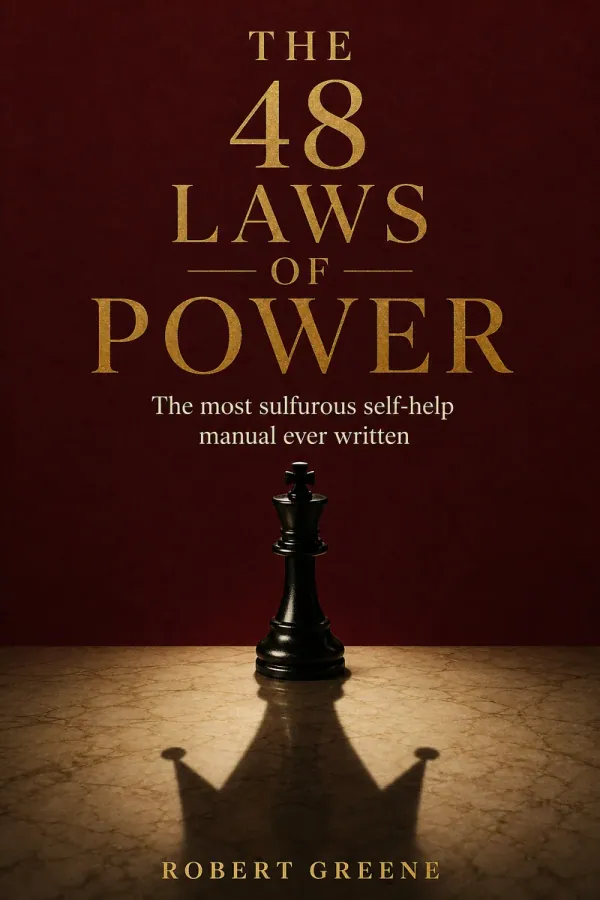
The 48 Laws of Power by Robert Greene: Summary and Study Notes
The most sulfurous self-help manual ever written
Study this topic in OriaThe essentials
In 1998, a former Hollywood screenwriter published a hefty book that breaks power down into 48 laws, each illustrated with historical episodes, from the court of Louis XIV to imperial China. You'll see how Robert Greene conceived this manual, how it works, which laws are the most famous and what stories go with them. You'll also understand why it circulates so widely in prisons, in rap and in boardrooms, and why so many critics call it cynical, contradictory or unscientific.
Key dates and facts
- 1959
- Robert Greene is born in Los Angeles
- 1995
- Meets Joost Elffers at Fabrica, near Venice
- 1998
- The 48 Laws of Power is published by Viking
- 1610
- Galileo names Jupiter's moons the "Medicean Stars"
- 17 Aug 1661
- Fouquet's party at Vaux-le-Vicomte in honour of Louis XIV
- 5 Sep 1661
- Fouquet arrested by d'Artagnan in Nantes
- 1680
- Fouquet dies, imprisoned at Pignerol
- 1998
- Published in the US by Viking
- 2009
- The 50th Law , written with 50 Cent
- 2014
- Dov Charney, an avid reader of the book, is fired from American Apparel
🖋️ Robert Greene, from Hollywood to the power manual
The 48 Laws of Power is the first book by the American writer Robert Greene, published in 1998. Before writing this manual, which went on to achieve cult status, Greene had neither power nor fame: he was mostly a sharp observer of the games of influence playing out around him.
🎓 A lover of antiquity with a dozen jobs
Born on 14 May 1959 in Los Angeles, Greene began his studies at Berkeley before finishing them at the University of Wisconsin–Madison, with a degree in classical studies: ancient Greek, ancient history, the great authors. He then moved through dozens of jobs, by his own count: construction worker, translator, writer at Esquire magazine, Hollywood screenwriter. He also spent several years living in Europe, between London, Crete, Barcelona and Paris.
It was in Hollywood that his insight took shape. Greene noticed that every transaction, professional or personal, revolved around someone trying to gain more power. And he found that the powerful people running the studios did not behave so differently from the Athenians and Chinese emperors he had studied. He wanted to show that these manoeuvres were nothing new: they had been repeating themselves for thousands of years.
🇮🇹 A meeting in Venice
In 1995, Greene was working as a writer at Fabrica, an art and communication school near Venice. There he met Joost Elffers, a Dutch book packager. On a walk together, Elffers asked him if he had an idea for a book. Greene started talking about one of his favourite subjects, the court of Louis XIV, then Machiavelli. The idea for a book on power was born.
Greene nonetheless hesitated: his job made him unhappy, but it was comfortable, and striking out on his own felt risky. He reread his favourite biography of Julius Caesar and drew inspiration from Caesar's decision to cross the Rubicon. He wrote up the project, which he would later call the turning point of his life. Elffers paid him a monthly advance so he could read and write without worrying about money, then sold the nearly finished manuscript to the publisher Viking Penguin.
📚 A body of work that keeps growing
The success of this first book launched a whole series: The Art of Seduction (2001), The 33 Strategies of War (2006), The 50th Law, written with the rapper 50 Cent (2009), Mastery (2012), The Laws of Human Nature (2018) and The Daily Laws (2021). But it is still The 48 Laws of Power that remains most closely tied to his name.
📐 The method: a law, some stories, a reversal
Robert Greene's The 48 Laws of Power is not a theoretical essay. It is a collection of practical rules, each drawn from historical examples. The book presents itself as a guide for three kinds of readers: those who want power, those who observe it, and those who want to protect themselves from it.
🧩 A modular architecture
Each law gets its own chapter, always built the same way:
- Transgression: the story of a figure who ignored the law and paid dearly for it.
- Observance: the story of a figure who applied it successfully.
- Keys to power: an explanation of the psychological mechanism at work.
- Reversal: the cases where the law does not apply, or how to defend yourself if someone uses it against you.
In the margins, quotes from great authors, printed in colour, back up the lesson. Joost Elffers, who designed the layout, wanted readers to be able to "enter the book anywhere", like a dictionary: a single law can be read on its own, with no need to know the others. The book runs to roughly 450 pages.
📜 Sources spanning several millennia
Greene draws on the great thinkers of strategy and politics: Machiavelli, Sun Tzu, Carl von Clausewitz, Baltasar Gracián, Nietzsche. He also tells the stories of a wide range of historical figures: Queen Elizabeth I, the Ethiopian emperor Haile Selassie, Henry Kissinger, the American showman P. T. Barnum, Napoleon, Mao Zedong, the seducer Casanova, the dancer Lola Montez, and the American con man "Yellow Kid" Weil. Kirkus Reviews sums up the book's starting idea: we supposedly live today much as courtiers once did, forced to appear polite while fighting for our place.
🎭 A view of the world as a royal court
For Greene, power is amoral: neither good nor bad in itself. Social life resembles one vast royal court where everyone schemes, whether they want to or not. It is therefore better to understand the rules than to pretend one can escape them.
"If the world is like a giant scheming court and we are trapped inside it, there is no use in trying to opt out of the game."
Robert Greene, The 48 Laws of Power (1998), preface
Greene presents his laws less as advice than as observations of human behaviour. In one interview, he explains that he wanted to reveal a kind of "dirty little secret": power has become a taboo subject, even though everyone plays the game.
The rest of the course
This page publishes the first 2 parts. The full course has 8: here is what the next ones cover.
- 🗂️ The great families of laws
A thematic grouping of the 48 laws: handling the powerful, hiding your intentions, protecting your reputation, attracting others, staying unpredictable, fighting.
- 👑 Law 1: never outshine the master
The first law explained with its two historical examples: the fall of Nicolas Fouquet before Louis XIV and Galileo's cleverness toward the Medici.
- 🏯 Protecting yourself and striking: laws 18, 15 and 47
Three laws on safety and conflict: not isolating yourself (Qin Shi Huang), crushing your enemy, and knowing when to stop at the height of victory.
- 🎭 Say little, dare greatly: laws 4, 28 and 10
Three laws on conduct: saying less than necessary, acting with boldness (Aretino against the pope), and avoiding the unhappy.
- 🎤 Prisons, rap and boardrooms
The book's success: sales, translations, popularity in American prisons, hip-hop culture, Hollywood and the business world.
- ⚖️ Amorality, cynicism, contradictions: the critics
What critics object to in the book (cynicism, contradictions, lack of evidence, cherry-picked examples) and how Greene defends himself.
Study “The 48 Laws of Power” with flashcards and quizzes
In Oria, you read the full course, then practice on it: flashcards, multiple-choice quizzes, open questions or the Feynman method. Cards and questions then come back in your daily review, paced by spaced repetition.
Study this topic in OriaSources
These notes draw on the sources below. If a point seems doubtful, refer back to them.