Business & money
Zero to One by Peter Thiel: Summary and Study Notes
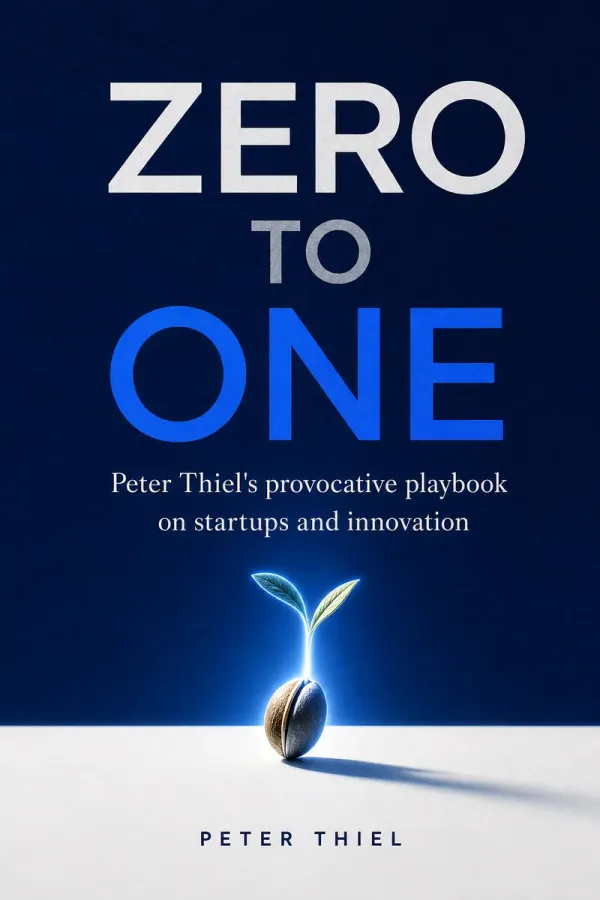
Peter Thiel's provocative playbook on startups and innovation
Study this topic in OriaThe essentials
Published in 2014, Peter Thiel's Zero to One, written with Blake Masters, grew out of a class he taught at Stanford University. The book makes a provocative argument: real progress means creating something entirely new, and the companies that pull it off become monopolies. You'll discover the difference between going "from 0 to 1" and "from 1 to n," the case for monopoly, the contrarian question, the power law and "secrets," as well as the criticisms leveled at the book and its author.
Key dates and facts
- 2012
- Peter Thiel's CS183 class at Stanford
- 2014
- Publication of Zero to One
- 2016
- French translation published by JC Lattès
- 1998
- Confinity is founded, the future PayPal
- 2002
- PayPal bought by eBay for $1.5 billion
- 2004
- Thiel becomes Facebook's first outside investor
- 2005
- Founders Fund is launched
🎓 From a Stanford class to a bestseller
Zero to One is a book about startups and innovation published on September 16, 2014, by the American entrepreneur and investor Peter Thiel, co-founder of PayPal, together with Blake Masters. Its subtitle promises "notes on startups, or how to build the future." The French edition appeared in 2016 from publisher JC Lattès.
📝 Lecture notes that went viral
The book has an unusual origin story. In the spring of 2012, Thiel taught a class on startups at Stanford University, titled CS183: Startup. Blake Masters, then a Stanford law student, had met Thiel the year before. He attended the class and posted highly detailed write-ups of each session on his blog, written as essays.
These notes quickly became popular within the tech world and circulated widely online. Masters then suggested to Thiel that they turn them into a book. Zero to One is a condensed, updated version of that material, running to about 200 pages.
📣 A heavily publicized launch
To promote the book, Thiel posted his first and only tweet ever on September 8, 2014. He then gave a string of interviews: with the site TechCrunch, on Tim Ferriss's podcast, on public radio station NPR, and in a question-and-answer session with Reddit users.
The book became a New York Times number-one bestseller. According to Blake Masters, more than 2.5 million copies have been sold worldwide.
🚀 From 0 to 1, or from 1 to n
The title of Peter Thiel's book sums up his thesis. In his view, there are two ways to move the world forward, and they are not equally valuable.
🪞 Copying or inventing
Horizontal progress, which Thiel calls going "from 1 to n," means copying things that already work and spreading them everywhere. Its name is globalization. In his lectures, Thiel used China as an example: you could bet that in fifty years it will look a great deal like the United States does today, with the same cities, the same cars, the same trains.
Vertical progress, going "from 0 to 1," means doing something radically new that did not exist before. Its name is technology. For Thiel, this is the harder path, but also the most valuable one.
"If you are copying these guys, you aren't learning from them."
Peter Thiel, Zero to One (2014), on Bill Gates, Larry Page and Mark Zuckerberg
🔁 Every moment happens only once
The book opens with this idea: the next Bill Gates will not build an operating system, and the next Mark Zuckerberg will not launch a social network. Whatever worked once cannot simply be repeated. That is why Thiel insists his book offers no formula for success: by definition, every innovation is unique, and no one can prescribe how to innovate.
🐢 A fear of stagnation
Behind this distinction lies a worry. For Thiel, technological progress was spectacular from the Industrial Revolution through the 1960s, and then slowed down in most fields, with the notable exception of computing. People talk a great deal about "developed" and "developing" countries, as if the only possible future were catching up to an already-known model. He fears that companies are content merely to improve on what they've inherited, and warns that this kind of stagnation could have worse consequences than the 2008 financial crisis.
The rest of the course
This page publishes the first 2 parts. The full course has 8: here is what the next ones cover.
- 👑 Monopoly versus competition
Zero to One's case for monopoly: why Thiel sees competition as destructive to profits, his four traits of a monopoly, and the "start small" strategy.
- 🤔 The contrarian question and "secrets"
Peter Thiel's famous interview question and his theory of "secrets": important truths that very few people see.
- 📈 The power law
The power-law principle in Zero to One: a handful of successes dwarf all the others, in venture capital as in life choices.
- 🧑🚀 Founders, teams and vision
Zero to One's advice on founders, company culture, sales, and the case against constant improvisation.
- 👤 Peter Thiel, investor and provocateur
The career of Peter Thiel, author of Zero to One: Stanford, PayPal, Facebook, Palantir, his ideas and political commitments, and Blake Masters's role.
- ⚖️ Praise and criticism
How Zero to One was received: enthusiasm from The Atlantic, criticism from Vox and Publishers Weekly, and the debate over the case for monopoly.
Study “Zero to One” with flashcards and quizzes
In Oria, you read the full course, then practice on it: flashcards, multiple-choice quizzes, open questions or the Feynman method. Cards and questions then come back in your daily review, paced by spaced repetition.
Study this topic in OriaSources
These notes draw on the sources below. If a point seems doubtful, refer back to them.