Business & money
The 22 Immutable Laws of Marketing by Al Ries and Jack Trout: Summary and Study Notes
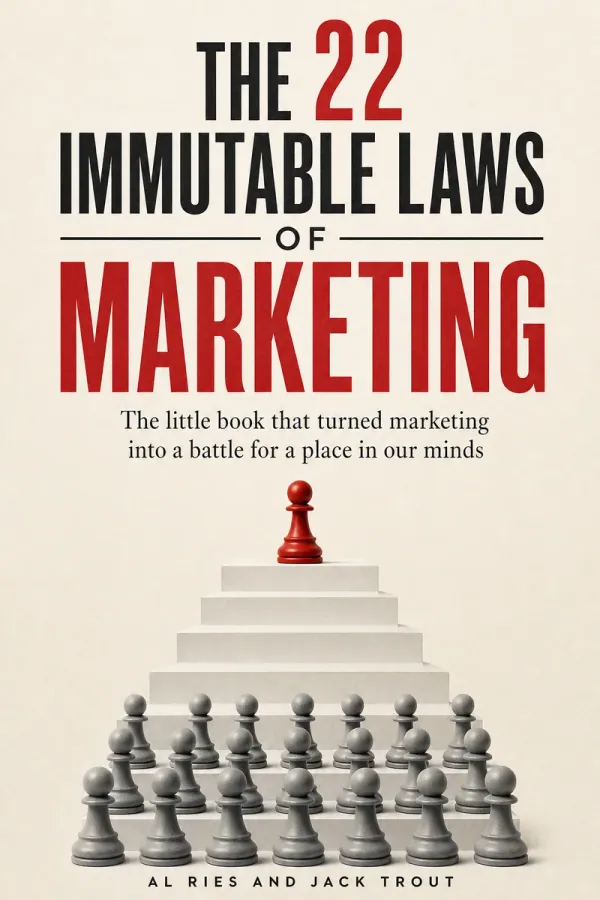
The little book that turned marketing into a battle for a place in our minds
Study this topic in OriaThe essentials
Published in 1993, The 22 Immutable Laws of Marketing condenses into 22 rules the thinking of Al Ries and Jack Trout, the inventors of “positioning.” Their idea: marketing is not played out between products but in customers' minds. You'll discover the law of leadership, the art of owning a word, the ladder and the duel between brands, the trap of line extension, the two authors, and what research says, often harshly, about these “laws.”
Key dates and facts
- 1981
- Positioning , their first big success
- 1993
- US publication of The 22 Laws
- 1994
- French translation from Dunod and the authors' split
- 1967
- Jack Trout joins Al Ries's agency
- 1972
- Series of articles on positioning in Advertising Age
- 1981
- Positioning: The Battle for Your Mind
- 1994
- End of the partnership
📘 A little book with a provocative title
The 22 Immutable Laws of Marketing was published in the United States in 1993 by HarperBusiness, then in paperback in April 1994. It is a very short book, about 140 pages, divided into 22 chapters: one per “law.” In French, it came out in 1994 from Dunod as Les 22 Lois du marketing. In both languages it carries the same menacing subtitle: Violate Them at Your Own Risk!
🗽 Two already famous ad men
Its authors, Al Ries and Jack Trout, were then running a marketing strategy firm based in Greenwich, near New York. They were known around the world for having popularized positioning: the idea that a brand must occupy a clear, unique place in the customer's mind. They had laid it out in Positioning: The Battle for Your Mind (1981), then in Marketing Warfare (1986), which compares competition to war, and in Bottom-Up Marketing (1989).
The 22 Laws was the last book they wrote together: the two partners split up in 1994. The book works as a summary, in the form of easy-to-remember rules, of more than twenty-five years of shared thinking.
⚙️ Laws like those of physics
The title is not modest. Ries and Trout claim that marketing obeys laws as solid as those of nature. Their favorite comparison is the airplane: you can design a magnificent aircraft, but it won't fly if it defies gravity. Likewise, a brilliant marketing plan will fail if it breaks one of their laws.
“There are laws of nature, so why shouldn't there be laws of marketing?”
Al Ries and Jack Trout, The 22 Immutable Laws of Marketing (1993)
Behind this peremptory tone, a single thesis runs through the whole book: the reality that counts in marketing is not that of products, but that of perceptions in buyers' heads. Almost all the laws follow from it. It is also this tone that would earn the book its harshest criticism.
🧠 Being first… in the mind
The first four laws in The 22 Immutable Laws of Marketing, Al Ries and Jack Trout's book, lay the foundations for everything else. They answer a simple question: why do some brands dominate for decades, even when competitors do better?
🛩️ Law no. 1: leadership
The first law fits into a single sentence.
“It's better to be first than it is to be better.”
Al Ries and Jack Trout, The 22 Immutable Laws of Marketing (1993)
To illustrate it, the book opens with a riddle. Who was the first person to fly solo across the Atlantic? Charles Lindbergh, in 1927: everyone remembers. And the second? According to the authors, it was the Australian aviator Bert Hinkler, who was supposedly faster. Nobody knows him. The moral: it is much easier to get into a mind first than to convince people later that you have a better product than the one already there.
🗂️ Law no. 2: the category
If you can't be first, you have to invent a new category in which you will be first. The book continues the Atlantic story: we remember Amelia Earhart because she was the first woman to make the solo crossing, in 1932. Same logic for beer: Budweiser held first place in Americans' minds, so Miller became the first name associated with light beer.
💭 Law no. 3: the mind
The third law qualifies the first: it is better to be first in the mind than first in the marketplace. Arriving early is useful only if it lets you settle into people's memory. A pioneer nobody remembers has gained nothing.
👓 Law no. 4: perception
The fourth law sums up the book's philosophy: marketing is not a battle of products, it is a battle of perceptions. For Ries and Trout, most mistakes come from executives convinced that it is enough to have the objectively best product. But customers don't compare spec sheets: they compare mental images.
The place a brand occupies in customers' minds relative to its competitors. For Ries and Trout, it is less about creating something new than about working with what is already in people's heads.
The rest of the course
This page publishes the first 2 parts. The full course has 8: here is what the next ones cover.
- 🔤 Owning a word
The laws of focus, exclusivity and attributes: a strong brand claims a single word or idea, as Volvo did with safety.
- 🪜 The ladder, the duel and the art of being second
The laws of the ladder, duality, the opposite and candor: how to position yourself against the leader, with Avis, Hertz and 7 Up.
- ✂️ Divide, sacrifice, don't overextend
The laws of division, perspective, line extension, sacrifice and singularity: why Ries and Trout advise staying focused.
- 🎲 The unexpected, success and money
The book's last six laws: unpredictability, success, failure, hype, acceleration and resources.
- ✍️ Al Ries and Jack Trout, the inventors of positioning
A biography of the two authors: careers at General Electric, a New York agency, the invention of positioning, famous campaigns, their split in 1994 and their legacy.
- ⚖️ Reception, criticism and limits
What researchers hold against The 22 Laws: “laws” based on anecdotes, an overstated first-mover advantage, predictions proved wrong, but a real contribution on keeping messages simple.
Study “The 22 Immutable Laws of Marketing” with flashcards and quizzes
In Oria, you read the full course, then practice on it: flashcards, multiple-choice quizzes, open questions or the Feynman method. Cards and questions then come back in your daily review, paced by spaced repetition.
Study this topic in OriaSources
These notes draw on the sources below. If a point seems doubtful, refer back to them.