Classic novels
The Odyssey by Homer: Summary and Study Notes
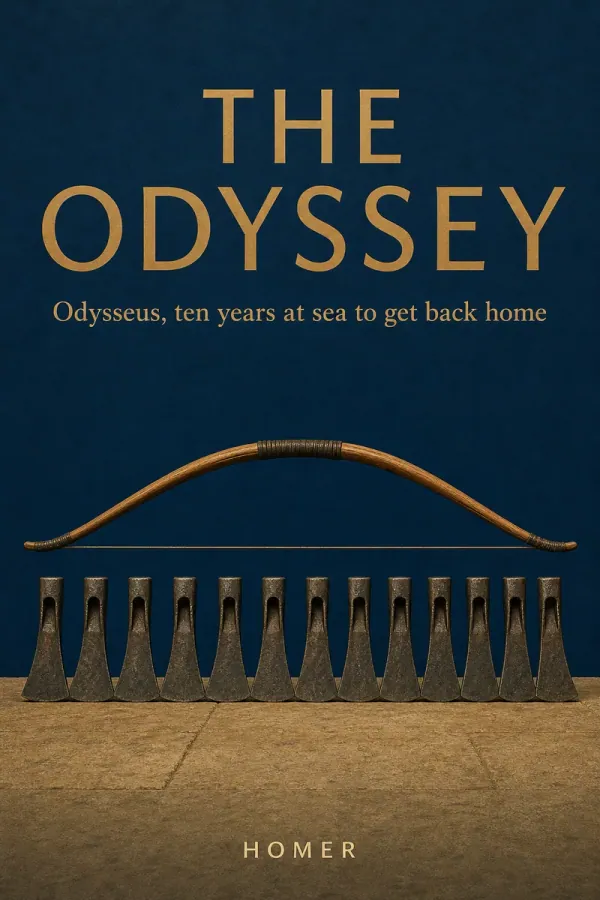
Odysseus, ten years at sea to get back home
Study this topic in OriaThe essentials
Attributed to Homer and composed toward the end of the 8th century BC, the Odyssey tells of Odysseus's homecoming, which takes him ten years to reach Ithaca after the Trojan War. The Cyclops, Circe, the Sirens, the descent into the underworld, then revenge against Penelope's suitors: the epic fixed forever the figure of the cunning hero. You'll discover the Homeric question, how the poem is built, its great adventures, what mètis is, the themes of homecoming and hospitality, and a legacy running from Virgil to Joyce and the movies.
Key dates and facts
- c. 750-700 BC
- Probable composition of the poem
- c. 530 BC
- First edition in Athens
- c. 445 BC
- The title attested in Herodotus
- 1795
- Wolf launches the Homeric question
- 1558
- Du Bellay, “Happy the man who, like Ulysses”
- 1699
- Fénelon, The Adventures of Telemachus
- 1922
- James Joyce, Ulysses
- 2026
- Christopher Nolan's The Odyssey
🏺 Homer and the Homeric question
The Odyssey is a Greek epic of 12,109 lines, written in dactylic hexameter, the meter of Greek epic verse. Ancient tradition attributes it, like the Iliad, to Homer, a bard — a singing poet who recited his verses to the accompaniment of a lyre. The Greeks pictured him as blind and firmly believed he had existed, yet they knew almost nothing about him: the biographies written about his life are too late to be credible, and even in antiquity his birthplace and era were already disputed.
❓ The “Homeric question”
In 1795, the German philologist Friedrich August Wolf published his Prolegomena ad Homerum. In his view, the two epics arose in an age without writing and were fixed only later, by several authors. The uproar was immense: Goethe and Schiller were outraged. Nineteenth-century scholars split into two camps. The Analysts looked for the different layers of composition in a text they considered a patchwork; the Unitarians defended the work of a single poet of genius.
In the 1920s and 1930s, the American Milman Parry, and then his student Albert Lord, reopened the debate. By studying the recurring epithets (“rosy-fingered Dawn,” Odysseus “of the enduring spirit”) and by listening to illiterate bards in Yugoslavia, they showed that these poems came out of a long oral tradition: the bards did not recite a memorized text, they recomposed their songs in performance using ready-made formulas.
A professional singer of archaic Greece who recited epic poems, often at aristocratic banquets. The Odyssey features several of them, including Demodocus, blind like Homer according to tradition.
📅 Dating the poem
Today, most specialists accept the overall unity of the work, without ruling out later additions. Its language is consistent and dates to the second half of the 8th century BC. The epic does not seem to reflect any social practice later than 750-700 BC, so it is generally dated to 750 – 700 BC, or as late as 675; some, like Martin West, place it later still, around 630. This was the age when the Greeks adopted the alphabet, founded colonies, and emerged from the “dark ages” that had followed the fall of Mycenaean civilization.
✍️ From voice to book
Most researchers believe the text was written down fairly quickly, perhaps dictated by the poet himself. Around 530 BC, in Athens, the tyrant Peisistratos (or a member of his family) is said to have had an official version produced for the Great Panathenaic festivals. The title Odyssey first appears in the historian Herodotus, around 445 BC. Finally, it was the scholars of the Library of Alexandria, in the 3rd and 2nd centuries BC, who divided the poem into 24 books. The first printed edition appeared in Florence in 1488.
⚔️ A sequel to the Iliad
The Odyssey is generally considered later than the Iliad, the other epic attributed to Homer, which recounts about fifty days from the last year of the Trojan War. It features the same heroes, but after the war, as a sequel or epilogue. Together with the Iliad, it belongs to the Trojan cycle, a set of epics about the Trojan War and its aftermath of which only these two works have survived; the others, such as the Returns, are known only through summaries.
👴 The same poet?
We don't know whether the two poems share an author. Their structures resemble each other, but their tone differs. As early as antiquity, the critic Longinus saw it as the work of an aging Homer; others think of an imitator from the next generation. One thing is certain: the author of the Odyssey probably knew the Iliad, and several passages respond to it. Together, the two epics cover the whole Trojan saga: the Odyssey even tells episodes absent from the Iliad, such as the Trojan Horse and the fall of the city.
🎵 “The man of many turns”
Like the Iliad, the poem opens with an invocation to the Muse that sums up the whole subject, without even naming the hero:
“Sing to me, Muse, of the man of many turns, who was driven far and wide after he sacked the sacred city of Troy. Many men's cities did he see and know their mind, many the woes he suffered in his heart upon the sea, seeking to win his own life and the homecoming of his comrades.”
Homer, Odyssey, I, 1-5 (translated)
The Greek word rendered here as “the man of many turns” is polytropos, usually translated as “of many wiles” or “much-turned.” It announces the hero: a man who travels widely and plays many tricks.
⏱️ Ten years told in 42 days
The story begins in medias res — in the middle of the action: ten years after the fall of Troy, Odysseus is the last of the victors still alive who has not come home. The main action spans only 42 days, and only sixteen days and eight nights are actually narrated. The day of the suitors' slaughter alone fills more than three books, while seventeen or eighteen days of sailing are compressed into about ten lines. Yet the poet reaches back more than ten years through embedded tales: the hero himself recounts his past adventures.
The philosopher Aristotle, in his Poetics, already admired this unity. In his view, the plot can be summed up in a few lines: a man wanders far from home, watched by Poseidon; at home, suitors squander his wealth and threaten his son; he returns, makes himself known to a few friends, and crushes his enemies. “Everything else is episode.” This tight focus on the homecoming gives the poem its force, while the flashbacks give it its scope.
The rest of the course
This page publishes the first 2 parts. The full course has 9: here is what the next ones cover.
- 🧭 Three parts: the Telemachy, the Phaeacians, Ithaca
The Odyssey's 24 books in three main parts: Telemachus's journey, Odysseus from Calypso to the Phaeacians, then the return to Ithaca.
- 👁️ From the Cyclops to Circe
The first half of the adventures Odysseus tells: the Cicones, the Lotus-eaters, the Cyclops Polyphemus, Aeolus, the Laestrygonians, and the sorceress Circe.
- 💀 From the Underworld to the Sirens, from Charybdis to Calypso
The second half of the adventures: the descent into the underworld (the Nekyia), the Sirens, Charybdis and Scylla, the cattle of the Sun, and the final shipwreck.
- 🏹 Penelope, the suitors, and the test of the bow
The second half of the poem set in Ithaca: Odysseus disguised as a beggar, Penelope's trick with the shroud, the dog Argos, the test of the bow, the slaughter, and the reunion.
- 🦊 Odysseus, the hero of mètis
What sets Odysseus apart: mètis (cunning intelligence), his epithets, his disguises and lies, his endurance and his flaws.
- 🏠 Homecoming, hospitality, and the human condition
The Odyssey's great themes: nostos (homecoming), xenia (hospitality), divine justice, and the choice of a mortal life.
- 🎬 From Virgil to Nolan: the legacy
The Odyssey's influence from antiquity to today: Virgil, Dante, du Bellay, Fénelon, Joyce, Atwood, film, and the word "odyssey."
Study “The Odyssey” with flashcards and quizzes
In Oria, you read the full course, then practice on it: flashcards, multiple-choice quizzes, open questions or the Feynman method. Cards and questions then come back in your daily review, paced by spaced repetition.
Study this topic in OriaSources
These notes draw on the sources below. If a point seems doubtful, refer back to them.