Classic novels
The Divine Comedy by Dante Alighieri: Summary and Study Notes
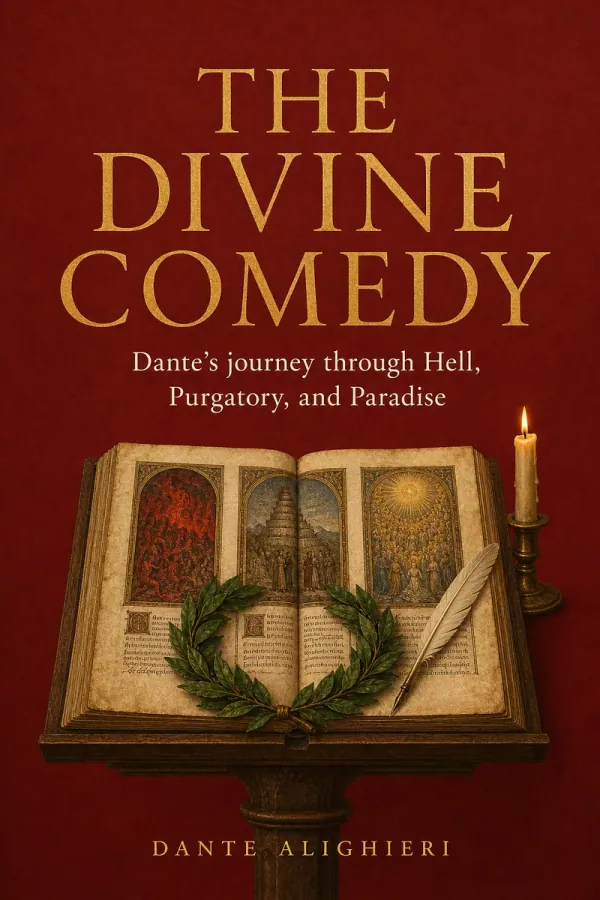
Dante's journey through Hell, Purgatory, and Paradise
Study this topic in OriaThe essentials
Written by the Florentine Dante Alighieri during his exile, between the early 14th century and his death in 1321, the Divine Comedy tells of the poet's journey through Hell, Purgatory, and Paradise, guided first by Virgil and then by Beatrice. You'll discover Dante's turbulent life, why this poem founded the Italian language, its architecture of numbers, the nine circles of Hell and their unforgettable encounters, the mountain of Purgatory, the heavens of Paradise, the text's hidden meanings, and seven centuries of legacy, from Botticelli to video games.
Key dates and facts
- 1265
- Born in Florence
- 1290
- Death of Beatrice
- 1302
- Conviction and exile
- 1321
- Dies in Ravenna
- c. 1306
- Probable start of writing
- 1315
- Earliest known citations of Inferno
- 1321
- Poem completed, Dante's death
- 1555
- First title "Divina Comedia"
- 1472
- First printed edition, in Foligno
- 1822
- The Barque of Dante , by Delacroix
🏙️ Dante, from Florence to exile
Dante Alighieri, whose actual first name was Durante, was born in Florence between mid-May and mid-June 1265, into a Florentine family loyal to the Guelphs, the party that supported the pope against the emperor. He lost his mother around the age of thirteen, then his father. Little is known of his education: he probably attended Franciscan and Dominican schools, became friends with the poet Guido Cavalcanti, and admired Brunetto Latini, a Florentine scholar he regarded as a teacher. He married Gemma Donati in 1292.
💘 Beatrice
According to his own account, Dante first met Beatrice at the age of nine, in 1274, and saw her again nine years later. The daughter of the Portinari family, she married another man and died in 1290. Between 1292 and 1294, Dante devoted the Vita Nuova to her, a collection of sonnets interspersed with prose celebrating his love and despair. In it, he announces that he will one day write of her what has never been written of any woman. Some critics see Beatrice as a largely allegorical figure.
⚔️ An engaged citizen
Dante took an active part in the life of his city: he fought at the Battle of Campaldino in 1289, then became one of the priors, the highest magistrates of Florence, from June 15 to August 14, 1300. But the Florentine Guelphs had split into two factions: the Blacks, close to Pope Boniface VIII, and the Whites, who favored greater autonomy for the city. Dante sided with the Whites. In October 1301, while he was in Rome on a final mission of conciliation, Charles of Valois, the pope's envoy, entered Florence with the backing of the Blacks.
🚪 Banished forever
Dante was convicted of corruption and disobedience. On March 10, 1302, a second judgment sentenced him to be burned at the stake; his property was confiscated. He would never see Florence again. He wandered from court to court across northern Italy, from Verona to Forlì, before settling in Ravenna, where he died of malaria during the night of September 13 to 14, 1321. In the poem, an ancestor of Dante's predicts this life of exile for him:
"You shall learn how salt the bread of others is, and how hard a path it is to go up and down another's stairs."
Dante, The Divine Comedy, Paradiso, Canto XVII (translated)
His tomb still stands in Ravenna, which has refused to return his remains to Florence, where an empty cenotaph awaits him in the Basilica of Santa Croce. The city that had cast him out did not revoke his banishment until 2008.
✍️ A "comedy" written in the language of the people
Dante wrote his great poem during his exile. The exact date he began is unknown: most specialists believe he started it around 1306, some around 1303 or 1308, others only around 1313. Inferno is thought to have been written mostly between 1306-1307 and 1309-1310, with excerpts circulating as early as 1315. Dante worked on the poem almost until his death in 1321; Paradiso may not have received all its final revisions. No manuscript in his own hand has survived.
"Midway along the road of our life, having strayed from the straight path, I found myself in a dark wood."
Dante, The Divine Comedy, Inferno, Canto I (translated)
🎭 Why a "comedy"?
Dante simply called his poem Commedia (or Comedìa). In the Middle Ages, a comedy was not necessarily funny: it was a work that began badly and ended well, written in a middling style. That is exactly the path of the poem, from the forest of error to the vision of Paradise. This is what a letter attributed to Dante, addressed to his patron Cangrande della Scala, explains, though its authenticity is not certain. In the text itself, Dante also calls it a "sacred poem."
The adjective "divine" comes from the writer Boccaccio, a great admirer of Dante, who used it in the 14th century in his Little Treatise in Praise of Dante. It did not become standard until the Venetian edition by Ludovico Dolce, in 1555, the first to carry the title Divina Comedia.
🗣️ The decisive choice of the vernacular
At the time, serious subjects were written in Latin, the language of scholars and the Church. Dante, however, wrote the story of the soul's salvation in the vernacular, spoken Florentine, an almost unheard-of boldness for his time. As early as 1303, he had argued in a Latin treatise, the De vulgari eloquentia, that a carefully crafted spoken language could handle the noblest subjects.
The poem's immediate success played a decisive role in making Tuscan the Italian language. This is why Dante is called the "father of the Italian language." Together with Petrarch and Boccaccio, he forms the "three crowns" who established Tuscan as a literary language.
The rest of the course
This page publishes the first 2 parts. The full course has 9: here is what the next ones cover.
- 🔺 A cathedral of numbers
The poem's structure (100 cantos, 14,233 lines, terza rima), the symbolism of 3 and 9, the geography of the afterlife in an Earth-centered universe, and the timeline of the journey during Holy Week of 1300.
- 🔥 Inferno: nine circles down to the center of the Earth
The poem's first part: the dark wood, the meeting with Virgil, the gate of Hell, then the descent through the nine circles, from Limbo down to the frozen lake where Lucifer is trapped.
- 💬 Francesca, Farinata, Ulysses, Ugolino: the encounters of Inferno
The most famous episodes of Inferno: the love of Francesca and Paolo, the proud Farinata, Ulysses's final voyage, and the tale of Count Ugolino, and the place of Dante's contemporaries in the poem.
- ⛰️ Purgatorio: climbing the mountain of hope
The second part: the island and mountain of Purgatory, its seven terraces where souls purge the deadly sins, free will, and then the Earthly Paradise where Virgil gives way to Beatrice.
- ✨ Paradiso: from the Moon to the Empyrean
The third part: Dante and Beatrice's ascent through the nine celestial spheres, his meetings with saints and his ancestor Cacciaguida, then the Empyrean, the celestial rose, Saint Bernard, and the final vision.
- 🧭 Virgil, Beatrice, and the poem's hidden meanings
The allegorical role of the three guides, the four levels on which the poem can be read, and its sources: Virgil and the Latin poets, Aristotle, Thomas Aquinas, the Bible, accounts of journeys through the afterlife, and the debate over Islamic influences.
- 📚 Seven centuries of the Comedy
The poem's spread and legacy: manuscripts, the first edition of 1472, translations, its eclipse in the 18th century and Romantic rediscovery, painters, musicians, writers, films, and video games up to the 700th anniversary in 2021.
Study “The Divine Comedy” with flashcards and quizzes
In Oria, you read the full course, then practice on it: flashcards, multiple-choice quizzes, open questions or the Feynman method. Cards and questions then come back in your daily review, paced by spaced repetition.
Study this topic in OriaSources
These notes draw on the sources below. If a point seems doubtful, refer back to them.